
The European Space Agency (ESA) is celebrating 20 years of sending medical doctors to Antarctica, a program designed to study how humans adapt to extreme isolation and environmental challenges. The lessons learned at Antarctica’s Concordia Station have become critical for planning long-duration space missions, including journeys to the Moon, Mars, and beyond.
Since 2005, the ESA has stationed one highly trained medical doctor annually at the Concordia base, located deep in East Antarctica at 3,200 meters above sea level. The station’s harsh conditions—extreme cold, isolation, low oxygen, and months of darkness—make it an ideal analogue for the challenges astronauts face during extended space travel.
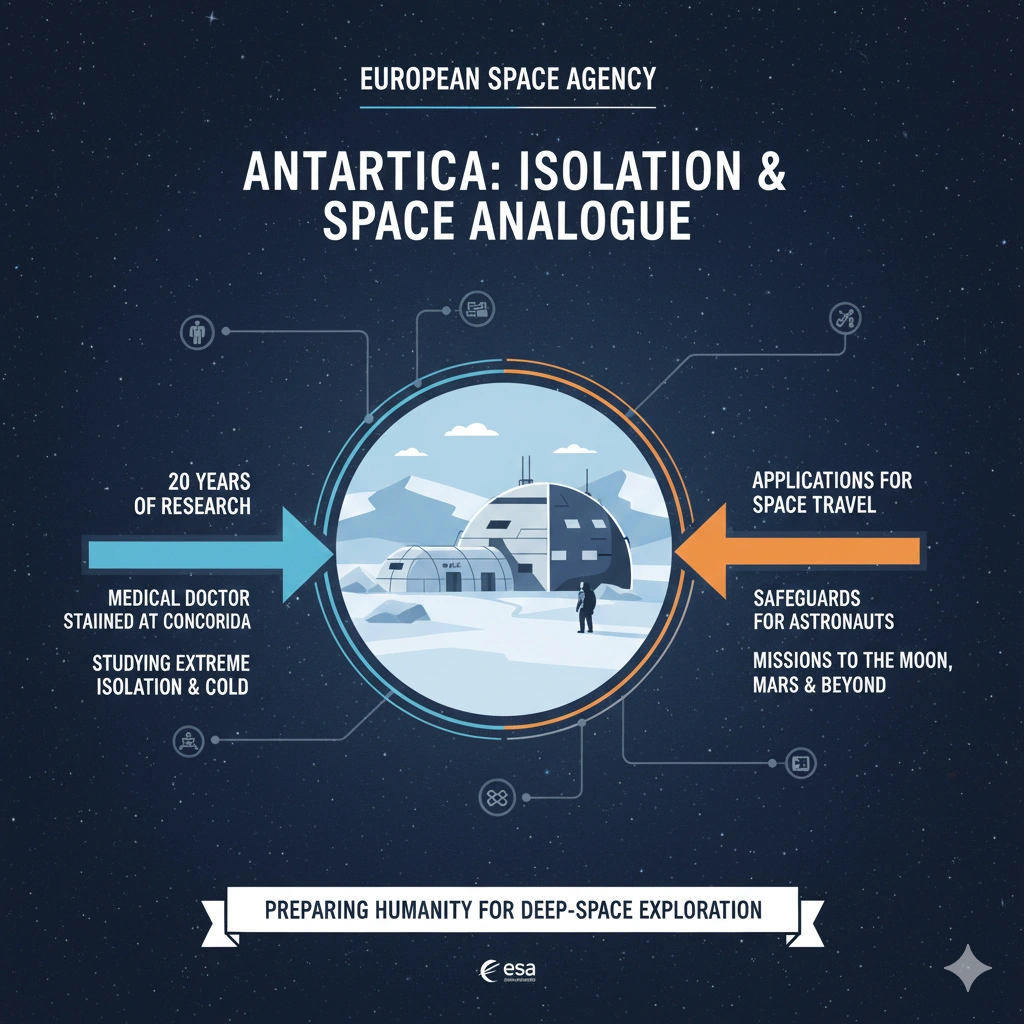
Living and Working in Antarctica: The ESA Doctor Program
Each selected ESA doctor spends approximately 13 months at Concordia Station, performing biomedical experiments on the crew and themselves. During this period, they study the physical and psychological effects of isolation, confinement, and extreme environmental conditions.
Winter in Antarctica brings temperatures dropping to –80°C, and the station becomes completely inaccessible for months. In addition to research duties, ESA doctors act as primary emergency responders, managing medical situations in one of the most remote and unforgiving environments on Earth. They work closely with European research teams to collect and analyze data that informs both terrestrial and space applications.
Key Research Areas in ESA Antarctica Missions
The ESA’s Antarctica missions focus on several critical areas relevant to astronaut health:
- Physiological adaptation: Studying how the human body responds to prolonged exposure to low oxygen levels, extreme cold, and isolation.
- Psychological resilience: Assessing the mental health impacts of long-term confinement and separation from society.
- Medical preparedness: Testing emergency response protocols in a setting where immediate external support is impossible.
- Team dynamics: Observing interactions and cooperation among small, isolated groups in high-stress environments.
Data from these missions have provided actionable insights that help design safeguards for astronauts and optimize mission planning for deep-space exploration.
Impact on Human Space Exploration
ESA’s two-decade program in Antarctica has become a cornerstone in preparing humans for extended missions beyond Earth. Lessons learned include:
- Effective sleep and stress management strategies in isolation.
- Physiological monitoring techniques that prevent long-term health complications.
- Operational procedures to manage medical emergencies in remote environments.
- Guidelines for crew cohesion and mental well-being on missions lasting over a year.
By simulating conditions similar to space, ESA ensures astronauts are better prepared for the challenges of microgravity, radiation exposure, and prolonged confinement during missions to Mars and lunar bases.
Looking Ahead: ESA’s Role in Deep-Space Missions
As human space exploration advances, the ESA Antarctica missions program remains essential for preparing astronauts. The ongoing research at Concordia Station not only enhances medical knowledge but also supports the design of future space habitats, life-support systems, and emergency protocols.
ESA plans to continue sending doctors annually, ensuring a continuous stream of empirical data to improve long-duration mission safety and performance. These missions underscore Europe’s commitment to exploration beyond Earth and highlight the synergy between extreme Earth environments and space research.
Read more on Antarctica news: 360 News Orbit – Antarctica