
The United States government issued a formal Emergency Exit from Saudi Arabia order on Monday, mandating the departure of all non-essential employees and their families stationed within the kingdom. This high-level State Department directive follows a dramatic escalation in regional hostilities, characterized by heightened risks from armed conflict, terrorism, and potential missile strikes originating from Yemen and Iran. As the security landscape shifts, U.S. embassy officials in Riyadh have prioritized the safety of diplomatic dependents, citing the increasing frequency of drone incursions across the Arabian Peninsula. This evacuation marks one of the most significant shifts in American regional posture since the current conflict began, signaling a deep concern for the stability of the Gulf’s primary energy exporter.
The decision to order an Emergency Exit from Saudi Arabia comes as global crude prices spiked above $110 per barrel following devastating Israeli airstrikes on Iranian infrastructure. On Sunday, the Israeli military confirmed a significant new wave of wide-scale strikes targeting “terror regime” assets across central and southern Iran, including naval headquarters in Bandar Abbas and missile complexes in Isfahan. These operations ignited massive fires near Tehran and Karaj, marking the first time direct hits have been recorded on Iran’s fuel and energy facilities. With Iranian Foreign Ministry spokesperson Esmaeil Baghaei ruling out any immediate ceasefire, the prospect of a prolonged regional war has sent shockwaves through international financial and energy markets.
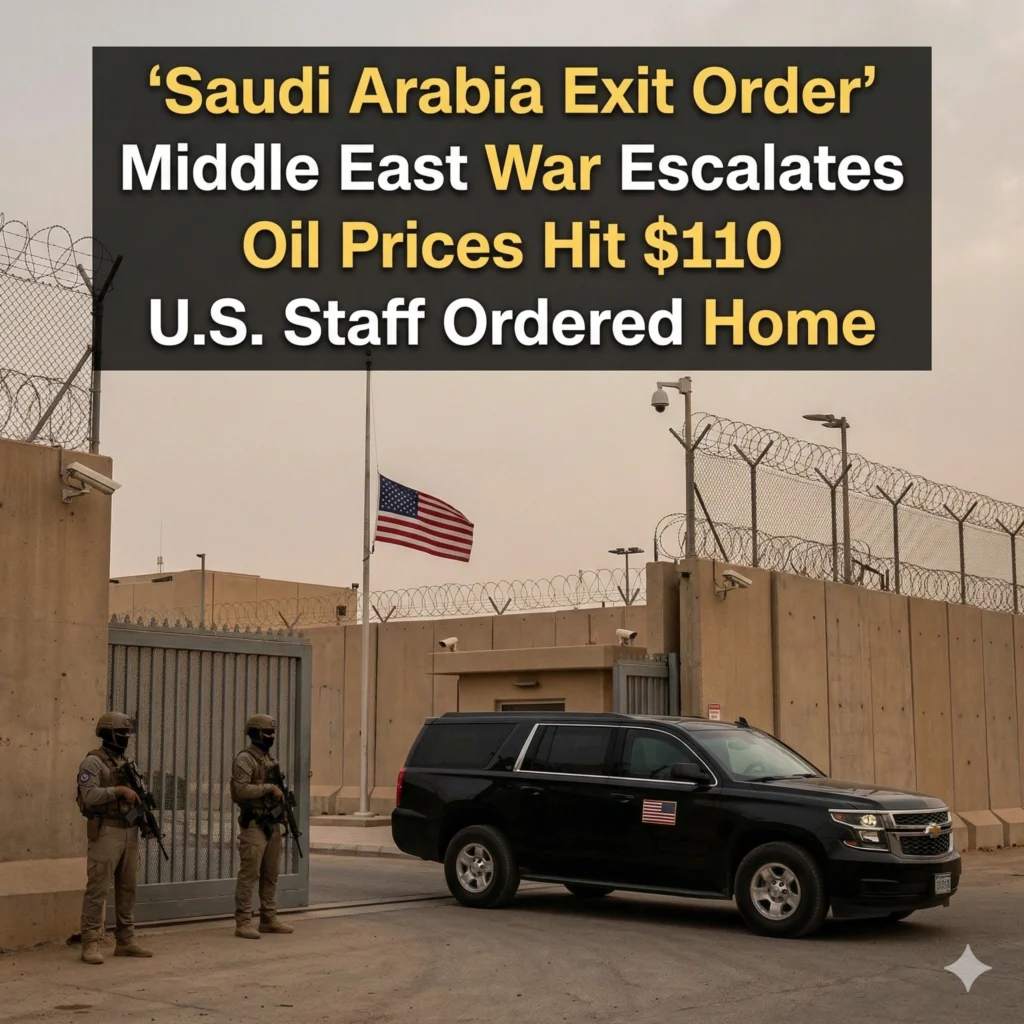
Emergency Exit from Saudi Arabia
The Emergency Exit from Saudi Arabia was triggered by intelligence reports suggesting that retaliatory strikes from proxy groups could target Western diplomatic installations. Consequently, the State Department has raised its travel advisory to the highest level, warning American citizens that the U.S. government has a limited ability to provide emergency services during such a volatile period. The departure order affects hundreds of personnel and their families, who are now being funneled through commercial and chartered flights out of Riyadh and Jeddah. This move is seen as a defensive precaution to minimize civilian casualties should the conflict spill further into the sovereign territory of the Gulf Cooperation Council members.
Furthermore, the Emergency Exit from Saudi Arabia reflects the deteriorating security situation in the Red Sea and the Persian Gulf, where maritime security risks are at an all-time high. The Iranian government has accused the United States of seeking control over its oil reserves and attempting to dismantle its territorial unity through these military escalations. In response, several Middle Eastern energy producers have announced plans to reduce their current output, further squeezing the global supply chain. As the Strait of Hormuz becomes a focal point for potential blockades, the international community is bracing for a sustained period of energy insecurity and geopolitical realignment.
Israeli Airstrikes on Iranian Infrastructure
The recent wave of Israeli airstrikes has effectively crippled several of Iran’s most sensitive industrial and defense sites, including those responsible for drone production. Military analysts suggest that by targeting Bandar Abbas and Isfahan, Israel is attempting to cut off the logistical heart of the Iranian naval and missile programs. These strikes were described by the Israeli Defense Forces as a necessary response to the ongoing aggression and the “terror regime’s” attempts to destabilize the entire Mediterranean and Gulf regions. The fires near Tehran, visible from satellite imagery, have highlighted the vulnerability of Iran’s energy grid to high-precision aerial bombardment.
The impact of these strikes on the global economy was immediate, with Brent crude reaching near $120 during early trading on Monday. The destruction of Iranian fuel infrastructure has not only reduced domestic supply but has also created a psychological fear that other regional energy hubs could be next. This fear is what prompted the Emergency Exit from Saudi Arabia, as the U.S. seeks to decouple its diplomatic presence from potential military targets. As the fires in Karaj continue to burn, the lack of a diplomatic channel between the warring parties suggests that the military phase of this conflict is far from over.
G7 Emergency Response and Market Stability
In response to the surging oil prices and the Emergency Exit from Saudi Arabia, G7 finance ministers held an emergency meeting on Monday to discuss global economic stability. The ministers weighed the possibility of a joint release of strategic petroleum reserves (SPR) to dampen the price spike and provide relief to consumers. However, despite the gravity of the situation, the group reached a broad consensus to hold off on a massive release until further market analysis is completed later this week. This cautious approach reflects a desire to save “ammunition” in case the conflict escalates into a total blockade of the Strait of Hormuz.
The G7 leaders are scheduled to meet in a virtual summit to determine a final response to what is being called the most severe energy crisis in decades. The transition from $70 oil to $120 oil in such a short period has threatened to derail the global recovery and trigger a wave of inflation. By coordinating their response, the world’s leading economies hope to project a sense of calm and deter further market speculation. However, the Emergency Exit from Saudi Arabia serves as a stark reminder that the physical security of the world’s energy heartland is no longer guaranteed by traditional alliances.
Impact on Global Energy Prices
The Emergency Exit from Saudi Arabia has added a significant “risk premium” to the price of oil, as traders worry about the long-term reliability of Saudi production. While the kingdom’s facilities have not been directly hit in this latest wave, the departure of U.S. personnel is interpreted as a sign that the threat level is unacceptably high. This has led to a rush for futures contracts, as energy companies seek to hedge against even higher prices in the coming months. The $110 per barrel mark is seen as just the beginning of a potential upward trend if the war continues to expand.
- Brent crude prices reached $118.50 during afternoon trading, the highest level in nearly three years.
- WTI crude followed suit, surpassing $114 per barrel as North American markets reacted to the Middle East news.
- Natural gas prices in Europe have also spiked by 15% due to the interconnected nature of global energy trading.
- Shipping insurance premiums for tankers operating in the Persian Gulf have tripled since the Emergency Exit from Saudi Arabia was announced.
The volatility in the energy sector is likely to persist as long as the Iranian Foreign Ministry maintains its hardline stance against negotiations. The refusal to engage in ceasefire talks means that the military “red lines” are being redrawn on a daily basis. For the global consumer, this translates to higher costs at the pump and increased prices for transported goods. The Emergency Exit from Saudi Arabia is the clearest signal yet that the world is entering a new era of energy-driven geopolitical instability.
Iranian Resistance and Foreign Policy
Iranian spokesperson Esmaeil Baghaei’s statement that there is “no room for talks” underscores the depth of the diplomatic rift between Tehran and the Western-backed coalition. The Iranian government views the Israeli strikes and the subsequent Emergency Exit from Saudi Arabia as part of a coordinated campaign of “maximum pressure” designed to force a political collapse. By framing the conflict as a defense of national sovereignty and oil reserves, the regime is attempting to unify its domestic population against external threats. This rhetoric makes it extremely difficult for international mediators to find a middle ground for de-escalation.
Furthermore, Iran has hinted at its own “counter-measures” should the strikes on its infrastructure continue. These could include further disruptions to maritime traffic or the activation of proxy networks across the Levant and the Arabian Peninsula. The Emergency Exit from Saudi Arabia is a direct response to these specific threats of asymmetrical retaliation. As the diplomatic space shrinks, the military commanders on both sides are increasingly in control of the narrative, leading to a dangerous cycle of action and reaction that could pull in even more regional players.
Strategic Shifts in the Gulf Cooperation Council
The Emergency Exit from Saudi Arabia has sent a shockwave through the other members of the Gulf Cooperation Council (GCC), including the UAE, Qatar, and Kuwait. These nations are now reassessing their own security protocols and the long-term presence of Western diplomatic and military personnel. The sudden departure of U.S. families suggests that the “security umbrella” that has long protected the region is being tested like never before. There are reports that other Western nations, including the UK and France, are considering similar departure orders to protect their citizens from the intensifying regional war.
In this environment, the GCC states are attempting to balance their strategic ties with the U.S. while maintaining open lines of communication with Tehran to prevent a total regional conflagration. The upcoming G7 meeting will be closely watched by these capitals to see if the West is prepared to offer more than just verbal support and strategic reserve releases. The Emergency Exit from Saudi Arabia has forced a reality check on the limits of traditional deterrence in the face of modern drone and missile warfare. As the conflict enters its next phase, the unity of the GCC will be a critical factor in determining the overall stability of the Middle East.
Humanitarian Concerns and Civilian Safety
While the Emergency Exit from Saudi Arabia focuses on government personnel, there are thousands of private American and European citizens living and working in the kingdom who are now facing a difficult choice. Many are monitoring the State Department’s notices closely, wondering if a full-scale civilian evacuation will be the next step. The risk of being “trapped” should the commercial airports close is a primary concern for the expatriate community. Humanitarian organizations are also sounding the alarm about the impact of the regional war on civilian populations in Iran and Yemen, where the infrastructure is far less resilient.
The strikes on Iranian industrial sites have already led to reports of civilian casualties and environmental damage due to the massive fires in Tehran and Karaj. These incidents, combined with the rising cost of food and fuel globally, are creating a humanitarian crisis that extends far beyond the immediate battlefields. The Emergency Exit from Saudi Arabia is a symptom of a much larger breakdown in regional order that threatens to displace millions if a ceasefire is not reached soon. As the military strikes become more frequent, the “collateral damage” to civilian lives and livelihoods is reaching a critical threshold.
Naval Tensions in Bandar Abbas
The targeting of the naval headquarters in Bandar Abbas is a significant move by the Israeli military to neutralize the Iranian capability to close the Strait of Hormuz. Bandar Abbas is the primary base for the Iranian Navy and Revolutionary Guard naval units, which utilize fast-attack craft and mines to control the narrow waterway. The Emergency Exit from Saudi Arabia was partially motivated by the fear that a desperate Iranian response could involve sinking commercial tankers in the strait to choke the global economy. By striking the base, Israel aims to diminish the tactical options available to Tehran’s naval commanders.
Military intelligence suggest that several high-value naval assets were damaged in the Isfahan and Bandar Abbas strikes, although the full extent of the damage is still being assessed via satellite. The loss of these facilities would make it much harder for Iran to sustain long-term maritime operations or support its proxies in Yemen. However, the “swarm” tactics favored by the Iranian Navy mean that even a wounded fleet can still pose a significant threat to international shipping. This ongoing naval tension is the primary driver behind the $120 oil price, as the market assumes that the Strait of Hormuz is no longer a safe passage.
The Role of Drone Warfare
A defining characteristic of the current regional war is the pervasive use of suicide drones by both state and non-state actors. The Emergency Exit from Saudi Arabia was specifically influenced by the threat of these low-flying, difficult-to-detect systems that have been used to target oil refineries and airports in the past. Iran’s drone production facilities were among the primary targets in the recent Israeli strikes, as the coalition seeks to “cut the head off the snake” in terms of aerial harassment. The technology has leveled the playing field, allowing smaller groups to strike deep into the territory of well-defended nations.
- The Isfahan strikes targeted a known drone manufacturing and testing complex used by the IRGC.
- Electronic warfare units in Saudi Arabia have been placed on high alert to intercept incoming swarms.
- The Emergency Exit from Saudi Arabia includes the removal of personnel from areas near critical infrastructure that could be “collateral” in a drone attack.
The evolution of this technology means that traditional air defenses, like the Patriot missile system, are being supplemented by new laser and microwave-based technologies. However, the cost of defense remains much higher than the cost of the drones themselves, creating a sustainable advantage for the attacker. This technological reality is what makes the Emergency Exit from Saudi Arabia a prudent, if painful, strategic move. Until a reliable counter-drone umbrella can be established, the risk to static targets like embassies and housing complexes remains unacceptably high.
Diplomatic Deadlock and the G7 Summit
As the G7 leaders prepare for their summit later this week, the diplomatic deadlock between the U.S. and Iran appears insurmountable. The Emergency Exit from Saudi Arabia has effectively closed off one of the few remaining channels for back-door negotiations, as the physical presence of senior diplomats is reduced. The G7 will likely issue a strong condemnation of the Iranian “terror regime” while calling for restraint from all sides, but such statements have had little impact on the ground in recent months. The focus of the summit will therefore shift toward “disaster management” and the economic containment of the war.
The release of strategic petroleum reserves remains the G7’s most potent economic tool, but it is a one-time fix that does not address the underlying security crisis. There is also a fear that releasing the reserves too early could leave the West vulnerable if the war spreads to the Mediterranean or the Suez Canal. The Emergency Exit from Saudi Arabia has highlighted the need for a more comprehensive Western strategy that includes both military deterrence and a viable path toward regional de-escalation. Without a breakthrough, the G7 will be forced to manage a permanent energy shock that could redefine the global order for a generation.
Future Outlook for Saudi-U.S. Relations
The long-term impact of the Emergency Exit from Saudi Arabia on the relationship between Washington and Riyadh is a subject of intense speculation. While the move is a security necessity, it could be perceived by the Saudi leadership as a lack of confidence in their ability to protect foreign guests. This comes at a time when Saudi Arabia has been attempting to diversify its own security partnerships, including closer ties with China and Russia. The U.S. will need to work hard to reassure its Gulf allies that the departure of personnel does not mean a departure from its strategic commitments to the region.
As the regional war intensifies, the role of Saudi Arabia as a “stabilizing force” in the oil market is being undermined by the very threats it faces. The kingdom’s ability to maintain high output while its neighbors are in flames is a testament to its operational resilience, but there is a limit to how much pressure any one nation can take. The Emergency Exit from Saudi Arabia may be the first of many such moves as the world adapts to a Middle East where the old rules of engagement no longer apply. The coming weeks will be critical in determining whether this is a temporary evacuation or the start of a long-term withdrawal from the heart of the Gulf.
Environmental and Economic Aftermath
The environmental impact of the strikes on Iranian energy facilities near Tehran and Karaj will be felt for years, as toxic smoke and oil leaks contaminate the local ecosystem. These fires are a literal and symbolic representation of the destruction wrought by the regional war. Economically, the cost of reconstruction in Iran, combined with the lost oil revenue in the Gulf, will run into the hundreds of billions of dollars. The Emergency Exit from Saudi Arabia is a proactive attempt to shield American personnel from these cascading failures, but the global economy cannot be so easily evacuated.
In conclusion, the Emergency Exit from Saudi Arabia is a watershed moment in the 2026 Middle East conflict. It reflects a shift from diplomatic engagement to emergency containment as the war between Israel and Iran enters its most dangerous phase. With oil prices soaring and the G7 in crisis mode, the international community is facing a test of its resilience and its resolve. The safety of personnel, the stability of the energy markets, and the future of regional peace all hang in the balance as the world waits for the next move in this high-stakes geopolitical drama.
For more details & sources visit: CNBC
For the latest updates from Saudi Arabia, visit our Saudi Arabia page.