
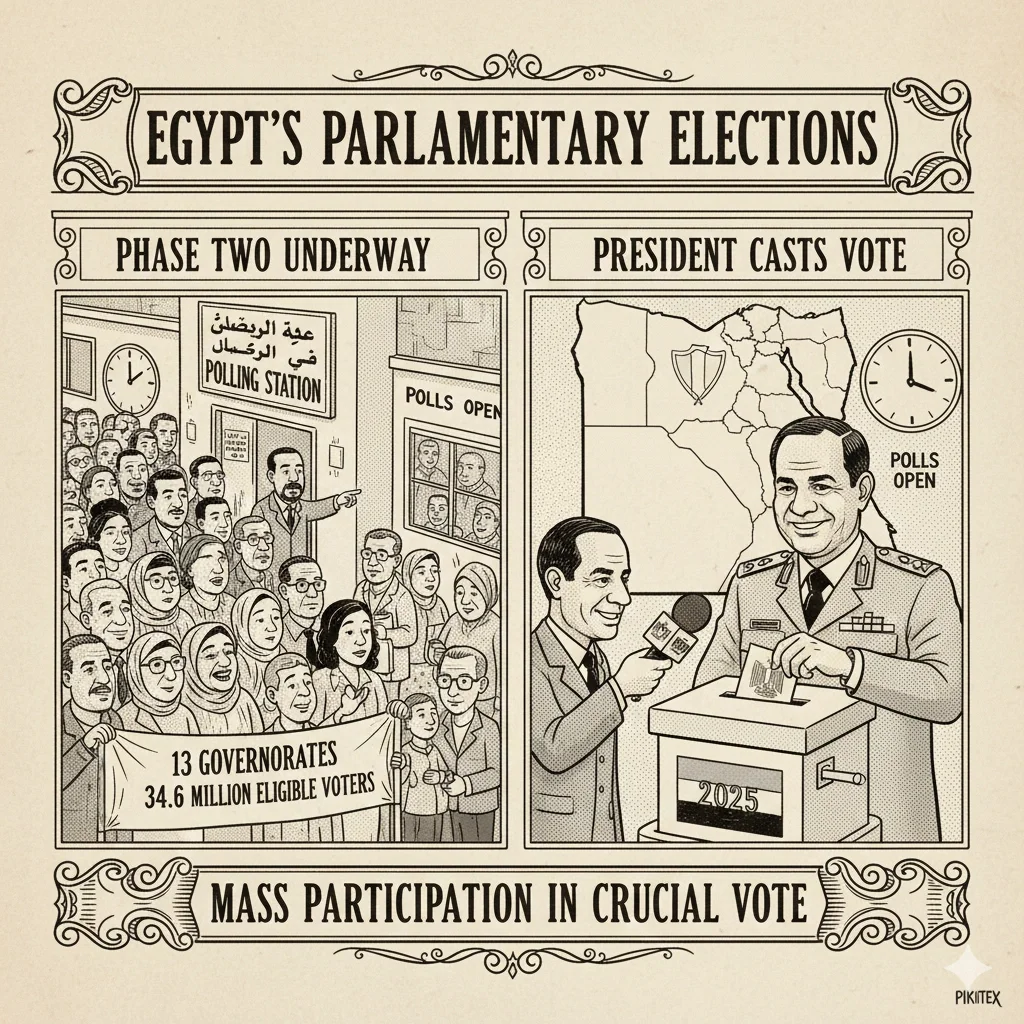
The Egypt parliamentary elections 2025 entered their second phase on November 24–25, with over 34.6 million eligible voters participating across 13 governorates. The elections aim to fill 141 individual seats in the House of Representatives under a mixed system of party lists and individual candidacies.
President Abdel Fattah Al-Sisi led by example, casting his vote early Monday at a school in Heliopolis, as polling stations opened nationwide. The second phase covers major governorates including Cairo, Qalyubia, Menoufia, Dakahlia, Kafr El-Sheikh, Gharbia, Damietta, Sharqia, Port Said, Ismailia, Suez, and both North and South Sinai.
Voting Logistics and Participation
The National Election Authority (NEA) announced that 34,611,991 citizens are eligible to vote across 73 constituencies, managed by 5,287 sub-committees. A total of 1,316 candidates are contesting the 141 individual seats in this round, ensuring broad representation of both party nominees and independent candidates.
This second phase follows the first phase held on November 10–11, which combined closed party lists and individual seats. The mixed electoral system is designed to balance party influence with independent representation, promoting diversity and voter choice.
Electoral Oversight and Transparency
Election officials have emphasized measures to ensure transparent and fair voting, including monitoring by independent observers and adherence to standardized procedures at polling stations. President Sisi and the NEA have stressed the importance of high voter turnout to reinforce democratic participation and legitimacy in the electoral process.
Voter engagement in the first phase was marked by moderate participation, with the pro-government National List securing initial seats while irregularities in some constituencies prompted annulments. Authorities have taken steps to address concerns, ensuring smooth operations during the second phase.
Candidates and Key Contests
The second phase features a wide range of candidates, from seasoned politicians to new entrants in the political landscape. The 1,316 candidates contesting 141 individual seats include representatives from major political parties, as well as independents aiming to influence legislative priorities at the national level.
Analysts note that outcomes in populous governorates like Cairo, Dakahlia, and Sharqia could shape the composition of the House of Representatives, impacting legislation on economic reform, social programs, and governance.
Looking Ahead: Election Outcomes and Legislative Impact
Once the second phase concludes, authorities will announce results, which will determine the overall composition of the Egyptian House of Representatives. Successful completion of the elections is expected to strengthen governance structures, enhance parliamentary representation, and support Egypt’s ongoing development initiatives.
Observers emphasize that the Egypt parliamentary elections 2025 are crucial for reinforcing voter confidence and ensuring that both party-aligned and independent voices are represented. The NEA continues to coordinate with local authorities to address logistical challenges and maintain electoral integrity.