
Egypt GDP Growth Hits 5.3 Percent as Prime Minister Mostafa Madbouly announces a landmark economic recovery for the nation in early 2026. This surge represents the strongest performance for the Egyptian economy since the third quarter of the 2021-22 fiscal year. Amidst a complex regional landscape, the government has successfully leveraged structural reforms to drive expansion across key industrial and service sectors. The announcement, made at the New Administrative Capital, signals a robust return to form for North Africa’s most populous nation as it navigates global inflationary pressures.
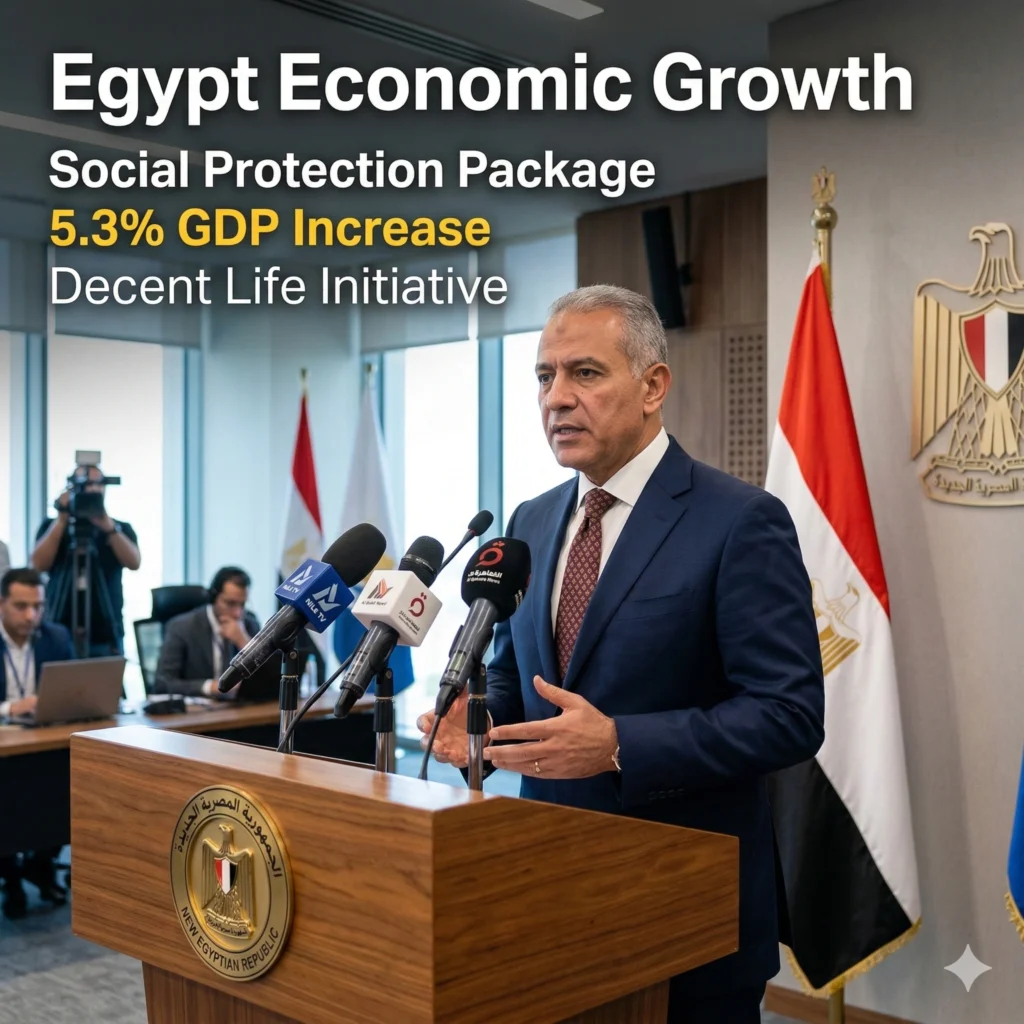
Macroeconomic Drivers Behind the Egypt GDP Growth Hits 5.3 Percent
The recent data confirming that Egypt GDP Growth Hits 5.3 Percent is a testament to the resilience of the local manufacturing and energy sectors. Despite the military escalations occurring in the broader Middle East, Egypt has managed to stabilize its domestic production lines and maintain steady export volumes. Prime Minister Madbouly attributed this success to the government’s ability to maintain budgetary discipline while fostering a pro-business environment. These efforts have successfully attracted foreign direct investment back into the Egyptian market after a period of global uncertainty.
Furthermore, the deepening of partnerships with the private sector has played a pivotal role in achieving these growth figures. By reducing bureaucratic hurdles and offering targeted incentives, the state has encouraged private enterprises to take a leading role in infrastructure projects. This shift has not only boosted the GDP but also created thousands of new jobs for the burgeoning youth population. As the government finalizes the 2026-27 budget bill, the focus remains on maintaining this momentum through continued transparency and market-oriented reforms.
Strategic Allocation of the $830 Million Social Package
While the headline news is that Egypt GDP Growth Hits 5.3 Percent, the social implications of this growth are equally significant for the average citizen. The $830 million social protection package is designed to provide a safety net for households facing the rising cost of living. A substantial portion of this funding, roughly $310 million, is being funneled directly into the Haya Karima initiative. This flagship national program is specifically tailored to revitalize rural infrastructure and improve the quality of life in neglected villages.
The Haya Karima project is ambitious, aiming to impact more than 60 million citizens by upgrading schools, hospitals, and sanitation systems. By focusing on human development, the government is ensuring that the benefits of the 5.3% growth are not confined to urban centers. This targeted spending is expected to reduce the poverty gap and stimulate local economies within the provinces. Prime Minister Madbouly emphasized that these investments are essential for building a modern state that prioritizes the dignity and well-being of every Egyptian family.
Fiscal Discipline and Debt Management Strategies
A core component of the strategy that ensured Egypt GDP Growth Hits 5.3 Percent is the rigorous focus on national budgetary discipline. The upcoming 2026-27 fiscal plan is being crafted with the specific goal of improving public debt indicators to ensure long-term solvency. By utilizing budget surpluses to fund social programs rather than taking on new debt, the administration is demonstrating a commitment to fiscal responsibility. This approach has been well-received by international financial institutions and credit rating agencies alike.
- The government is prioritizing the reduction of the debt-to-GDP ratio through 2027.
- Revenue collection has been modernized through digital tax systems and broader compliance.
- Spending is being redirected toward high-impact human development projects.
- Crisis monitoring units are tracking global oil prices to mitigate energy subsidies.
These measures provide the fiscal space necessary to navigate a delicate period characterized by an unstable regional environment. By securing strategic food reserves and stabilizing the electricity grid, the state is insulating the economy from external shocks. The ability to maintain a 5.3% growth rate while simultaneously lowering the deficit is a major achievement for the current economic team. This balance of growth and discipline is expected to be the cornerstone of Egyptian economic policy for the foreseeable future.
Regional Challenges and Economic Resilience
The fact that Egypt GDP Growth Hits 5.3 Percent during a time of significant military escalation in the region is particularly noteworthy. The Egyptian authorities have activated specialized crisis monitoring units to track potential economic ripple effects in real time. These units analyze everything from maritime trade disruptions in the Red Sea to fluctuations in global natural gas supplies. By being proactive, the government has been able to implement preemptive measures to protect the domestic market from volatility.
Maintaining stability in the electricity grid has been a top priority, especially as demand increases alongside industrial expansion. The government has taken steps to secure reliable oil and natural gas supplies, ensuring that factories remain operational and homes remain powered. This focus on energy security is a critical pillar of the broader economic recovery plan. Despite the pressures of the regional crisis, Egypt’s strategic geographic position and diversified economy have allowed it to maintain an upward trajectory that many neighboring nations have struggled to match.
Egypt GDP Growth Hits 5.3 Percent
The current data shows that Egypt GDP Growth Hits 5.3 Percent, marking a record performance for the Madbouly administration. This specific figure represents a psychological and economic turning point for the nation as it leaves behind the stagnation of previous years. The government’s ability to hit this target while managing a 40 billion Egyptian pound social package demonstrates a sophisticated handle on both macro and microeconomics. It proves that aggressive growth and social welfare can coexist when managed with transparency.
This growth rate is not merely a number on a spreadsheet; it represents increased industrial output and a more vibrant domestic market. As the New Administrative Capital becomes the heart of governance, the efficiency of state operations has improved, leading to faster implementation of economic policies. The 5.3% benchmark is now the new standard against which future quarters will be measured. Investors are looking at this consistency as a sign that Egypt is finally reaping the rewards of its long-term structural adjustment programs initiated years ago.
Expanding the Haya Karima National Initiative
A vital part of the narrative surrounding the news that Egypt GDP Growth Hits 5.3 Percent is the expansion of the Haya Karima program. By allocating $310 million to this cause, the government is addressing the root causes of economic migration and rural underdevelopment. The initiative focuses on building essential infrastructure, such as clean water networks and reliable internet access, in the furthest reaches of the country. This creates a foundation for local businesses to thrive outside of Cairo and Alexandria.
- Improvements in rural healthcare facilities have reduced the burden on urban hospitals.
- New educational centers are focusing on vocational training for the local workforce.
- Infrastructure investments have decreased transportation costs for agricultural goods.
The success of Haya Karima is intrinsic to the overall health of the Egyptian economy. As rural areas become more productive, they contribute more significantly to the national GDP. This holistic approach ensures that the 5.3% growth is inclusive and geographically diverse. The Prime Minister has reiterated that the goal is to raise national living standards across the board, making the “Decent Life” initiative a permanent fixture of the Egyptian social contract. This commitment is a key reason for the positive sentiment among the populace.
Strengthening Private Sector Partnerships
To ensure that Egypt GDP Growth Hits 5.3 Percent again in the coming quarters, the government is deepening its ties with private enterprises. The state is gradually moving away from being the primary employer and instead acting as a facilitator for private-led growth. This transition is crucial for creating a dynamic economy that can compete on a global scale. By selling stakes in state-owned enterprises and encouraging public-private partnerships, Egypt is unlocking new sources of capital and expertise.
These partnerships are particularly active in the construction, renewable energy, and technology sectors. Private firms are bringing in advanced management techniques and innovative technologies that drive productivity. The government’s role has shifted toward regulation and providing the necessary legal framework to protect investments. This collaborative environment is a major driver of the 5.3% growth rate, as it allows for a more efficient allocation of resources across the economy. The success of this model is being closely watched by other emerging markets in the region.
Future Projections for the Egyptian Economy
Looking ahead, the momentum that helped Egypt GDP Growth Hits 5.3 Percent is expected to carry into the next fiscal year. Economic analysts predict that if regional tensions de-escalate, Egypt could see growth rates approaching 6% by 2027. The government’s focus on carving out additional fiscal space will allow for even greater investment in technology and human development. This forward-looking approach is designed to transform Egypt into a regional hub for energy and logistics.
However, the administration remains cautious, keeping its crisis units active to respond to any sudden changes in the global landscape. The priority remains stabilizing the currency and keeping inflation under control to protect the gains made by the working class. The 5.3% growth is a strong foundation, but the journey toward a fully modernized economy requires years of consistent performance. With the 2026-27 budget focusing on debt reduction and social equity, the roadmap for the future appears clear and well-defined for the Egyptian people.
For more details & sources visit: APAnews
For the latest updates from Egypt, visit our Egypt news page.