
Tensions erupted late Tuesday at the COP30 climate talks in Belém, Brazil, when a group of Indigenous and non-Indigenous demonstrators stormed the main conference venue. The clashes between protesters and UN security guards briefly disrupted the summit before order was restored.
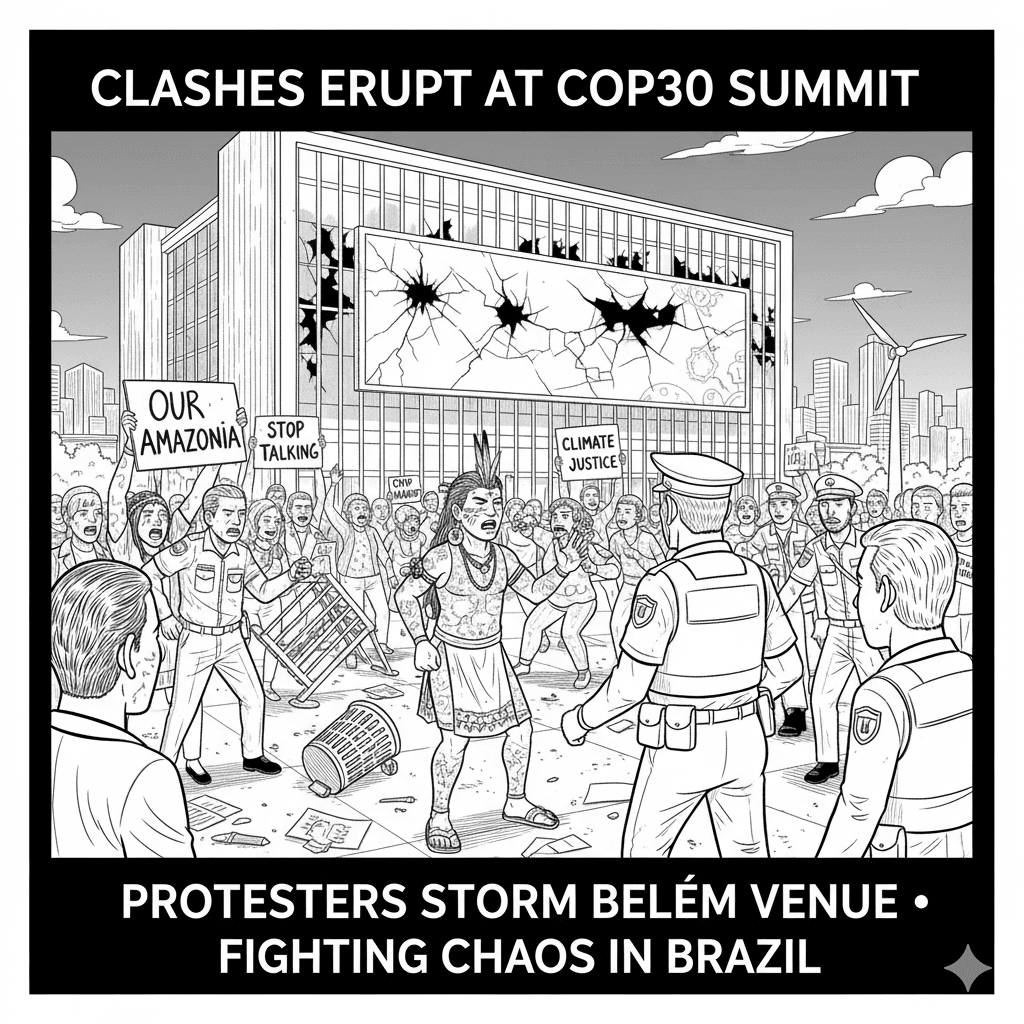
Chaos at the COP30 Climate Talks in Belém
Eyewitnesses at the COP30 climate talks reported chaotic scenes as protesters pushed through the main entrance of the Blue Zone, a restricted area for accredited delegates. Some participants, wearing traditional feathered headdresses, knocked a door off its hinges before entering the hall, prompting a swift response from UN security teams.
Security personnel attempted to contain the breach as protesters shouted slogans and waved banners calling for stronger action to protect the Amazon rainforest. One demonstrator carried a sign reading “Our forests are not for sale”, while others wore shirts with the word “Juntos” (“Together”) printed across them.
A UN Climate spokesperson confirmed that two guards sustained minor injuries and that property damage inside the venue was minimal. “Negotiations are continuing as planned,” the spokesperson said.
Security Tightens After Protest at COP30
Following the confrontation, Brazilian fire brigade officers and UN security officials formed a perimeter around the conference centre to prevent further incidents.
Agustin Ocaña of the Global Youth Coalition defended the protesters’ actions, stating, “They’re not acting out of violence — they’re desperate to protect their land and the Amazon river.”
The United Nations later issued a statement emphasizing that both UN and Brazilian security “took protective actions to secure the venue” while ensuring that all delegates remained safe.
Peaceful Protests Turned Chaotic
This was the first major disruption at COP30, which had previously seen mostly peaceful demonstrations. Brazil’s government has encouraged civil society engagement during this year’s summit, allowing public marches and alternative forums alongside official negotiations.
Protesters have raised concerns that global climate discussions often exclude Indigenous voices and local communities most affected by deforestation. Many participants argued that the COP30 climate talks must focus on protecting ecosystems and Indigenous rights rather than prioritizing corporate interests.
Activist Movements Continue Outside the Venue
Activist groups announced plans to maintain demonstrations throughout the week, including a “People’s Summit”, a global youth rally, and the largest climate march scheduled for Saturday.
Thousands of participants are expected to join, including Indigenous leaders Raoni Metuktire and Davi Kopenawa Yanomami, who will lead a symbolic river flotilla to Belém as part of the continuing protests.
Background: What’s at Stake at COP30
The COP30 climate talks in Brazil have drawn more than 50,000 participants from 190 countries. Delegates are negotiating measures to accelerate greenhouse gas reduction, expand renewable energy, and protect vulnerable ecosystems such as the Amazon basin.
While the clashes underscored frustration among activists, many hope the demonstrations will amplify calls for environmental justice and equitable climate solutions.
Despite the disruption, negotiations continued without interruption, with global leaders urging unity, accountability, and urgent climate action.
The Guardian: Tussles Break Out Between Protesters and Security at COP30
UN Climate Change Official Site
For more regional updates and industry insights, visit our Brazil News Section