
Chocolate Prices Valentine’s Day 2026 is a topic of intense concern as global markets face an unprecedented “climate crunch” that threatens the world’s favorite confection. This year, lovers exchanging heart-shaped boxes are finding that their sweet gestures come with a significantly higher price tag and a bitter reality regarding the sustainability of the cocoa supply chain.
The traditional chocolate industry, long dependent on cheap labor and forest expansion, is hitting a wall as extreme weather events and ecological degradation collapse yields in primary growing regions. As the world celebrates romance, the underlying crisis in West Africa and Latin America highlights a fragile system where Chocolate Prices Valentine’s Day 2026 reflect not just inflation, but the true environmental cost of cocoa production.
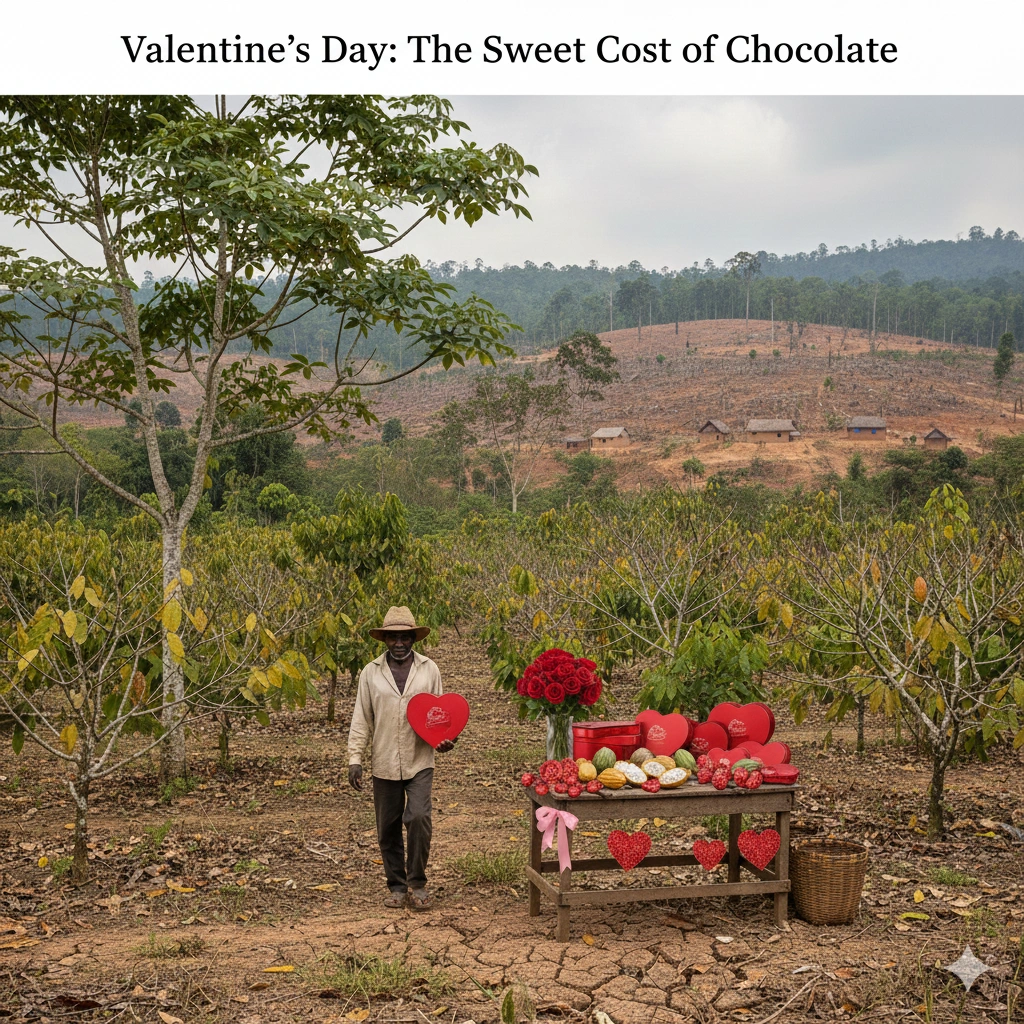
The Impact of Climate Shocks on Global Harvests
The recent volatility in the cocoa market is a direct result of “climate shocks” that have disrupted the delicate biological requirements of the cacao tree. Cacao is a notoriously finicky crop, requiring specific humidity, temperature, and rainfall patterns to produce the pods used for chocolate. In 2025 and early 2026, the El Niño phenomenon combined with long-term global warming to create a “perfect storm” of drought and disease, such as black pod rot, which thrives in unpredictable moisture conditions. These environmental pressures have sent benchmark prices to more than three times their historical averages, making Chocolate Prices Valentine’s Day 2026 a major headline in financial and consumer news outlets alike.+1
Furthermore, the reliance on a few concentrated geographic areas makes the entire global supply chain extremely vulnerable to localized weather disasters. When the “Cocoa Belt” of West Africa suffers, the entire world feels the pinch at the checkout counter. Experts note that without immediate intervention to help farmers adapt to these shifting patterns, the quality and quantity of cocoa will continue to decline. The high Chocolate Prices Valentine’s Day 2026 are merely the beginning of a long-term trend where luxury goods derived from sensitive ecosystems become increasingly scarce. This shift is forcing major chocolate brands to reconsider their sourcing strategies and invest more heavily in climate-resilient farming techniques to ensure their survival.
Chocolate Prices Valentine’s Day 2026
The reality of Chocolate Prices Valentine’s Day 2026 is visible in every retail aisle, from artisanal boutiques to massive supermarket chains. Consumers are noticing that “shrinkflation”—where the price stays the same but the product weight decreases—has become a standard industry tactic to mask the soaring cost of raw cocoa. In some regions, the price of a standard milk chocolate bar has risen by 40% compared to two years ago, while premium dark chocolate, which requires a higher percentage of cocoa solids, has seen even steeper increases. This economic pressure is fundamentally changing how people shop for holiday treats, with many opting for smaller portions or alternative sweets as Chocolate Prices Valentine’s Day 2026 continue to climb.
Beyond the immediate cost to the consumer, these price hikes reflect a deeper shift in the commodity market. Traders are no longer viewing cocoa as a stable, predictable crop but as a high-risk asset prone to sudden fluctuations. This volatility makes it difficult for small-scale chocolatiers to plan their production, often leading to seasonal shortages of specific varieties. The high Chocolate Prices Valentine’s Day 2026 are also fueling a conversation about “fair price” versus “low price.” While consumers feel the sting of expensive candy, analysts argue that these prices are necessary to provide farmers with the capital needed to implement sustainable practices that can withstand the encroaching climate crisis.
Deforestation and the Cycle of Ecological Decline
For decades, the drive to keep chocolate affordable has led to massive deforestation across West Africa, Southeast Asia, and Latin America. As older plantations lost productivity, farmers often cleared primary forests to find nutrient-rich soil, creating a cycle of environmental destruction. This “full-sun monocrop” expansion has removed the very trees that once provided the shade and microclimate cacao needs to thrive. The current crisis is, in many ways, a feedback loop: by destroying forests to plant more cocoa, the industry has exacerbated the local heat and drought that are now killing the crops. The high Chocolate Prices Valentine’s Day 2026 are the financial manifestation of this ecological debt coming due.+1
Recent modeling suggests that if current deforestation and warming trends continue, up to half of the world’s current cocoa-growing land could become unsuitable by 2050. This would force production into even more sensitive “new frontiers,” potentially triggering further environmental damage. To combat this, new regulations like the European Union’s Deforestation-Free Import Rules are being strictly enforced in 2026. These laws require companies to prove that their cocoa was not grown on recently deforested land. While these regulations are essential for the planet’s health, they add a layer of compliance cost that contributes to the elevated Chocolate Prices Valentine’s Day 2026, as supply chains must be fully traceable and transparent.
Agroforestry as a Sustainable Path Forward
In response to the climate crunch, many organizations are pointing to “agroforestry” as the most viable solution for the future of chocolate. In places like Ecuador’s Napo province, Indigenous Kichwa communities have utilized the “chakra” system—diverse forest gardens where cacao grows alongside fruit trees, timber, and medicinal plants—for generations. These shaded farms are naturally more resilient to extreme heat and provide a habitat for pollinators that monocrop plantations lack. By adopting these models, the industry could stabilize yields and even sequester carbon, turning cocoa farms from carbon sources into carbon sinks. This shift is a key factor in the narrative surrounding Chocolate Prices Valentine’s Day 2026.
- Agroforestry systems can lower ground temperatures by up to 5°C compared to open-sun farms.
- Diverse farms provide secondary income for farmers through fruit and timber sales, reducing poverty.
- Shade-grown cocoa often produces a higher-quality flavor profile, commanding premium market prices.
- Soil health is maintained naturally through leaf litter, reducing the need for expensive chemical fertilizers.
Implementing these systems on a global scale requires significant investment and a move away from the “lowest-cost” mindset. High-end chocolate buyers are already paying “climate premiums” to support these sustainable farms, a trend that is reflected in the high Chocolate Prices Valentine’s Day 2026. If the mass market follows suit, it could provide the financial lifeline smallholder farmers need to transition their land. This would not only protect the environment but also ensure that chocolate remains available for future generations of Valentine’s Day celebrations.
The Role of Corporate Responsibility and Traceability
Major global chocolate corporations are under more pressure than ever to move beyond symbolic sustainability pledges and toward radical transparency. In 2026, “traceability” has become the industry’s most important buzzword. Consumers are increasingly using QR codes on packaging to track their chocolate’s journey from the specific farm plot to the factory. This level of accountability is necessary to ensure that the increased revenue from high Chocolate Prices Valentine’s Day 2026 actually reaches the farmers who are doing the hard work of climate adaptation. Without fair compensation, many younger farmers are abandoning cocoa for more stable urban jobs, creating a long-term labor crisis.
Technological innovations, such as satellite monitoring and blockchain-based payment systems, are being deployed to verify “zero-deforestation” claims. While these tools are effective, they are not a silver bullet. Critics argue that the core issue remains the “poverty trap” that keeps many cocoa farmers earning well below a living wage. The spike in Chocolate Prices Valentine’s Day 2026 should, in theory, benefit the producers; however, much of the profit often stays with middlemen and large-scale distributors. For the industry to be truly sustainable, the fundamental economic structure must change to prioritize the well-being of the ecosystems and the people who steward them.
Consumer Choices in a Volatile Market
As Chocolate Prices Valentine’s Day 2026 reach historic highs, the power of the consumer is more apparent than ever. People are being encouraged to look for certifications such as Rainforest Alliance or Fairtrade, which, while not perfect, offer a baseline for ethical sourcing. Choosing “bean-to-bar” products from smaller companies that maintain direct relationships with farmers can also ensure that the extra money spent goes toward resilient infrastructure. The reality of 2026 is that cheap chocolate is increasingly seen as a red flag for environmental or social exploitation. This cultural shift is making the high Chocolate Prices Valentine’s Day 2026 more acceptable to a public that is becoming more aware of the climate crisis.
- Look for dark chocolate with a cocoa percentage of 70% or higher for the best value and health benefits.
- Consider alternative gifts like locally sourced fruits or baked goods that use sustainable ingredients.
- Support brands that publish annual impact reports regarding their carbon footprint and farmer wages.
This shift in consumer behavior is forcing even the largest discount brands to rethink their recipes. Some have begun blending cocoa with other ingredients to maintain price points, while others are investing in “lab-grown” cocoa alternatives. While these innovations may help manage the high Chocolate Prices Valentine’s Day 2026, they do not solve the underlying problem of supporting the millions of smallholder families whose livelihoods depend on the cacao tree. Ultimately, the choice to pay more for ethical chocolate is an investment in a future where Valentine’s Day remains a sweet tradition.
The Mid-Century Outlook for the Cocoa Belt
Looking forward toward 2050, the outlook for the traditional “Cocoa Belt” remains precarious. Scientific models indicate that if the world does not meet its carbon reduction targets, the regions currently producing the bulk of our chocolate will become nearly uninhabitable for the cacao tree. This would lead to a massive migration of the industry toward cooler, higher-altitude areas, potentially causing fresh waves of deforestation in previously untouched mountainous forests. The Chocolate Prices Valentine’s Day 2026 are a “early warning system” for what a fully disrupted tropical agricultural sector looks like. It serves as a stark reminder that food security is inextricably linked to climate stability.
To prevent this catastrophic shift, international cooperation is essential. The FAO and other global bodies are backing schemes in Sao Tome and Principe and the Ivory Coast that focus on “forest-safe” production. These projects aim to prove that intensive, sustainable farming on existing land can meet global demand without further expansion. If these models succeed, they could provide a blueprint for other tropical commodities like coffee and palm oil. The narrative of Chocolate Prices Valentine’s Day 2026 is therefore not just about a holiday treat, but about the resilience of the entire global food system in the face of an uncertain environmental future.
Investing in the Future of Chocolate
The final takeaway from the current market crisis is that healthy ecosystems must be treated as essential infrastructure. Just as a city requires roads and bridges, a stable supply of chocolate requires healthy soil, predictable rainfall, and vibrant biodiversity. The high Chocolate Prices Valentine’s Day 2026 represent the cost of maintaining this infrastructure. Governments and private investors must provide better finance and technical support to smallholders, ensuring they have the tools to plant shade trees, manage pests naturally, and harvest high-quality beans. This is the only way to move beyond the current era of volatility and ensure a long-term supply.
As the 2026 Valentine’s Day celebrations wind down, the conversation about chocolate is unlikely to fade. The legislative hurdles, environmental challenges, and economic shifts discussed here are part of a broader transformation. While the high Chocolate Prices Valentine’s Day 2026 may be a source of temporary frustration for shoppers, they are a necessary part of the transition toward a more honest and sustainable economy. By paying the true price of cocoa today, we are protecting the possibility of sharing a box of chocolates with the people we love for many years to come. The future of chocolate depends on our willingness to value the forest as much as the bean.
For more details & sources visit: Al Jazeera
Read more on global developments: 360 News Orbit – Extended Orbit