
Shenzhou-20 — China has delayed the return of three astronauts from its Tiangong space station following a suspected debris strike on their spacecraft. The China National Space Administration (CNSA) confirmed that safety assessments are ongoing, with no new return date yet announced.
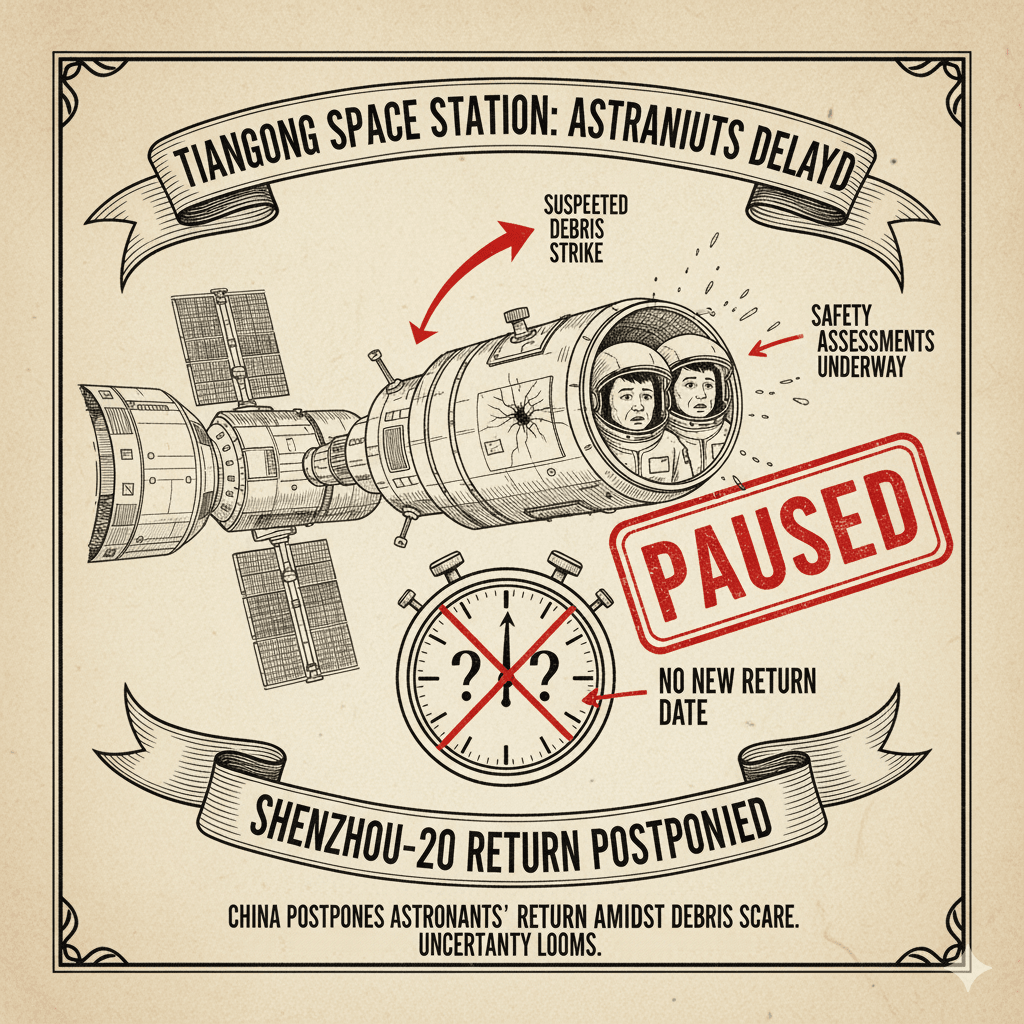
Shenzhou-20 Mission Faces Delay After Suspected Debris Collision
The Shenzhou-20 spacecraft, carrying astronauts Chen Dong, Chen Zhongrui, and Wang Jie, was originally scheduled to return to Earth this week after completing a six-month stay aboard the Tiangong space station. However, mission controllers detected an anomaly believed to be linked to a small piece of space debris possibly impacting the return capsule.
In a statement, the CNSA said additional inspections are required to ensure the spacecraft’s integrity before re-entry. “Crew safety remains our highest priority,” the agency emphasized, noting that the astronauts remain in stable condition aboard Tiangong while engineers perform detailed diagnostics and structural evaluations.
Smooth Handover to Shenzhou-21 Crew Before Delay
Before the delay, the Shenzhou-20 crew completed a formal handover to the Shenzhou-21 team, who successfully arrived and docked at the Tiangong station days earlier. The new crew includes Wu Fei, celebrated as China’s youngest astronaut ever to enter space, symbolizing the country’s growing emphasis on youth participation in its expanding space program.
The handover was designed to ensure seamless operational continuity aboard Tiangong, which remains fully functional. Officials say mission coordination between the two teams has been “exemplary,” despite the unexpected delay.
Shenzhou-20 Highlights China’s Advancing Space Capabilities
Despite the setback, the Shenzhou-20 mission marks another milestone in China’s ambitious space agenda. Over the past six months, the crew conducted dozens of experiments in materials science, medicine, and microgravity research, as well as multiple spacewalks to install new solar panels and external instruments.
Earlier this year, Chinese astronauts achieved the longest spacewalk in the nation’s history, further demonstrating the growing technical maturity of China’s human spaceflight program. Officials have also confirmed preparations for China’s first foreign astronaut visit — from Pakistan — scheduled for 2026, signaling greater international collaboration.
Space Debris Risk Echoes Global Concerns
The Shenzhou-20 incident underscores the increasing danger posed by space debris, a growing issue affecting all major spacefaring nations. NASA, ESA, and other agencies have faced similar challenges: for instance, NASA’s Boeing Starliner mission encountered critical issues that left astronauts stranded in orbit for months before a safe return.
Experts warn that collisions with even small fragments of space junk can cause serious damage to spacecraft traveling at orbital velocities. The CNSA has not confirmed the size or source of the debris suspected in this case but reaffirmed that all necessary safety protocols are being followed.
Next Steps for China’s Tiangong Space Program
As evaluations continue, CNSA engineers are expected to determine whether the Shenzhou-20 return capsule can safely perform atmospheric re-entry or whether alternative return logistics are required. The Tiangong space station remains stable, and mission controllers report normal conditions for both crews on board.
The setback is unlikely to affect China’s long-term schedule, as new launches and cargo missions are already planned for 2026 under the nation’s Space Development Strategy 2035.
Source:
CNBC – China delays Shenzhou-20 astronauts’ return after suspected debris strike
For more China-related updates, visit our China News page.