
China has announced a significant leadership reshuffle, introducing new governors and party chiefs across several major provinces. The appointments reflect Beijing’s ongoing efforts to strategically manage personnel within both central and provincial administrations, ensuring stability and alignment with national priorities.
The China leadership reshuffle underscores the government’s focus on effective governance, political continuity, and placing trusted officials in key regional roles.
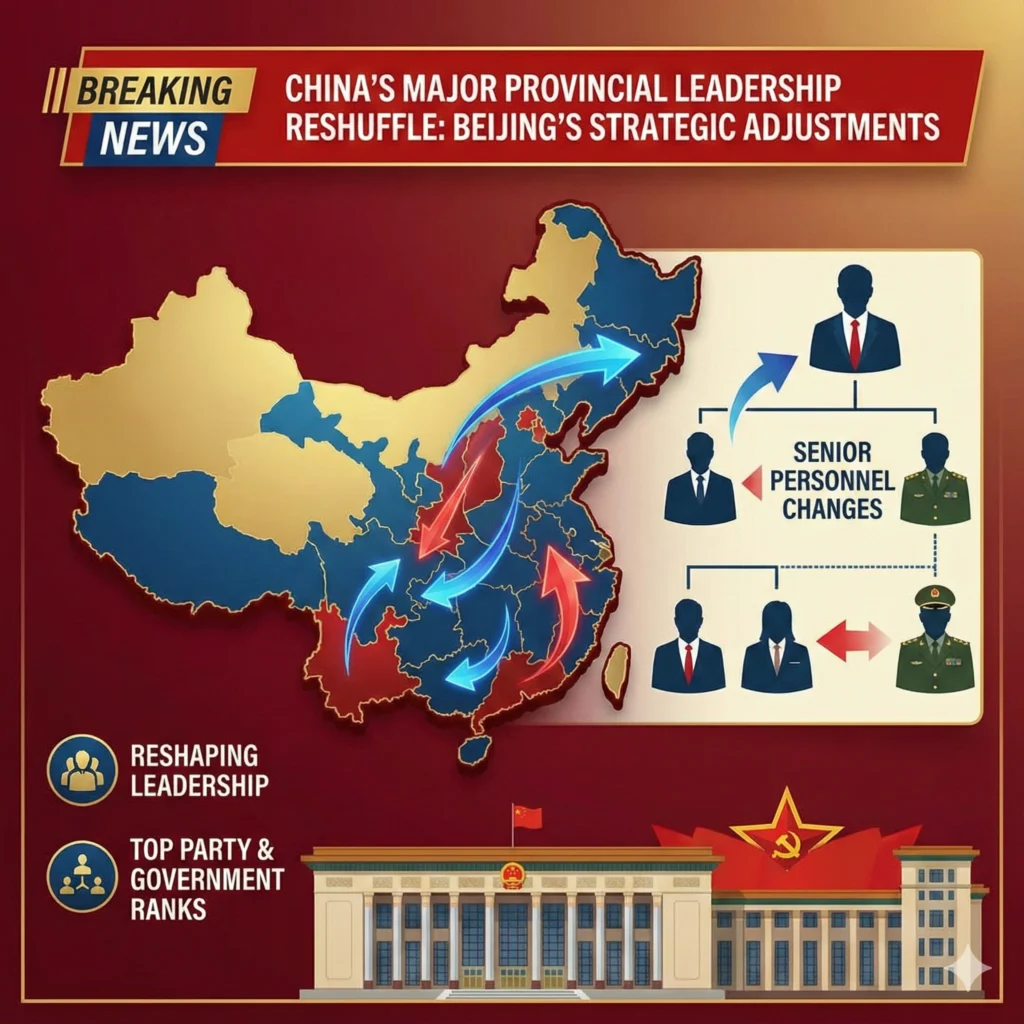
Key Appointments in the Reshuffle
Several high-profile appointments were confirmed as part of the reshuffle:
- Liu Haixing: Named Minister of the International Department of the Communist Party of China Central Committee.
- Meng Fanli: Promoted from Shenzhen Party Secretary to Governor of Guangdong Province.
- Wang Weizhong: Transferred from Governor of Guangdong to Party Secretary of Inner Mongolia.
- Liu Xiaotao: Formerly Suzhou Party Secretary, appointed Governor of Jiangsu Province.
- Xu Kunlin: Former Governor of Jiangsu, now Party Secretary of Liaoning Province.
These strategic placements highlight the Chinese leadership’s careful consideration of experience, political reliability, and regional expertise when selecting officials for high-level positions.
Significance of the Leadership Changes
The China leadership reshuffle is significant for several reasons:
- Policy Continuity: By moving experienced officials into key roles, Beijing ensures that ongoing policy initiatives, including economic reform, environmental management, and urban development, continue uninterrupted.
- Regional Governance: Appointments in provinces like Guangdong, Jiangsu, Liaoning, and Inner Mongolia demonstrate a focus on economically and politically strategic regions.
- Talent Redistribution: The reshuffle enables the transfer of officials with proven administrative skills to regions where their expertise can drive development and governance improvements.
Analysts note that such reshuffles are a common practice in China, reflecting both political trust and strategic planning rather than reactive changes.
Impact on Regional Administration
Each new appointment carries implications for provincial administration:
- Guangdong Province: Under Governor Meng Fanli, authorities expect continued economic growth, particularly in Shenzhen’s tech and innovation sectors.
- Inner Mongolia: Wang Weizhong’s experience is expected to strengthen political oversight and economic development strategies.
- Jiangsu and Liaoning: The exchanges between Liu Xiaotao and Xu Kunlin reflect a balance between continuity and fresh leadership to drive regional priorities, including industrial and technological initiatives.
These changes are anticipated to influence local governance, investment climates, and policy implementation in critical regions.
Political and Strategic Context
The China leadership reshuffle occurs amid a broader context of domestic and international challenges, including economic transitions, urbanization pressures, and global diplomatic engagement. Placing trusted officials in strategic positions allows the central leadership to reinforce policy coherence and ensure alignment with national objectives.
Observers emphasize that the appointments are part of a systematic approach to talent management and political stability, consistent with China’s long-term governance model.
Looking Ahead
With this China leadership reshuffle, attention will focus on how newly appointed governors and party chiefs execute policy, manage regional challenges, and drive development priorities. The reshuffle also signals Beijing’s intent to maintain control over key administrative regions while promoting efficiency and growth.
The reshuffle’s success will likely be measured by economic performance, social stability, and the effective implementation of national priorities across the provinces.
Source: US-China.org
For more China-related updates, visit our China News page