
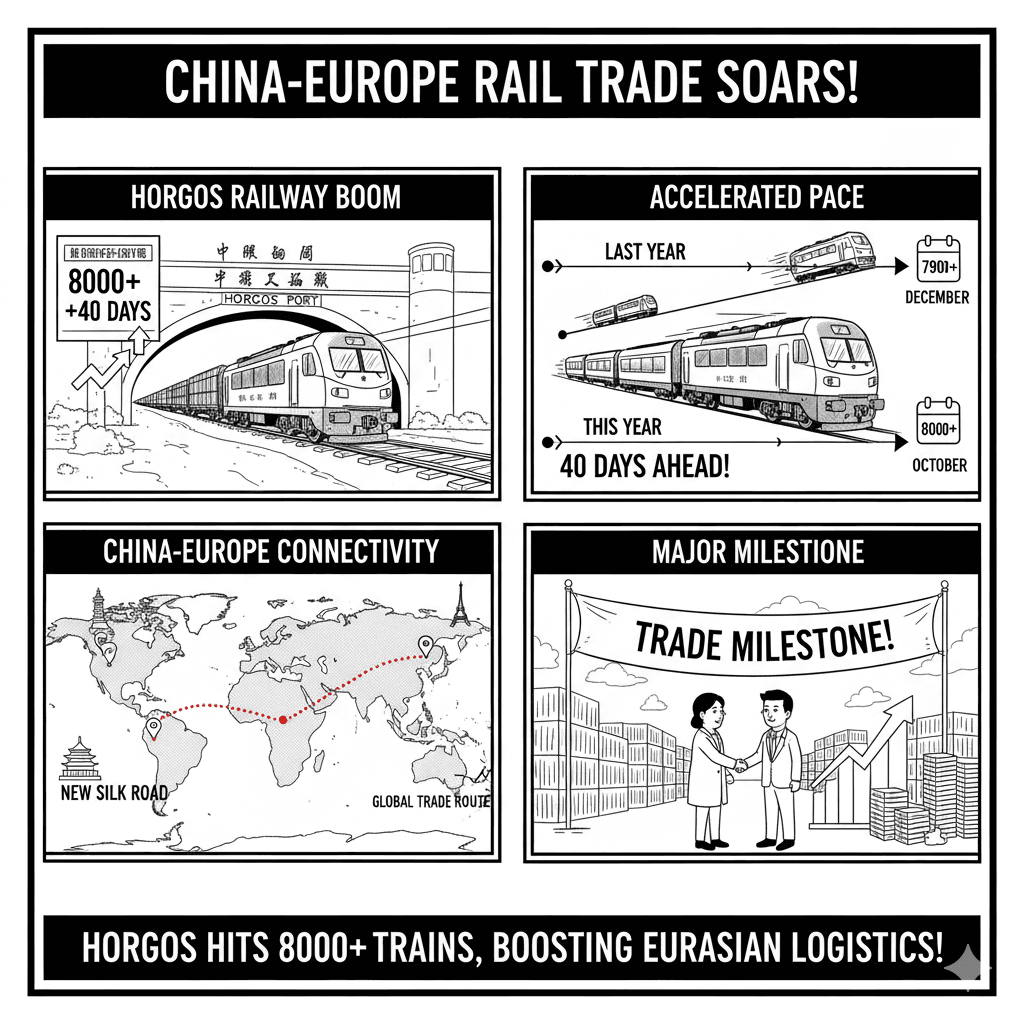
China’s Horgos Railway Port in Xinjiang has achieved a new milestone, with China-Europe freight trains via Horgos Port surpassing 8,000 in 2025, marking a 40-day lead compared to last year. This development reinforces China’s growing role in global supply chain resilience and Eurasian trade connectivity, driven by the Belt and Road Initiative (BRI).
Record-Breaking Milestone for Horgos Port in 2025
Earlier this week, a China-Europe freight train carrying electronic components, textiles, and daily consumer goods departed from Horgos Railway Port bound for Malaszewicze, Poland, officially pushing the port’s total train count for the year beyond 8,000.
According to data from Horgos Customs, the port currently handles over 27 freight trains daily, connecting China’s manufacturing hubs with key logistics centers across Europe and Central Asia. This figure represents steady year-on-year growth and highlights the port’s vital role as one of China’s largest inland international logistics gateways.
Customs officials report that this achievement came 40 days earlier than in 2024, demonstrating significant efficiency improvements and growing demand for cross-continental rail freight.
A Vital Link Between China and Europe’s Supply Chains
The China-Europe freight trains via Horgos Port serve as a crucial artery linking China’s Yangtze River Delta, Pearl River Delta, and Chengdu-Chongqing economic regions with markets in Germany, Poland, Kazakhstan, and other parts of Europe.
These rail routes are increasingly preferred for offering a balanced alternative between sea and air transport — faster than sea freight and more cost-effective than air cargo.
Li Qing, a manager at a Xinjiang-based logistics firm, said that cargo volumes through Horgos have risen by 20% year-on-year, with total freight exceeding 5 million tonnes in 2025. The steady increase, he noted, reflects both the port’s efficiency and the rising international demand for Chinese goods such as electronics, textiles, machinery, and e-commerce products.
Efficiency and Digital Modernization Transform Horgos Operations
Authorities at Horgos Customs have introduced advanced digital clearance systems and AI-assisted logistics management to streamline trade processes.
- Import clearance times have dropped from 36 hours to 16 hours.
- Export processing now averages just one hour, enabling faster turnaround.
- The port has implemented paperless documentation and intelligent cargo scanning, significantly reducing bottlenecks.
These advancements align with China’s broader “Smart Port” initiative, part of the national digital economy strategy aimed at modernizing logistics infrastructure under the 15th Five-Year Plan.
Strategic Role in the Belt and Road Initiative
The China-Europe Railway Express network — which includes Horgos, Alashankou, Chongqing, Xi’an, and Zhengzhou — remains a centerpiece of the Belt and Road Initiative (BRI).
To date, more than 50,000 China-Europe freight trains have passed through Horgos, connecting 46 cities across 18 countries. This growing network underpins Eurasia’s evolving trade landscape, supporting diversified supply chains and reducing reliance on maritime routes.
Economists note that the expansion of China-Europe freight trains via Horgos Port is not only a logistics success but also a symbol of China’s commitment to open trade and connectivity amid shifting global dynamics.
Future Outlook: Sustainability and Expansion Ahead
Looking ahead, Horgos Port is expected to further expand its capacity through:
- Upgraded rail infrastructure for higher-speed freight handling.
- Integration with Central Asia–Europe multimodal transport corridors.
- The introduction of green energy-powered trains to reduce carbon emissions.
Officials estimate that by 2026, annual freight train volume via Horgos could exceed 10,000, consolidating its status as a top land port for China-Europe trade.
China’s Ministry of Transport confirmed ongoing investments in digital logistics corridors, enhancing the synchronization between ports, customs, and private freight companies.
For more China-related updates, visit our China News page.