
China Demands Immediate Ceasefire is the central message from Beijing today as the global community reacts to a dramatic escalation in Middle Eastern hostilities. Chinese Foreign Minister Wang Yi held a high-level diplomatic phone call with his Israeli counterpart, Gideon Saar, to formally express Beijing’s opposition to the recent military actions. This demand follows a series of coordinated military strikes launched by Israel and the United States against strategic targets in Tehran and Beirut. The strikes have not only heightened regional tensions but have also severely disrupted global energy markets and financial stability.
Chinese Foreign Minister Wang Yi informed Israeli Foreign Minister Gideon Saar that Beijing formally opposes the recent military actions against Iran and Lebanon. Explosions occurred across Tehran and Beirut on Tuesday as the United States and Israel intensified their coordinated air campaign in the region. Global financial markets experienced a significant downturn following news of the strikes due to fears of prolonged disruptions to international energy supplies. Consequently, the Chinese ministry is emphasizing that the true value of military power should be found in preventing war rather than engaging on the battlefield.
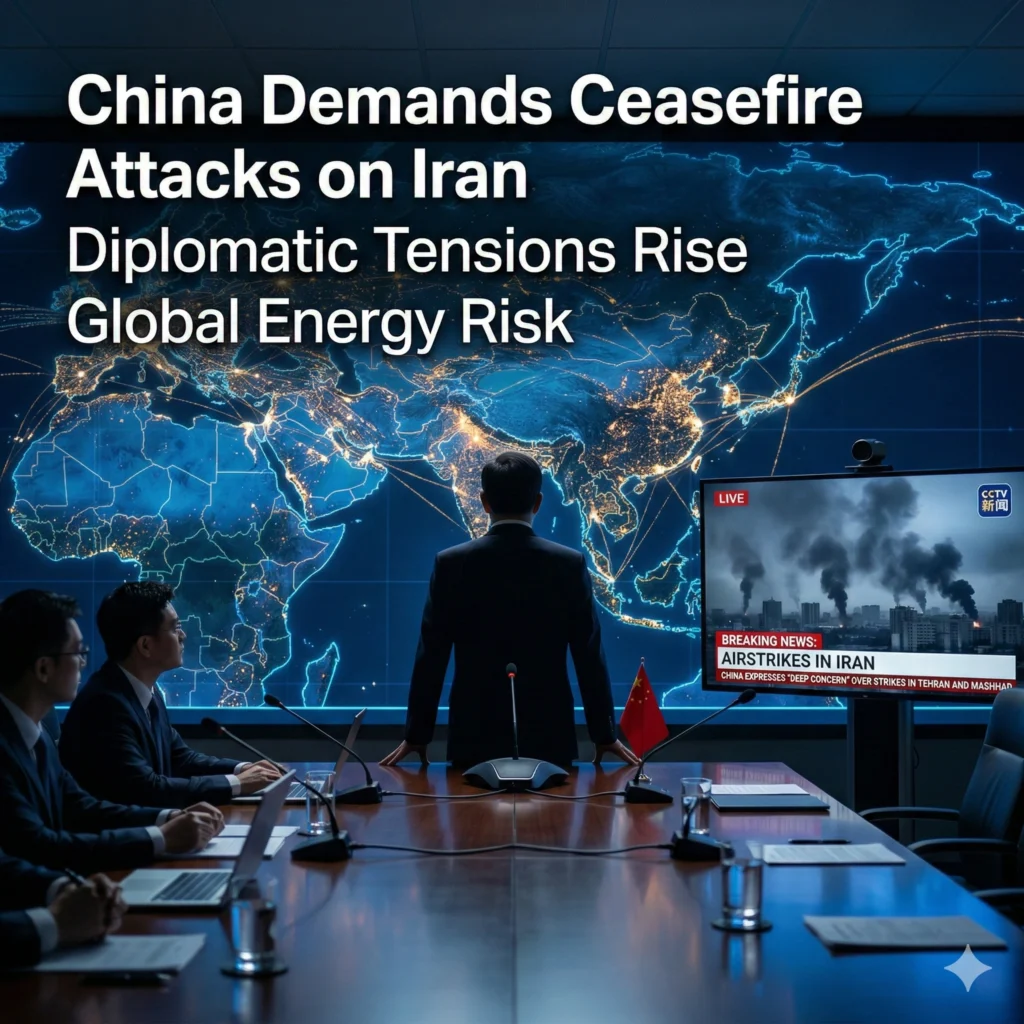
China Demands Immediate Ceasefire
The escalation has prompted urgent international analysis regarding the potential for a wider conflict involving multiple Middle Eastern powers. Because China is a major consumer of Middle Eastern oil, any instability in the Strait of Hormuz directly threatens its national energy security. Therefore, the demand for an immediate cessation of hostilities is both a diplomatic stance and an economic necessity for Beijing. Foreign ministry officials indicated that China will continue to monitor the situation closely to protect regional stability and economic interests.
Market analysts are watching for further reactions from major oil-producing nations as the conflict impacts the prospect of global energy security. Diplomatic channels between Beijing and Jerusalem remain open despite the sharp disagreement over the necessity of the recent aerial strikes. Wang Yi reiterated that China’s position is rooted in the principles of sovereignty and non-interference. He stressed that a regional conflagration would benefit no one and would only lead to a cycle of endless retribution.
Moreover, the timing of these strikes has complicated ongoing diplomatic efforts to stabilize the global economy. As the world recovers from previous supply chain shocks, a new energy crisis triggered by Middle Eastern instability is a nightmare scenario for global trade. China, as the world’s largest manufacturer, is particularly sensitive to these fluctuations. By demanding a ceasefire, Beijing is positioning itself as the voice of reason and stability in an increasingly volatile international landscape.
Impact on Global Energy Markets
The immediate aftermath of the strikes saw Brent crude prices spike significantly as traders factored in the risk of supply disruptions. When China Demands Immediate Ceasefire protocols are mentioned, it often correlates with a slight stabilization in market anxiety. However, the fear remains that a “tit-for-tat” cycle between Israel, the US, and Iran could lead to the closure of vital shipping lanes. This would result in a massive increase in shipping insurance costs and a global surge in inflation.
China’s reliance on Iranian and Saudi oil means it cannot afford to remain a passive observer in this conflict. The Foreign Ministry has been in constant contact with the Secretariat of the Gulf Cooperation Council to ensure a unified response to the crisis. By advocating for a ceasefire, China is attempting to protect the flow of energy that powers its industrial heartlands. The economic shockwaves of the Tuesday strikes were felt as far away as the New York and Tokyo stock exchanges.
- Oil prices surged by over 8% within hours of the reported explosions in Tehran.
- Major shipping companies have already begun rerouting vessels away from the Persian Gulf.
- Gold prices reached a record high as investors sought “safe-haven” assets amid the uncertainty.
- Energy-dependent nations in Southeast Asia have expressed similar concerns to Beijing’s diplomatic core.
Coordination with Iran and Regional Powers
On Monday, prior to the strikes, Wang Yi held intensive discussions with the Iranian Foreign Minister to gauge the pulse of the leadership in Tehran. Following the strikes, these communications have intensified as China Demands Immediate Ceasefire to prevent an Iranian counter-response. Beijing is walking a fine line, attempting to support its strategic partner in Tehran while maintaining a working relationship with Israel. This balancing act is critical for China’s long-term goal of being a primary mediator in the region.
The calls with Oman and France suggest that China is looking for a broad international coalition to pressure for a de-escalation. Oman, often a backchannel for US-Iran communications, plays a pivotal role in these efforts. Meanwhile, the discussion with France indicates that China is looking for European support to create a “neutral block” that can bridge the gap between the warring parties. This multi-directional diplomacy is a hallmark of Wang Yi’s “peace through development” philosophy.
The message to Tehran has been one of restraint, while the message to Jerusalem and Washington has been one of condemnation for the “use of force.” This dual-track approach aims to create a cooling-off period where negotiations can replace missiles. If China can successfully broker even a temporary pause in hostilities, it will significantly enhance its prestige on the global stage. The ministry has made it clear that “the flames of war must not be allowed to spread.”
The Humanitarian Crisis in Beirut and Tehran
The coordinated air campaign has resulted in significant damage to infrastructure in both Beirut and Tehran, raising alarms about a humanitarian disaster. Reports indicate that civilian areas near military installations have been affected, leading to a surge in internal displacement. When China Demands Immediate Ceasefire, it highlights the human cost of these operations. The Chinese Red Cross has already been put on alert to provide medical supplies if the situation deteriorates further.
In Beirut, the strikes have hit areas already struggling with long-term economic instability, threatening to push the Lebanese state toward a total collapse. Chinese officials have expressed concern that a failed state in Lebanon would provide a vacuum for even more radical elements to emerge. This “chaos theory” is something Beijing is desperate to avoid, as it prefers stable, predictable authoritarian or democratic partners for its Belt and Road Initiative projects.
In Tehran, the psychological impact of strikes on a sovereign capital cannot be understated. It marks a significant escalation in the “shadow war” that has been simmering for years. By bringing the conflict into the light of open warfare, the US and Israel have crossed a red line that China views as a threat to the global order. The Chinese Ministry of Foreign Affairs has called for an independent assessment of the damage to ensure that international laws of war are being respected.
US and Israeli Strategic Justifications
While China Demands Immediate Ceasefire, the United States and Israel have defended their actions as “preemptive and necessary.” According to statements from the Pentagon, the strikes targeted facilities used to manufacture precision-guided munitions and drones. Israel has argued that the escalation was a direct response to intelligence suggesting an imminent attack on its soil. This fundamental disagreement on the “necessity” of force is the core of the diplomatic rift between Beijing and Jerusalem.
The US has reiterated its “ironclad” commitment to Israel’s security, suggesting that more strikes could follow if Tehran does not alter its behavior. This stance is seen by Beijing as a “provocative and dangerous” policy that ignores the underlying causes of regional tension. Wang Yi argued that military strikes only serve to harden the resolve of the targeted populations, making a peaceful solution even more difficult to achieve. The clash of these two worldviews is currently playing out in the halls of the UN Security Council.
Despite the harsh rhetoric, China has not yet moved to implement sanctions against Israel or the US, preferring to use “moral and diplomatic suasion.” This suggests that Beijing still believes a diplomatic off-ramp is possible if all parties are willing to engage. The open channels between Wang Yi and Gideon Saar are a testament to this belief. However, if the strikes continue, the tone of the Chinese response is expected to shift from “disagreement” to “active opposition.”
Potential for a Wider Regional Conflict
The biggest fear in the international community is that the Tuesday strikes will trigger a regional war involving Saudi Arabia, Turkey, and other powers. As China Demands Immediate Ceasefire, it is specifically addressing the risk of a “chain reaction” where one strike leads to a dozen more. If the conflict pulls in the Gulf monarchies, the global economy would face a depression-level event. This is why China has urged the Gulf nations to “stand together” and remain neutral.
Turkey, a NATO member with significant interests in both Lebanon and Iran, has also expressed deep concern. If the conflict expands, Turkey might feel compelled to intervene to protect its borders or its proxies. This would bring two of the world’s most powerful militaries—the US and Turkey—into a potentially confrontational geographic space. China’s diplomacy is aimed at preventing this specific nightmare from becoming a reality.
The role of non-state actors, such as various militias in the region, also complicates the ceasefire demand. These groups often operate outside the direct control of central governments and could launch “revenge attacks” that sabotage any diplomatic progress. Beijing has called on all parties with influence over these groups to exercise maximum restraint. The goal is to create a “sanitized diplomatic space” where the major powers can talk without the distraction of ongoing skirmishes.
China’s Constructive Role in Easing Tensions
Beijing’s claim of playing a “constructive role” is backed by its previous success in mediating the Saudi-Iran rapprochement. By using that same diplomatic toolkit, China hopes to prove that it is a viable alternative to Western-led security frameworks. When China Demands Immediate Ceasefire, it is also offering its services as a neutral venue for talks. Foreign Ministry officials have hinted that Algiers or Muscat could serve as host cities for a new round of peace summits.
This constructive role involves sharing intelligence on potential flashpoints and providing economic incentives for de-escalation. China has hinted that it could increase investments in regional infrastructure if a lasting peace is achieved. This “carrot” approach contrasts with the “stick” approach favored by Washington. Whether the promise of economic development can outweigh the ancient animosities of the Middle East remains the central question of the 2026 conflict.
- China has proposed a “Regional Security Forum” to discuss maritime safety.
- The Chinese envoy for the Middle East is currently on a multi-city tour of the region.
- Beijing has offered to help rebuild damaged civilian infrastructure in both Beirut and Tehran.
- The Ministry of Commerce is reviewing trade agreements to ensure they support regional stability.
Financial Market Reactions to the Conflict
The global financial system reacted with predictable volatility to the news of the strikes. Stock markets in Shanghai, London, and New York all closed lower as investors fled to the safety of the US dollar and gold. The “China Demands Immediate Ceasefire” headline provided a temporary floor for some stocks, as it suggested that a major global power was actively working to stop the bleeding. However, the tech sector remains particularly vulnerable due to its reliance on stable global supply chains.
Semiconductor manufacturers, many of whom have facilities in East Asia, saw their share prices dip on fears of a broader logistical shutdown. If the Middle East goes into a total war, the cost of moving goods between Europe and Asia would skyrocket. This would lead to higher prices for everything from smartphones to cars. China’s focus on market stability is thus a direct reflection of its desire to protect its massive export economy.
Cryptocurrency markets also saw high volatility, with Bitcoin initially dropping before recovering as some viewed it as a “digital gold.” Central banks around the world are reportedly monitoring the situation to see if emergency interest rate cuts or liquidity injections are necessary. The “Tuesday Shock,” as some are calling it, has rewritten the economic forecast for the rest of 2026. Stability is now the only priority for global financial regulators.
Long-term Geopolitical Consequences
The shift toward a more confrontational US-Israeli stance against Iran marks a definitive end to the era of “strategic patience.” As China Demands Immediate Ceasefire, it is acknowledging that the rules of the game have changed. This will likely lead to a permanent increase in military spending across the region, further draining resources away from social and economic development. China view this “militarization of diplomacy” as a regressive step for human civilization.
Furthermore, the strikes have likely killed any immediate hope of reviving the nuclear deal in its previous form. Iran is now expected to accelerate its defensive programs, leading to a new arms race in the region. This creates a more dangerous world for everyone, including China. Beijing’s long-term strategy will likely involve creating its own “security umbrella” for its partners, further bifurcating the world into Western and Eastern spheres of influence.
The diplomatic fallout between China and Israel will also be lasting. While the two nations have strong economic ties, the sharp disagreement over these strikes creates a “trust deficit.” Israel views China’s demands as an interference in its right to self-defense, while China views Israel’s actions as a reckless disregard for global stability. This tension will likely spill over into other areas of bilateral cooperation, such as technology transfers and infrastructure projects.
The Role of the United Nations
In the coming days, the UN Security Council is expected to hold an emergency session to address the crisis. As China Demands Immediate Ceasefire, it will likely lead the charge for a formal resolution condemning the strikes. However, a US veto is almost certain, leading to a diplomatic stalemate in New York. This failure of the UN to act will likely push China and its allies to seek alternative multilateral frameworks to address the conflict.
The “Group of 77” and the BRICS+ nations are already issuing statements of concern that mirror Beijing’s rhetoric. This suggests a growing divide between the “Global South” and the Western alliance. China is effectively positioning itself as the leader of the Global South, defending the principles of sovereignty and territorial integrity. This narrative is highly effective in Africa, Latin America, and Southeast Asia, where memories of “external interference” are still fresh.
The UN Secretary-General has called for an “immediate cessation of all acts of violence,” but without the support of the permanent members, the office has little power to enforce peace. China’s role is thus to use its economic and diplomatic weight to do what the UN cannot. By directly engaging with the foreign ministers of the involved parties, Wang Yi is attempting to create a “de facto” ceasefire on the ground, regardless of what happens in the debating chambers of New York.
Protecting International Energy Supplies
The security of the Strait of Hormuz is the “jugular vein” of the global economy, and the strikes have put it in direct jeopardy. When China Demands Immediate Ceasefire, it is specifically looking at the tankers that pass through this narrow waterway every day. A single miscalculation or a stray missile could lead to an environmental and economic catastrophe. China has reportedly increased its naval presence in the region to “provide humanitarian assistance and ensure the safety of its merchant fleet.”
Energy security is now a matter of national survival for many nations. If the flow of oil is restricted, the resulting power outages and transport shutdowns could lead to civil unrest in many parts of the world. This is the “hidden danger” that Wang Yi discussed with his French and Omani counterparts. The global energy infrastructure is surprisingly fragile, and the Tuesday strikes have exposed the deep cracks in that system.
- Strategic petroleum reserves are being tapped in several Asian nations to offset potential shortages.
- Insurance premiums for oil tankers in the Persian Gulf have tripled overnight.
- Alternative pipelines through Central Asia are being pushed to operate at maximum capacity.
- Renewable energy projects are receiving renewed interest as a way to decouple from Middle Eastern volatility.
Beijing’s Monitoring of Regional Stability
Foreign ministry officials have stated that they will “continue to monitor the situation closely.” This is more than just a diplomatic phrase; it involves real-time satellite surveillance and intelligence sharing with regional allies. As China Demands Immediate Ceasefire, it is also preparing for the possibility that its demands will be ignored. Contingency plans are being drawn up for the evacuation of Chinese nationals from Lebanon and Iran if the situation escalates into a full-scale war.
The “constructive role” China plays also involves discouraging other nations from joining the fray. By keeping the conflict localized, the chances of a global conflagration are reduced. This requires a level of diplomatic finesse that will test the limits of China’s foreign policy establishment. The coming weeks will determine whether the “Chinese Model” of diplomacy can actually bring peace to the world’s most troubled region.
As the smoke clears over Tehran and Beirut, the world waits for the next move. Will the US and Israel launch a second wave? Will Iran strike back? Or will the calls for a ceasefire from Beijing and other world capitals finally be heard? The stakes could not be higher. The peace of the world and the stability of the global economy hang in the balance.
Conclusion and Future Outlook
The demand for a ceasefire is not just a request; it is a signal of China’s maturing role as a global superpower. No longer content to stay on the sidelines, Beijing is now actively attempting to shape the security architecture of the Middle East. The phone call between Wang Yi and Gideon Saar was a historic moment in this transition. It showed a China that is willing to confront its trade partners in the name of regional stability.
Whether this intervention will be successful remains to be seen. The forces of history and the “logic of the battlefield” are powerful opponents. However, by offering a clear alternative to war—one based on dialogue, negotiation, and mutual economic benefit—China is giving the world a reason to hope. The “Tuesday Shock” may yet be the catalyst that forces the international community to finally address the root causes of the Middle East conflict.
For now, the world remains on edge. The 15 aircraft in Algeria and the missiles in the Persian Gulf are all part of the same global tension. China’s message is clear: the era of unilateral military action must end. In its place, there must be a new global order based on the principles of the UN Charter and the reality of an interconnected global economy. Only then can the “true value of military power” be realized in the prevention of war.
For more details & sources visit: Reuters
For more China-related updates, visit our China News page.