
The China Brazil space partnership is entering a new phase of technological and scientific collaboration, with projects spanning satellite-based internet services and the creation of a joint space research laboratory. These initiatives reinforce decades of cooperation between the two nations and highlight a growing commitment to space technology, innovation, and global scientific collaboration.
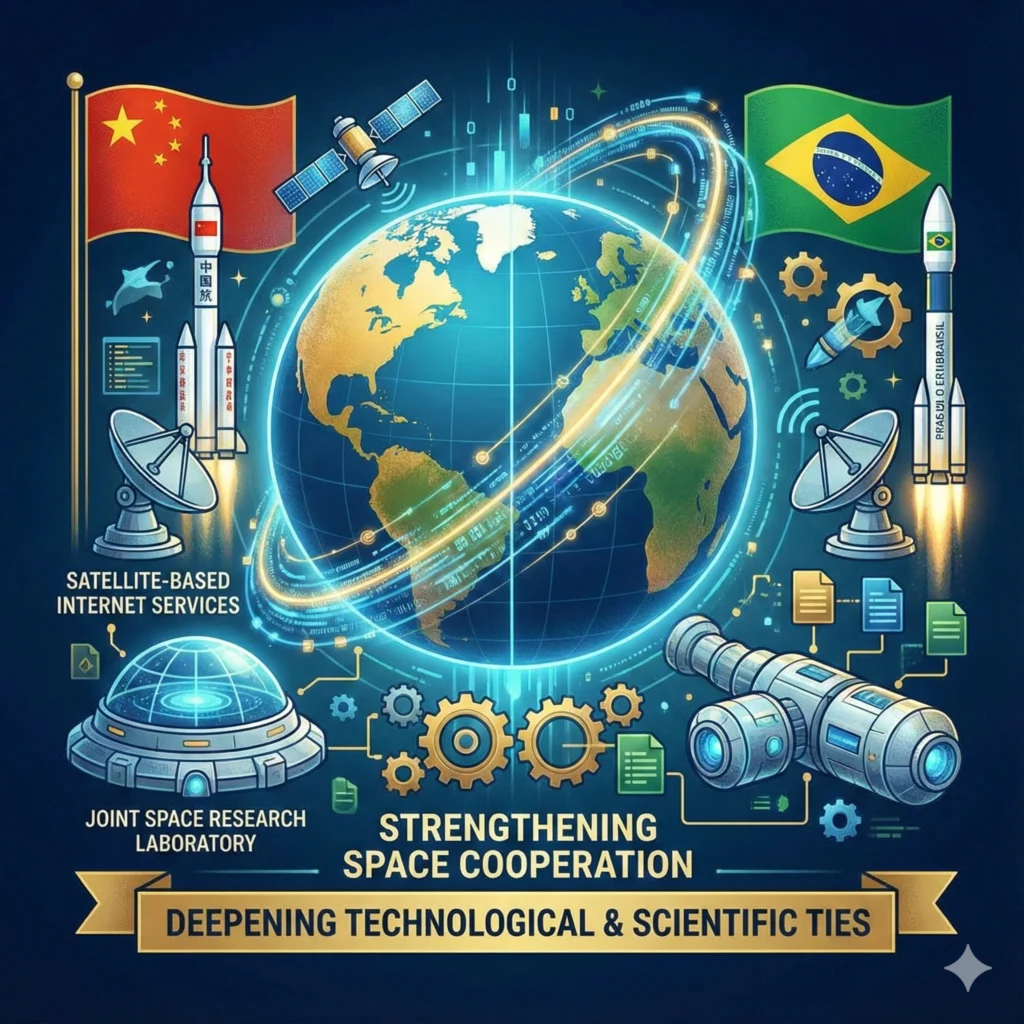
Satellite Internet Expansion Across Brazil
A major milestone in the China Brazil space partnership is the planned rollout of satellite internet in remote regions of Brazil by early 2026. The initiative is being led by China’s low-Earth-orbit (LEO) satellite firm SpaceSail, in partnership with Brazil’s state-owned telecommunications provider Telebras.
The service will target underserved areas, providing connectivity to schools, hospitals, and essential services. SpaceSail’s Qianfan satellite constellation—which has grown to over 100 operational satellites since mid-2024—will support high-speed, low-latency internet coverage across Brazil’s vast and often inaccessible regions. This effort demonstrates the partnership’s focus on leveraging space technology for social and economic development.
Joint Laboratory for Radio Astronomy and Space Research
In addition to satellite internet, the China Brazil space partnership includes the creation of the China–Brazil Joint Laboratory for Radio Astronomy Technology. This facility, established in collaboration with leading Brazilian universities and the China Electronics Technology Group Corporation, aims to advance:
- Astronomical observation and data analysis
- Deep-space exploration projects
- International scientific collaboration and technology transfer
The laboratory is expected to become a hub for cutting-edge research, combining China’s expertise in electronics and space technology with Brazil’s growing academic and research capacity.
Historical Context and Ongoing Cooperation
The new projects build on decades of successful cooperation between the two countries, notably the China–Brazil Earth Resources Satellite (CBERS) program, which has enabled Earth observation, environmental monitoring, and agricultural development since the 1980s. Analysts note that the expansion into satellite internet and joint research represents a natural evolution, emphasizing both applied and scientific benefits.
Implications for Technology, Education, and Regional Development
The China Brazil space partnership carries significant implications for Brazil and the wider Latin American region:
- Technological Advancement: Access to LEO satellite internet and radio astronomy infrastructure strengthens Brazil’s capabilities in space technology.
- Educational Opportunities: Schools and universities in remote regions gain reliable connectivity, enhancing research, digital literacy, and STEM education.
- Scientific Leadership: The joint laboratory positions Brazil as a regional hub for astronomical research and international collaboration.
Experts believe these initiatives also highlight China’s broader strategy to expand global influence through science and technology partnerships, leveraging experience gained from its ambitious domestic space program.
Looking Ahead
The upcoming implementation of satellite internet services and operationalization of the joint laboratory are expected by early 2026. Both nations are committed to continued collaboration, with potential expansions into satellite navigation, climate monitoring, and deep-space scientific projects. The China Brazil space partnership demonstrates how bilateral cooperation can combine economic, social, and scientific objectives, strengthening ties across continents while advancing global space technology.
Source: Global Times
For more regional updates and industry insights, visit our Brazil News Page.