
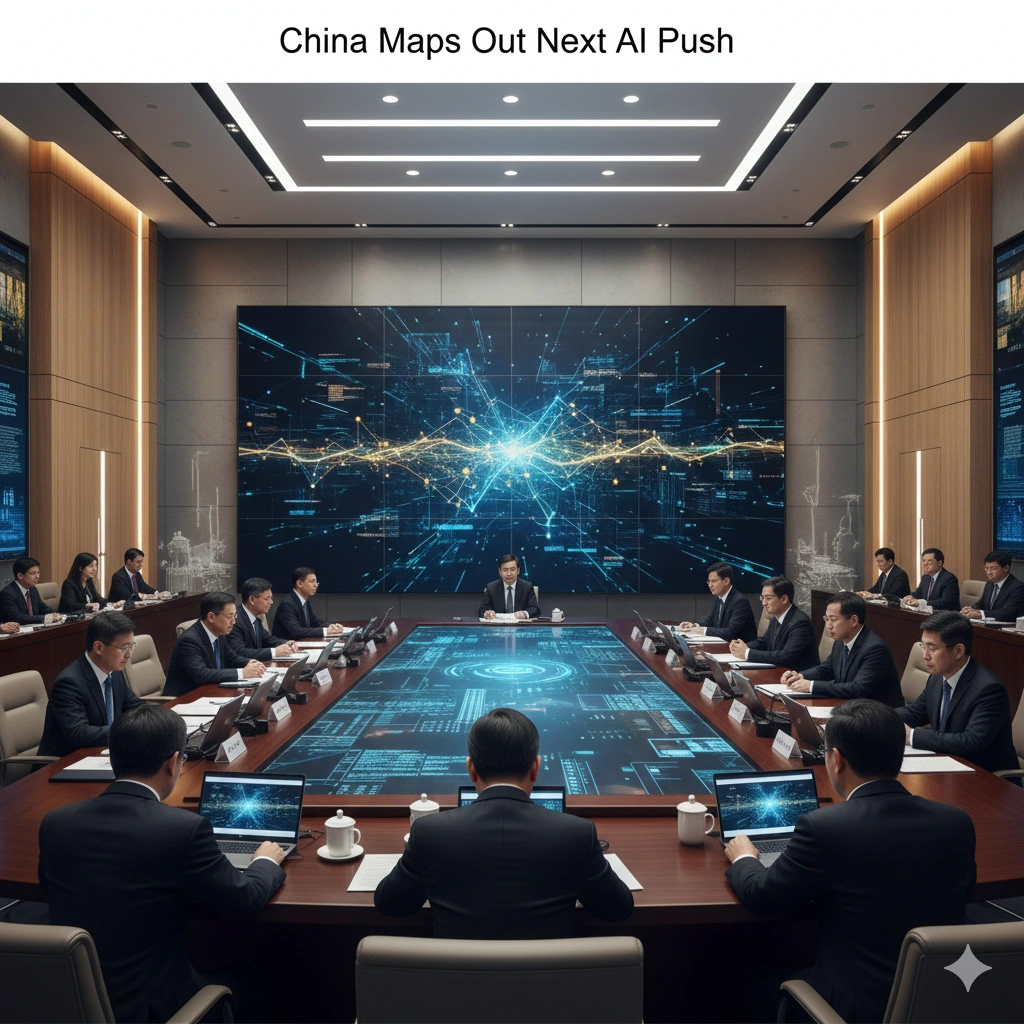
The China AI Development Drive is gaining renewed momentum after Premier Li Qiang urged expanded international technology cooperation and smarter coordination of computing resources to strengthen artificial intelligence growth. Speaking at a State Council group study session, Li stressed that AI must become a powerful engine of high-quality economic development and a foundation for China’s next wave of productive forces.
His remarks underline Beijing’s commitment to positioning artificial intelligence at the core of national modernization strategy.
Strategic Planning to Capture Global AI Trends
Premier Li emphasized that China must accurately assess global AI trends and respond with forward-looking policy frameworks. According to him, the rapid evolution of artificial intelligence demands strategic foresight, especially in emerging technologies that could reshape industries and global competitiveness.
He called for stronger integration between innovation, industrial upgrading, and real-world application. The China AI Development Drive, he argued, must move beyond research achievements and focus on large-scale deployment across sectors.
By doing so, China aims to unlock the full economic and social value of artificial intelligence technologies.
Coordinating Computing Power and National Resources
A major theme of the session was optimizing strategic resources such as data, computing capacity, and electricity supply. Artificial intelligence systems—particularly large-scale models—require vast processing infrastructure.
Li urged better national coordination to prevent resource fragmentation and ensure computing power is efficiently distributed. Strengthening infrastructure connectivity will allow AI enterprises and research institutions to operate more effectively.
This emphasis reflects China’s understanding that AI competitiveness depends not only on innovation but also on robust, scalable infrastructure.
Strengthening AI Governance and Ethical Standards
The China AI Development Drive also includes a renewed focus on governance. Premier Li pressed for refining laws, standards, regulations, and ethical frameworks to manage AI expansion responsibly.
With AI applications spreading rapidly into finance, healthcare, manufacturing, and public services, regulatory clarity has become essential. Li stressed the need to balance rapid innovation with responsible oversight to maintain public trust and ensure long-term sustainability.
Effective governance, he noted, will provide stability for enterprises while protecting national security and data integrity.
Expanding International Technology Exchanges
In a notable move, Li called for broader international technology exchanges, signaling that China intends to remain engaged in global AI collaboration.
Despite growing global technology competition, China aims to foster an open and inclusive environment that supports cross-border research, talent exchange, and industrial partnerships. This outward-looking approach could accelerate innovation while reinforcing China’s global technological presence.
The China AI Development Drive, therefore, combines domestic capacity building with strategic global engagement.
Talent Development and Industrial Transformation
Li also emphasized building a strong and diversified AI talent pipeline. Training professionals with multi-disciplinary skills will be essential to sustaining long-term innovation.
Beyond talent development, he encouraged wider commercial adoption of AI solutions across traditional industries. From manufacturing automation to digital services optimization, large-scale AI deployment is expected to drive productivity gains and economic transformation.
Such industrial upgrading aligns with Beijing’s broader ambition to enhance competitiveness through advanced technology.
High-Level Participation Highlights AI Priority
The session included insights from Zhou Bowen, head of the Shanghai Artificial Intelligence Laboratory, reinforcing the collaboration between policymakers and research institutions. Senior leaders, including Vice Premiers Ding Xuexiang and Zhang Guoqing, along with State Councilor Wu Zhenglong, also attended.
Their participation underscores that artificial intelligence is now a central pillar of China’s national development agenda.
As the China AI Development Drive advances, its impact will likely extend beyond domestic borders. With coordinated infrastructure, improved governance, expanded global engagement, and large-scale deployment, Beijing is positioning AI as a cornerstone of future economic strength.
For more details & sources visit: The Nation (Pakistan)
For more China-related updates, visit our China News page.