
The Caspian Sea naval strike has fundamentally altered the geopolitical landscape of the Middle East and Central Asia, marking the first time Israeli military power has reached into the historically secluded waters shared by Russia and Iran. The Israeli Air Force conducted a high-precision operation against the Iranian port of Bandar Anzali, a critical terminal for the “sanctions-busting” maritime corridor.
This daring mission resulted in the destruction of an Iranian Navy corvette, four missile boats, and a strategic command center. By neutralizing this naval outpost, Israel has directly challenged the primary supply line used to funnel artillery shells, drones, and missile components between Moscow and Tehran. This escalation signals a new phase of the regional war, where logistics hubs previously considered “safe havens” are now active targets.
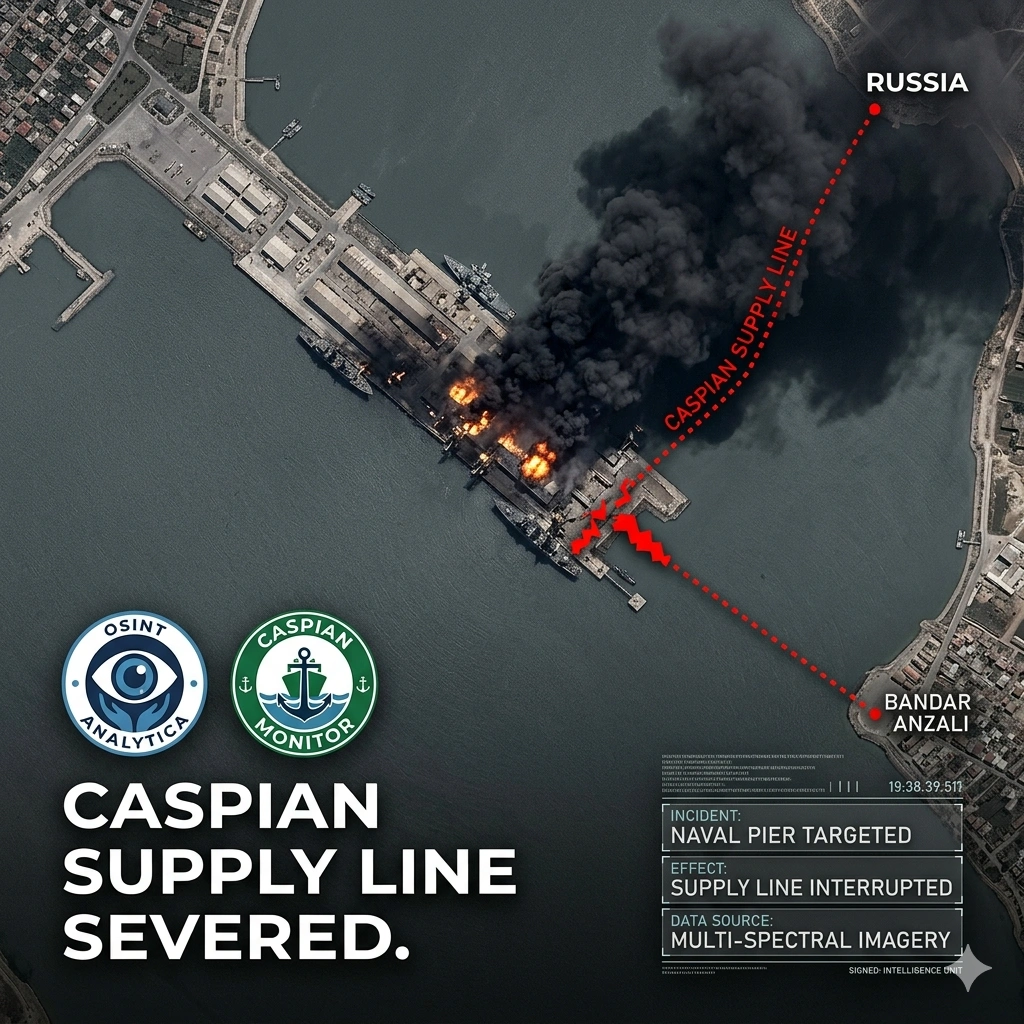
Caspian Sea naval strike and the Bandar Anzali hub
The Caspian Sea naval strike focused on the strategic port of Bandar Anzali, which serves as a gateway for military hardware moving toward Russian ports approximately 600 miles to the north. For years, this route remained outside the reach of Western and Israeli intelligence operations, allowing for the discreet transfer of thousands of Shahed-136 drones. These drones have become a staple of both Russian operations in Ukraine and Iranian strikes against U.S. and Israeli interests. The destruction of the ship repair facility at the port ensures that the Iranian Navy’s operational capacity in the Caspian will be hindered for months, if not years.
Intelligence reports highlighted by the Wall Street Journal indicate that cargo volumes through this specific route had tripled over the past year. This surge in activity was characterized by a “blending” strategy, where military shipments were hidden within civilian vessels carrying wheat, oil, and construction materials. The Caspian Sea naval strike was designed to unmask this smuggling operation and demonstrate that no maritime corridor is immune to intervention. The precision of the attack suggests that Israeli forces had access to real-time telemetry and high-level internal intelligence regarding the port’s daily operations.
The geopolitical significance of the Caspian Sea naval strike extends to the Kremlin, which has long viewed these waters as its own “backyard.” By striking a Russian-linked logistics hub, Israel is sending a clear message that it will no longer tolerate the flow of Iranian weaponry to Russian forces. The Kremlin’s immediate condemnation of the attack as an “unacceptable risk” to Russian personnel highlights the sensitivity of this specific maritime theater. This incident forces Russia to reconsider its defensive posture in the Caspian, which has historically been a low-priority zone for air defense compared to its Western borders.
Disrupting the Russia-Iran military corridor
The Caspian Sea naval strike is a direct attempt to degrade the military-industrial capacity of the “axis of resistance.” The corridor between Russia and Iran has become a lifeline for both nations as they face crushing international sanctions. Russia provides Iran with advanced satellite technology and aircraft components, while Iran reciprocates with the mass production of low-cost suicide drones and artillery ammunition. Breaking this cycle of mutual support is a primary objective for Israel as it seeks to contain Iranian influence across Eurasia.
Military analysts suggest that the Caspian Sea naval strike utilized advanced long-range drones or stealth aircraft capable of bypassing regional radar networks. The logistics required to strike a target 600 miles deep into the Caspian are immense, involving multiple mid-air refuelings or covert launch platforms. This capability proves that Israel has expanded its “war between wars” doctrine to include any geography that facilitates the arming of its enemies. The destruction of the missile boats at Bandar Anzali also prevents Iran from enforcing its maritime claims in the northern waters during this period of high tension.
- Target: Bandar Anzali naval outpost and repair facility.
- Assets Destroyed: 1 Corvette, 4 Missile Boats, 1 Command Center.
- Strategic Goal: Disruption of the Shahed-136 drone supply chain.
- Distance: Approximately 600 miles from the nearest Russian ports.
The economic impact of the Caspian Sea naval strike will also be felt in the shipping industry. Insurance premiums for vessels operating in the Caspian are expected to skyrocket, making the “sanctions-busting” route significantly more expensive for both Moscow and Tehran. This financial pressure complements the physical destruction of the hardware, creating a two-pronged assault on the logistics of the war. As shipping companies reassess the safety of Bandar Anzali, the volume of military transfers is likely to see a sharp, albeit temporary, decline.
Implications for Russian-Israeli relations
The Caspian Sea naval strike represents a historic low point in the diplomatic relationship between Jerusalem and Moscow. For years, the two nations maintained a “deconfliction” agreement in Syria, allowing Israel to strike Iranian targets while avoiding Russian assets. However, the direct targeting of a route essential to Russia’s war efforts in Ukraine suggests that this agreement is effectively dead. The Kremlin’s warning about spillover risks indicates that Russia may feel compelled to provide Iran with more advanced air defense systems to protect their shared logistics.
Despite the harsh rhetoric from the Kremlin, Russia’s ability to retaliate is limited by its heavy involvement in the European theater. The Caspian Sea naval strike exploits this overextension, forcing Russia to choose between protecting its domestic interests or supporting its Iranian allies. If Russia chooses to escalate, it could lead to direct friction between Israeli and Russian forces in other parts of the world, such as the Mediterranean or the Red Sea. The international community is watching closely to see if Moscow will move beyond verbal condemnation to active military intervention.
The visual of the maritime corridor highlights how the Caspian Sea naval strike has cut the “umbilical cord” of the Russia-Iran alliance. For Israel, the risk of a Russian response is outweighed by the immediate necessity of preventing more drones from reaching the hands of Hezbollah or Russian units in Ukraine. This bold move aligns Israel more closely with Western interests, as the destruction of the Bandar Anzali hub directly benefits the defense of Ukraine. The Caspian Sea naval strike is thus a masterstroke of multi-theater strategy.
Caspian Sea naval strike
The Caspian Sea naval strike is the most significant military development in Central Asia in the 2026 calendar year. By bringing the conflict to the shores of the Iranian port of Bandar Anzali, Israel has shown that its reach is truly global. The destruction of the Iranian Navy corvette and missile boats serves as a warning to any nation facilitating the smuggling of advanced weaponry. As the smoke clears over the Caspian, the focus remains on whether Iran and Russia can rebuild this “safe haven” or if it has been permanently compromised.
- First-ever Israeli operation in the Caspian Sea region.
- Destruction of high-value Iranian naval assets.
- Warning to the Kremlin regarding “sanctions-busting” routes.
- Strategic disruption of the global Shahed-136 drone network.
The Caspian Sea naval strike has forced a total re-evaluation of maritime security in the region. Neighboring countries such as Azerbaijan and Turkmenistan are now concerned about the potential for further strikes in their waters. The neutrality of the Caspian, once a given, has been shattered by the realities of modern drone and missile warfare. As long as Iran continues to use the sea for military transfers, the threat of another Caspian Sea naval strike remains a persistent and dangerous reality for all stakeholders.
Technological sophistication of the attack
The technical execution of the Caspian Sea naval strike has left military experts in awe of Israel’s long-range capabilities. Reaching Bandar Anzali requires navigating through complex airspaces while avoiding detection from some of the most advanced radar systems in the world. The use of electronic warfare to “blind” Iranian sensors at the port was likely a key component of the mission’s success. This allowed the strike packages to enter the Caspian, destroy the corvette and missile boats, and exit before the Iranian Air Force could scramble interceptors.
The destruction of the ship repair facility was a particularly surgical move within the Caspian Sea naval strike. By targeting the tools and infrastructure needed to fix ships, Israel has ensured that any vessels not destroyed in the initial blast will remain grounded. This “infrastructure-first” approach is a hallmark of modern Israeli military doctrine, which seeks to achieve long-term denial of capability rather than just short-term attrition. The command center’s destruction also disrupted the local coordination of the smuggling fleet, leading to chaos in the immediate aftermath.
- Use of advanced electronic warfare to suppress local radar.
- Precision targeting of specific naval berths and repair dry-docks.
- Long-range flight paths avoiding traditional detection zones.
- Coordination with satellite intelligence for real-time battle damage assessment.
The Caspian Sea naval strike also highlighted the vulnerability of Iranian naval architecture. The corvette, while modern by regional standards, was unable to defend itself against the incoming ordnance. This disparity in technology is a major concern for Tehran as it attempts to modernize its fleet to protect its maritime interests. The success of the Caspian Sea naval strike may lead Iran to pull its remaining ships deeper into civilian harbors, further complicating the “blending” of military and commercial traffic.
Economic and energy security in the Caspian
The Caspian Sea is not only a military corridor but also a vital hub for global energy and oil exports. The Caspian Sea naval strike has created ripples of concern through the energy markets, as any instability in these waters can impact oil prices. While the strike was targeted specifically at military and smuggling assets at Bandar Anzali, the proximity of energy infrastructure makes the risk of “collateral damage” a major concern for international investors. The Caspian Sea naval strike has added a “war premium” to the cost of doing business in the region.
Many of the vessels used for smuggling weaponry also carry legitimate cargo like wheat and refined petroleum products. The Caspian Sea naval strike has made it difficult for these ships to find crews willing to sail into Bandar Anzali. This disruption of trade is part of a broader strategy to isolate the Iranian and Russian economies. By making the Caspian a “hot” zone, Israel is effectively enforcing a maritime blockade without having to station a single ship in the water. This “phantom blockade” is a highly efficient way to exert pressure on sanctioned regimes.
- Increased insurance rates for all Caspian maritime traffic.
- Slowdown in the delivery of civilian goods due to security checks.
- Potential for retaliatory strikes on energy pipelines in the region.
- Reluctance of international shipping firms to dock at Iranian ports.
The long-term economic consequences of the Caspian Sea naval strike will depend on how quickly Iran can restore confidence in its port security. If the strikes become a regular occurrence, the Bandar Anzali route could be abandoned entirely in favor of much longer and more expensive land-based transport. This shift would put even more strain on the already fragile Russian and Iranian logistics networks. The Caspian Sea naval strike has proven that even the most “secure” routes can be rendered economically unviable through targeted kinetic action.
Retaliatory threats and regional stability
Following the Caspian Sea naval strike, the Iranian government has vowed a “crushing response” against Israeli and American interests in the region. The proximity of the attack to the Russian border has also led to speculation that a joint Iranian-Russian response could be in the works. This could involve increased cyber-attacks, targeting of Israeli commercial shipping in the Indian Ocean, or the use of proxy forces in Lebanon and Syria. The Caspian Sea naval strike has effectively widened the geographic scope of potential retaliation.
Regional stability is at its lowest point in decades as a direct result of the Caspian Sea naval strike. Countries like Azerbaijan, which have a complex relationship with both Israel and Iran, find themselves in an impossible diplomatic position. They must balance their security cooperation with Israel against the potential for Iranian “spillover” attacks on their own territory. The Caspian Sea naval strike has forced every nation on the sea’s border to reconsider their neutrality and their defense budgets.
- Iran may target Israeli-linked tankers in the Persian Gulf.
- Russia could provide “S-400” systems to protect Iranian ports.
- Increased drone activity over the Mediterranean in retaliation.
- Potential for localized border skirmishes between Azerbaijan and Iran.
The international community’s response to the Caspian Sea naval strike has been divided. While many Western nations privately welcome the disruption of the drone supply chain to Russia, they publicly express concern over the risk of a wider war. The United Nations has called for restraint from all parties to prevent the Caspian from becoming a permanent combat zone. However, as the Caspian Sea naval strike proves, the time for diplomatic restraint may have already passed as the major powers prepare for a prolonged and expanded conflict.
Environmental risks of naval warfare in the Caspian
The Caspian Sea is a closed body of water with a sensitive ecosystem that is highly vulnerable to pollution. The Caspian Sea naval strike, which involved the sinking of several ships and the destruction of a repair facility, has likely released significant amounts of oil and hazardous chemicals into the water. Unlike the open ocean, the Caspian has no way to “flush out” these pollutants, meaning the environmental impact of the strike could last for decades. This is a major concern for the local fishing industries and the sturgeon populations that provide the world with caviar.
Environmental agencies are currently attempting to assess the extent of the damage following the Caspian Sea naval strike. Satellite imagery shows oil slicks originating from the destroyed corvette and missile boats at Bandar Anzali. If the ship repair facility contained large quantities of industrial solvents or heavy metals, the contamination could spread across the southern Caspian coast. This environmental tragedy is an often-overlooked cost of the regional war that impacts the livelihoods of millions of innocent civilians living on the sea’s shores.
- Sinking of the corvette released thousands of gallons of diesel fuel.
- Destruction of the repair facility likely leaked heavy metals into the harbor.
- Disruption of the sturgeon breeding grounds in the southern Caspian.
- Long-term impact on the water quality for coastal Iranian cities.
The Caspian Sea naval strike serves as a reminder that modern warfare has no geographical or environmental boundaries. The “sanctions-busting” route was chosen because of its isolation, but that same isolation makes it an ecological disaster waiting to happen during a kinetic engagement. As the military powers continue to target maritime hubs, the protection of the Caspian’s unique biodiversity is becoming a secondary concern to the demands of national security. The Caspian Sea naval strike is as much an environmental warning as it is a military one.
Strategic shift in Israeli military doctrine
The Caspian Sea naval strike represents a fundamental shift in how Israel views its “long-arm” capabilities. Historically, the Israeli Air Force focused on threats in its immediate neighborhood, such as Lebanon, Syria, and Gaza. However, the 2026 campaign has seen strikes in Yemen, Iraq, and now the Caspian Sea. This “global reach” doctrine is designed to intercept threats at their source, before they can ever reach Israeli borders. The Caspian Sea naval strike is the most extreme example of this proactive defense strategy.
By carrying out the Caspian Sea naval strike, Israel has demonstrated that it is no longer willing to wait for international sanctions to take effect. Instead, it is using kinetic power to enforce its own “red lines” regarding the proliferation of Iranian technology. This shift toward unilateral enforcement has significant implications for international law and the role of the United Nations. The Caspian Sea naval strike shows that in the current era of regional conflict, military action is often the first, rather than the last, resort for ensuring national survival.
- Shift from regional defense to global interception of threats.
- Use of unilateral kinetic force to enforce non-proliferation.
- Demonstration of “over-the-horizon” technical and tactical mastery.
- Re-definition of “safe zones” for Iranian and Russian logistics.
The success of the Caspian Sea naval strike will likely embolden Israeli planners to look at other distant targets that facilitate the “axis of resistance.” This could include training facilities in Central Asia or financial hubs in the far east. The Caspian Sea naval strike has proven that if a target is connected to the Iranian military machine, it is within range of the Israeli Air Force. This new reality is something that every commander from the Mediterranean to the Caspian must now account for in their strategic planning.
Conclusion and the future of the Caspian route
The Caspian Sea naval strike has permanently changed the strategic calculus of the Russia-Iran alliance. The “safe haven” of Bandar Anzali has been compromised, and the flow of drones and missiles to the front lines has been significantly disrupted. While Iran and Russia will undoubtedly attempt to repair the damage and find new ways to bypass the blockade, the psychological impact of the Caspian Sea naval strike cannot be undone. Israel has proven that it can strike anywhere, at any time, to protect its interests and those of its allies.
As the region moves forward from the Caspian Sea naval strike, the focus will be on the potential for further escalation and the ecological recovery of the sea. The 130,000 refugees fleeing Lebanon and the strikes on military clinics in Anbar are all part of the same interconnected conflict that has now reached the Caspian. The Caspian Sea naval strike is a grim milestone in this unfolding tragedy, a symbol of a world where the rules of war are being rewritten in real-time. The eyes of the world remain on the Caspian, watching for the next move in this high-stakes game of global security.
In finality, the Caspian Sea naval strike stands as a testament to the devastating precision of modern military technology. It is a story of strategic brilliance and humanitarian and environmental risk, all occurring in a body of water that the world had almost forgotten. As the year 2026 continues to be defined by this “great regional war,” the strike on Bandar Anzali will be remembered as the moment the conflict truly lost its boundaries. The Caspian is no longer a sea of isolation; it is a sea of war.
For more details & sources visit: The Wall Street Journal
Read more about Russia news on 360 News Orbit – Russia