
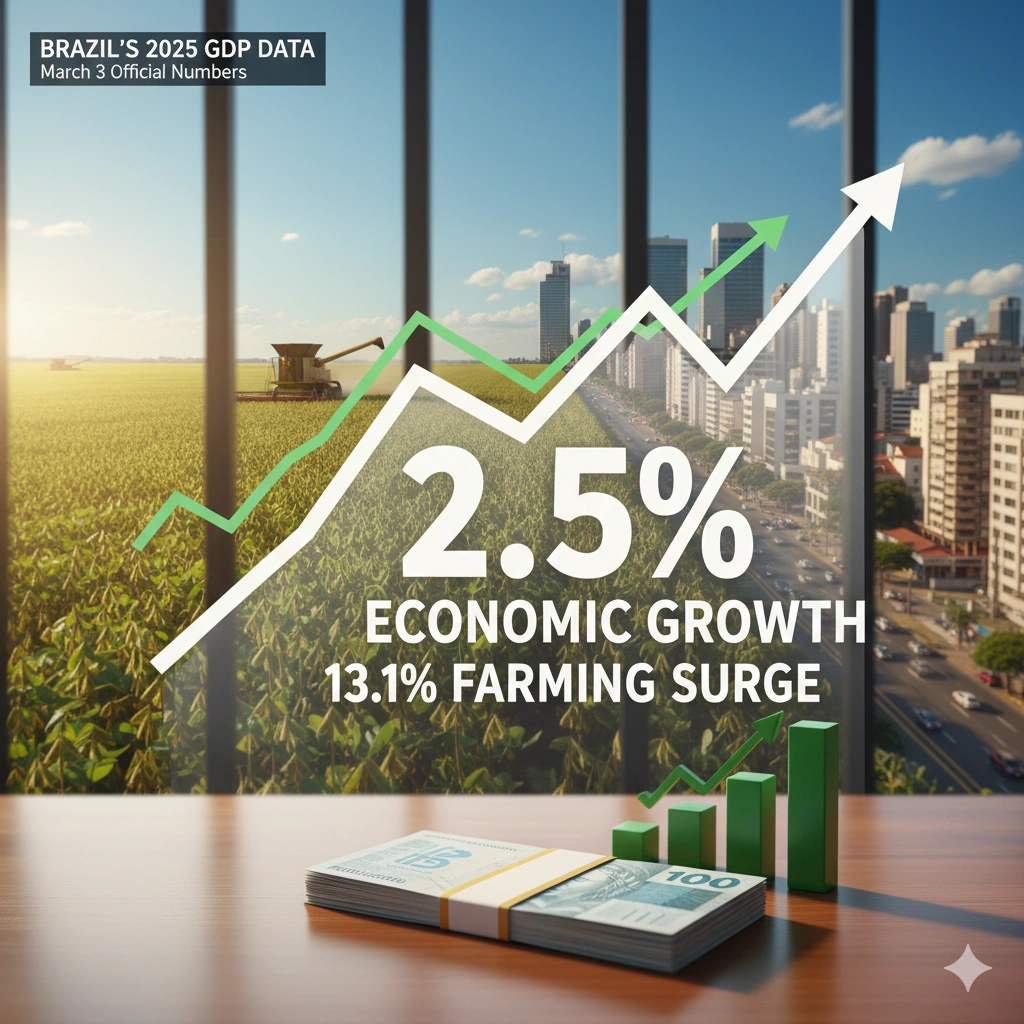
Brazil Economic Growth 2025 reflects a resilient performance as the nation navigates a complex financial landscape. The Central Bank’s IBC-Br index recently confirmed that the economy expanded by 2.5% over the past year, surpassing many initial forecasts from top financial analysts. This growth was largely anchored by a massive surge in the agricultural sector, which managed to offset slower performance in the industrial and service departments. As the official GDP data approaches in early March, the narrative of a farming-led recovery continues to dominate the headlines.
The internal dynamics of the Brazilian markets suggest that while high interest rates have dampened consumer spending, the export-heavy agricultural industry remains a powerhouse. Investors are looking at the Brazil Economic Growth 2025 figures as a sign that the country can maintain stability even under tight monetary policy. The Selic rate, currently sitting at a multi-decade high, has been a significant hurdle for many domestic businesses. However, the sheer volume of crop yields and international demand has provided a necessary cushion for the broader economy.
Brazil Economic Growth 2025 is a critical metric for the government as it weighs the timing of future interest rate cuts. With the inflation cycle showing signs of cooling, the Central Bank is under increasing pressure to ease the financial burden on the private sector. The 2.5% expansion provides enough of a safety net to suggest that the economy is not in immediate danger of a recession. Instead, the data points toward a period of moderation where the focus shifts from rapid expansion to sustainable long-term stability across all sectors.
The Agricultural Surge of 2025
The primary engine behind the Brazil Economic Growth 2025 was a staggering 13.1% increase in farming output throughout the year. This boom was driven by favorable weather conditions in key growing regions and a significant uptick in global commodity prices. Brazil continues to solidify its position as a leading global exporter of soy, corn, and beef, which brings in vital foreign currency. Without this specific sector’s performance, the overall economic picture would have looked much more subdued for the South American giant.
Economists note that the agricultural sector’s contribution is what allowed the IBC-Br index to top the 2.3% forecasts seen earlier in the fourth quarter. While other industries struggled with the high cost of credit, farmers were able to leverage their strong export positions to maintain high levels of production. This divergence between the “green” economy and the urban industrial centers is a defining characteristic of the Brazil Economic Growth 2025. It highlights a structural reliance on the land that remains the backbone of the nation’s financial health.
The ripple effects of this farming success are felt in the logistics and transportation industries, which saw increased demand for moving goods to ports. Even though the broader service sector showed signs of fatigue, the specific niche of agricultural services remained highly active. This interconnectedness ensures that a win in the fields translates to gains in various other parts of the national infrastructure. Consequently, the Brazil Economic Growth 2025 story is one of a singular sector lifting the spirits of an entire country’s financial outlook.
Brazil Economic Growth 2025
The Central Bank’s proxy for GDP, the IBC-Br index, serves as the most reliable early indicator of the Brazil Economic Growth 2025. By blending data from industry, services, and tax revenues, it provides a comprehensive snapshot of the country’s pulse before the official March announcement. The fact that the index ended the year on a high note, despite a slight dip in December, suggests that the underlying fundamentals are stronger than many feared. It indicates that the tightening cycle of 450 basis points has successfully curbed inflation without causing a total collapse.
Market participants are now focusing on how the Brazil Economic Growth 2025 will influence the Selic rate trajectory in the coming months. Most analysts believe that the current 15% rate is at its peak and that the first cuts could arrive as early as next month. The stabilization of the economy at 2.5% growth provides the Central Bank with the confidence to pivot toward a more accommodative stance. This shift is expected to revitalize the industrial sector, which has been the primary laggard in the recent economic reports.
The quarterly data for the final three months of the year showed a seasonally adjusted growth of 0.4%, which was a pleasant surprise for many. This late-year momentum suggests that the Brazil Economic Growth 2025 was not just a result of a strong start but also a resilient finish. While December saw a 0.2% monthly decline, this was far better than the deeper contractions that some bearish economists had predicted. It shows that the Brazilian consumer is still active, albeit more cautious with their spending habits given the current credit environment.
Monetary Policy and High Interest Rates
One of the most significant challenges to the Brazil Economic Growth 2025 was the aggressive stance of the Central Bank to fight rising prices. The Selic rate being held at 15% represents one of the highest real interest rates in the world, which naturally puts pressure on investment. Despite this “tight” policy, the economy managed to grow, which speaks to the efficiency of the productive sectors. Many businesses had to find ways to innovate and cut costs to remain profitable while debt servicing became increasingly expensive.
The 450-basis-point hike cycle that ended in July was a necessary bitter pill to ensure that the Brazil Economic Growth 2025 was built on a foundation of stable prices. Had inflation spiraled out of control, the nominal growth figures would have been meaningless in terms of real purchasing power. Now that the cycle has halted, the narrative is shifting toward how much and how fast the rates will come down. This anticipation is already starting to improve sentiment in the stock market and among large-scale industrial planners.
According to reports from Pantheon Macroeconomics, the stabilization seen in the IBC-Br data is exactly what the Central Bank needed to see. The Brazil Economic Growth 2025 confirms that the “soft landing” scenario is the most likely outcome for the country. There is a general consensus that the worst of the monetary tightening is over, and the focus for 2026 will be on recovery. This transition period is vital for ensuring that the broad moderation seen in non-agricultural sectors does not turn into a permanent stagnation.
Industrial and Service Sector Performance
While agriculture was the star, the industrial sector’s contribution to the Brazil Economic Growth 2025 was notably more muted. Manufacturing faced headwinds from high energy costs and reduced domestic demand for durable goods. However, even in this environment, certain niche industries related to export processing managed to hold their own. The lack of broader industrial growth is the main reason why the non-agricultural GDP growth stood at a more modest 1.8% for the year.
The service sector, which typically accounts for a large portion of the national economy, also showed signs of slowing during the Brazil Economic Growth 2025 cycle. High credit costs have made it difficult for small and medium enterprises to expand their operations or hire new staff. Nevertheless, the digital economy and fintech sectors in Brazil continue to be a bright spot, attracting international venture capital. These modern industries are helping to diversify the economy, even if they aren’t yet large enough to rival the impact of the agricultural giants.
To achieve a more balanced Brazil Economic Growth 2025, the government is looking at new infrastructure projects and tax reforms. The goal is to reduce the “Brazil Cost”—the logistical and bureaucratic hurdles that make doing business in the country difficult. If these reforms can gain traction in the coming year, the 2026 outlook for industry and services could improve significantly. For now, the reliance on the primary sector remains the dominant theme for any serious economic analysis of the region.
- The agricultural sector grew by 13.1%, far outpacing other industries.
- Total GDP growth of 2.5% beat the initial conservative 2.0% estimates.
- Industrial growth remained flat or slightly negative in certain key states.
- Foreign direct investment remained stable despite high domestic interest rates.
Global Market Influence on Brazil
The Brazil Economic Growth 2025 was heavily influenced by the performance of China and the United States, Brazil’s two largest trading partners. Strong demand for iron ore and protein from Asian markets helped keep the export balance in a healthy surplus. This external demand is a key pillar of the Brazil Economic Growth 2025, as it provides the hard currency needed to service international debt. The volatility of the Real against the Dollar also played a role in making Brazilian exports more competitive on the global stage.
Global commodity cycles are often the deciding factor for the Brazil Economic Growth 2025, regardless of domestic political shifts. As long as the world needs food and raw materials, Brazil’s primary sectors will continue to provide a baseline for growth. However, economists warn that relying too heavily on commodities can lead to “Dutch Disease,” where the rest of the economy suffers. Finding the right balance between natural resource wealth and high-tech industrialization is the long-term challenge for Brazilian policymakers.
Recent data from international trade monitors suggests that Brazil is also expanding its reach into new markets in the Middle East and Africa. This diversification of trade partners is a strategic move to insulate the Brazil Economic Growth 2025 from localized economic shocks in any single region. By selling beef and grain to a wider array of nations, Brazil is building a more resilient export engine. This forward-thinking approach is one reason why the 2025 numbers managed to beat the consensus estimates of global banks.
Future Projections for 2026 and Beyond
As we move past the Brazil Economic Growth 2025, the attention of the market is shifting toward the 2026 forecast. Most economists are eyeing a GDP growth rate of around 2.3% for the next year, assuming that interest rates begin their downward journey. The 2025 performance has set a high bar, especially for the agricultural sector, which may face tougher year-over-year comparisons. If the weather remains cooperative, however, there is no reason to believe that the farming boom will suddenly end.
The sustainability of the Brazil Economic Growth 2025 will depend on the government’s ability to manage its fiscal deficit. High interest rates have made the cost of government borrowing very expensive, which limits the funds available for public investment. If the administration can prove it is serious about fiscal responsibility, it will pave the way for lower long-term rates. This, in turn, would provide a massive boost to the Brazil Economic Growth 2025 momentum as it carries over into the next fiscal year.
- Analysts expect a gradual easing of the Selic rate starting in March.
- Inflation is projected to stay within the Central Bank’s target range.
- Infrastructure spending is likely to increase ahead of the next election cycle.
- Domestic consumption is expected to rebound as credit becomes cheaper.
The Role of Domestic Consumption
In previous years, domestic consumption was the main driver of the economy, but for the Brazil Economic Growth 2025, it took a backseat to exports. The high cost of borrowing for cars, appliances, and homes meant that many Brazilian families had to tighten their belts. Retailers reported a shift in consumer behavior, with a greater focus on essential goods and a decline in luxury spending. This internal moderation is actually what helped keep inflation in check during the Brazil Economic Growth 2025 period.
As interest rates begin to fall, the pent-up demand from the Brazil Economic Growth 2025 era is expected to be unleashed. Banks are already preparing new credit products to entice consumers back into the market for big-ticket items. This expected surge in domestic demand will be the perfect complement to the ongoing agricultural strength. If both internal and external engines are firing at the same time, Brazil could see a very strong performance in the latter half of 2026.
The labor market also showed surprising resilience during the Brazil Economic Growth 2025, with unemployment staying at historically low levels. This stable employment helped prevent a deeper slowdown in the service sector, as people still had wages to spend on basics. The quality of jobs, however, remains a point of contention for many labor unions and social advocates. Improving productivity and wage growth will be essential to ensure that the Brazil Economic Growth 2025 benefits all levels of society.
Technical Analysis of the IBC-Br Index
For those diving into the data, the IBC-Br index provides a wealth of information about the Brazil Economic Growth 2025. It is a seasonally adjusted series that allows for direct comparisons between different months and quarters. The fact that the Q4 growth was 0.4% shows that the economy had more “carry-over” than anticipated. This technical strength is a positive signal for the March 3rd official GDP release, which uses a slightly different methodology but usually follows the same trend.
The December dip of 0.2% in the IBC-Br was largely attributed to a temporary slowdown in industrial production and some year-end inventory adjustments. Most market observers are viewing this as a minor blip rather than a sign of a new downward trend. When looking at the full year of Brazil Economic Growth 2025, the trajectory is clearly positive. The index has proven to be a reliable proxy that helps businesses and investors plan their capital allocations with a higher degree of certainty.
- The index reached its highest point in mid-2025 during the harvest season.
- Tax revenue collections were slightly higher than expected due to efficient auditing.
- The service sector components of the index remained flat throughout the second half.
- Industrial weakness was most pronounced in the heavy machinery and automotive sectors.
Impact of Global Interest Rates
The Brazil Economic Growth 2025 did not happen in a vacuum; it was also influenced by the Federal Reserve’s actions in the United States. As global rates remained higher for longer, capital tended to flow toward “safer” Dollar-denominated assets. This put pressure on the Brazilian Real and forced the local Central Bank to keep rates high to prevent capital flight. The interconnectedness of global finance means that Brazil Economic Growth 2025 is always partially at the mercy of decisions made in Washington and Frankfurt.
Fortunately, as the global inflation wave began to recede, the pressure on the Real started to ease toward the end of the year. This gave the Brazilian authorities more room to breathe and plan for the eventual easing cycle. The Brazil Economic Growth 2025 is a story of successful navigation through these international waters. By keeping the economy growing at 2.5%, Brazil has shown that it can compete for global capital even when the stakes are high.
Investors are now looking at Brazil as an attractive destination for “carry trade” and long-term equity investments. The combination of solid growth, high yields, and a stable currency makes for a compelling case. The success of the Brazil Economic Growth 2025 has effectively put the country back on the radar for many emerging market funds. This influx of capital will be vital for funding the next generation of Brazilian startups and infrastructure projects.
Conclusion and Official GDP Outlook
As we await the official March 3rd numbers, the consensus is clear: the Brazil Economic Growth 2025 was a triumph of the agricultural sector over high interest rates. The 2.5% figure is a testament to the resilience of the Brazilian economy and its ability to adapt to changing global conditions. While the road ahead will require careful management of the Selic rate and fiscal spending, the foundation is solid. The “Green Giant” has once again proven that it can carry the weight of the nation’s economic aspirations.
The broad moderation in non-agricultural sectors is a reminder that there is still work to be done to ensure a balanced recovery. However, with the cooling of inflation and the expected pivot in monetary policy, the outlook for 2026 is cautiously optimistic. The Brazil Economic Growth 2025 will be remembered as the year when the fields saved the cities, providing the necessary stability for the next phase of growth. For now, the focus remains on celebrating a result that beat the odds and defied the skeptics.
Final confirmation of these trends will come when the government releases its detailed breakdown of consumer spending and government investment. These sub-components will give a clearer picture of where the strengths and weaknesses of the Brazil Economic Growth 2025 truly lie. Until then, the IBC-Br data stands as the definitive record of a year that exceeded expectations. Brazil is moving forward, and its economic heart continues to beat strong in the face of adversity.
For more details & sources visit: Reuters
For more regional updates and industry insights, visit our Brazil News Page.