
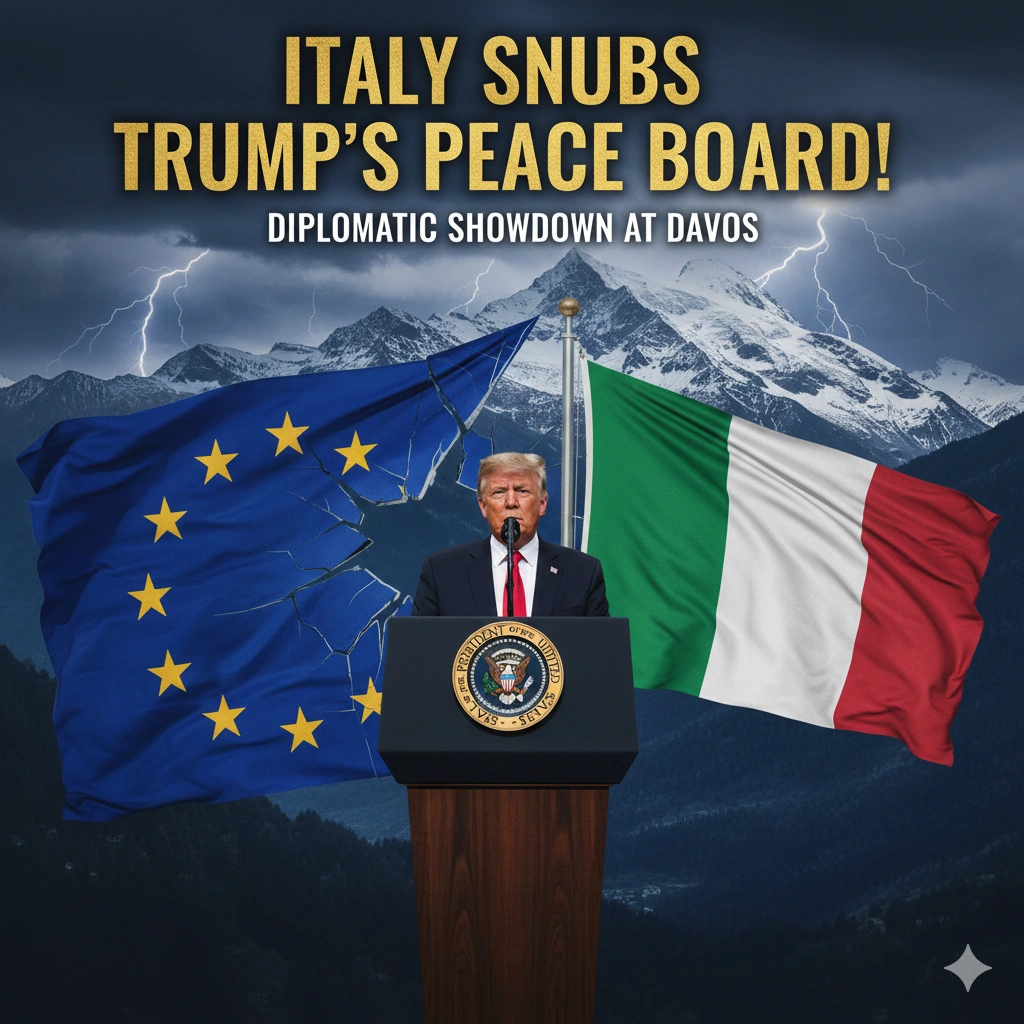
Italy has officially rejected U.S. President Donald Trump’s proposed Board of Peace, triggering debate across Europe over constitutional integrity, global governance, and the future of multilateral diplomacy. Despite cordial relations between Prime Minister Giorgia Meloni and President Trump, Rome’s refusal highlights deep legal and political concerns surrounding the structure and authority of the initiative.
The Board of Peace was unveiled at the World Economic Forum in Davos in January 2026 and promoted as a new international body aimed initially at rebuilding Gaza before expanding its mandate to other global conflict zones. While the proposal attracted interest from several countries, Italy concluded that participation would violate its constitutional principles and undermine established international institutions.
1. Constitutional Limits on Unequal International Bodies
Italy’s primary objection centers on constitutional provisions that prohibit participation in international organizations where member states do not operate on equal footing. According to reporting by Corriere della Sera, the Board of Peace requires a $1 billion payment to secure a permanent seat, effectively granting disproportionate influence to wealthier nations.
Italian officials argue that this financial threshold creates an unequal governance model incompatible with Italy’s constitutional framework, which emphasizes parity, sovereignty, and democratic accountability in international cooperation.
2. Concentration of Power Under Trump’s Lifetime Chairmanship
Another major concern is the governance structure of the Board of Peace itself. Under its proposed charter, President Trump would serve as lifetime chair, holding decisive authority over the organization’s actions.
Even resolutions passed by majority vote would require Trump’s personal approval to take effect. Additionally, executive leadership appointments would be made directly by him. Italian policymakers view this level of centralized control as fundamentally at odds with democratic norms and modern multilateral governance.
3. Risk of Undermining the United Nations
Italian diplomats have also warned that the Board of Peace could function as a parallel institution to the United Nations, potentially weakening the legitimacy and authority of existing global frameworks.
Rather than strengthening international cooperation, critics fear the initiative could fragment peacekeeping and reconstruction efforts, replacing consensus-based decision-making with executive discretion. French officials have reportedly voiced similar concerns, describing the Board’s structure as a threat to national sovereignty and institutional balance.
4. Diplomatic Signals and Meloni’s Strategic Absence
Prime Minister Giorgia Meloni’s decision to skip the Board of Peace’s inaugural ceremony was widely interpreted as a deliberate diplomatic signal. While Meloni has maintained pragmatic relations with Trump, her absence reinforced Italy’s stance that constitutional obligations outweigh political alliances.
Rome’s position also reflects broader European Union solidarity, prioritizing collective diplomatic norms over unilateral or financially driven initiatives.
5. Fractures in Trump’s European Coalition
Italy’s refusal exposes growing divisions within President Trump’s efforts to build a Europe-aligned coalition around the Board of Peace. While Hungary and Israel have openly embraced the initiative, and countries such as the United Arab Emirates, Egypt, and Pakistan have shown interest, key European powers remain cautious or opposed.
By rejecting what critics describe as a “cash-for-influence” model, Italy has reaffirmed its commitment to equal-footing diplomacy and rule-based international order.
Broader Implications for Global Governance
Italy’s decision sends a clear message: peace initiatives must be grounded in transparency, shared authority, and established international law. While the Board of Peace may appeal to nations seeking swift reconstruction mechanisms, Rome maintains that durable peace cannot be achieved through centralized power or financial leverage alone.
As debates continue, Italy’s stance underscores the enduring tension between populist-driven global initiatives and traditional multilateral institutions.