
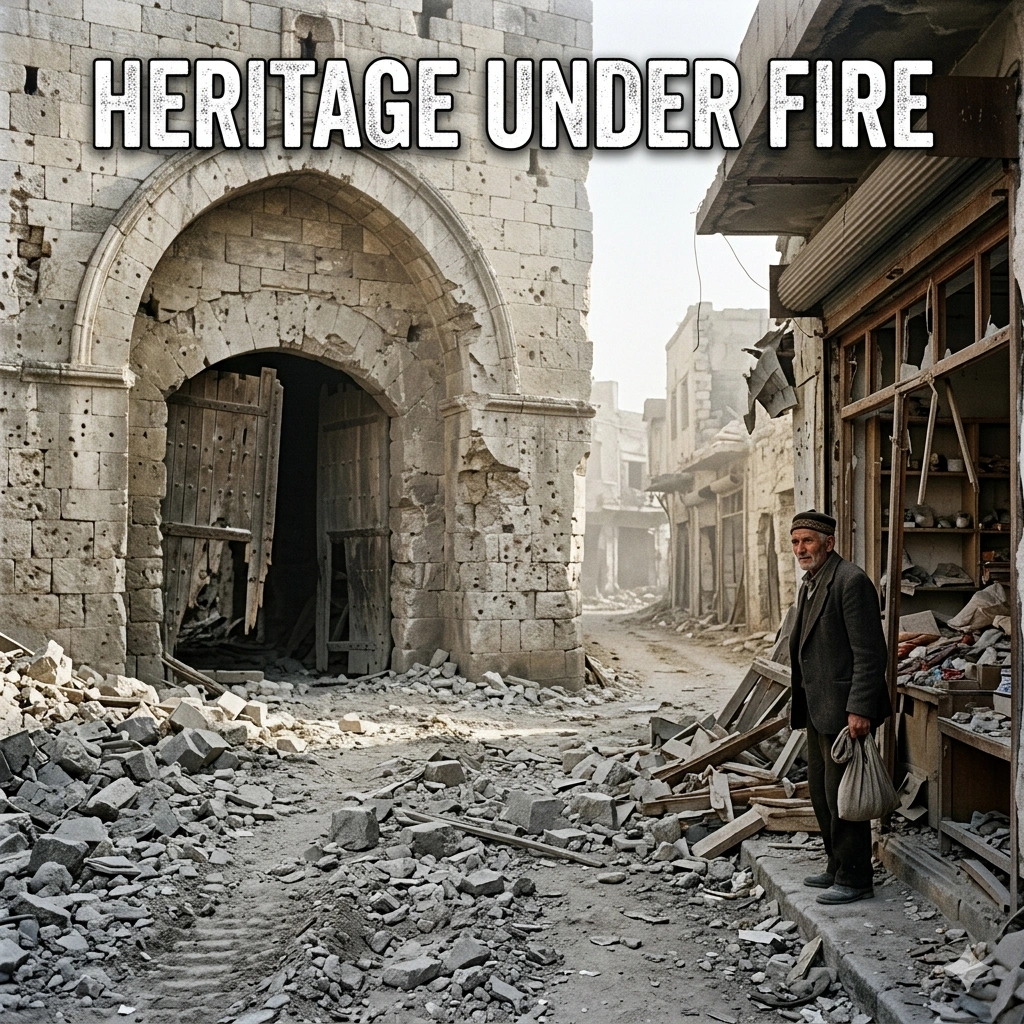
Barquq Castle Destruction has become a somber symbol of the cultural toll taken by the ongoing conflict in Gaza. Reports confirm that the 14th-century fortress, which stood as the architectural heart of Khan Younis for over six centuries, has suffered devastating damage. This site was not merely a military relic but the foundational landmark that gave the city its historical identity and served as a backdrop for the region’s most vibrant commercial life.
The impact of the Barquq Castle Destruction extends far beyond the crumbling stone walls of the 1387 Mamluk structure. The surrounding Grain Market, once famous for its labyrinthine alleys and the intoxicating scent of traditional spices, has been reduced to a landscape of dust and debris. For the residents of Khan Younis, the loss of these sites represents a systematic dismantling of their heritage, leaving a haunting silence where generations of families once gathered to prepare for holidays and daily life.
The 1387 Legacy and Barquq Castle Destruction
Barquq Castle Destruction marks the potential end of a legacy that began during the Mamluk era under Sultan Barquq. Built as a caravanserai to protect traders traveling between Cairo and Damascus, the castle was the reason the city of Khan Younis exists today. Its massive stone gates once welcomed travelers and merchants, serving as a sanctuary for commerce and culture. The recent military strikes have targeted the very heart of this history, threatening to erase a physical link to the 14th century that survived countless previous conflicts.
The architectural significance of the site made the Barquq Castle Destruction a global concern for historians and archaeologists. Experts argue that the intricate masonry and the historic layout of the fortress provided invaluable insights into medieval Islamic fortifications. With the walls now breached and the internal structures collapsing, the “weight of history” that residents once felt has been replaced by the crushing weight of modern warfare. This loss is viewed by many as an irreparable blow to Palestinian cultural heritage that can never be fully restored to its original glory.
Vanishing Markets Following Barquq Castle Destruction
The immediate vicinity of the fortress has always been home to the Grain Market, which is now a casualty of the Barquq Castle Destruction. This market was the economic engine of the old city, where spice merchants and grain sellers operated stalls that had often been in their families for decades. Today, the vibrant colors of the holiday displays have been replaced by the gray tones of pulverized concrete. The aromatic atmosphere that defined the childhoods of thousands of residents has vanished, leaving only the smell of smoke and stagnant dust.
- The Grain Market served as the primary hub for local food security and staples.
- Pre-Eid traditions, once central to the market’s calendar, have been entirely disrupted.
- Merchants who operated for over 40 years have seen their livelihoods buried in rubble.
- The physical connection between the castle and the market created a unique urban ecosystem.
Barquq Castle Destruction
The Barquq Castle Destruction has forced local traders like 60-year-old Nahed Barbakh to navigate a landscape they no longer recognize. Barbakh, who has spent his entire life in the shadow of the castle, reports that the bustling crowds of shoppers have been replaced by a few desperate passersby. The sense of community that the market fostered was inextricably linked to the presence of the castle. Without the landmark to anchor the district, the social fabric of the historic center is rapidly unravelling under the pressure of the occupation’s strikes.
The psychological impact of the Barquq Castle Destruction is profound, as the site was a source of local pride and resilience. Seeing the 600-year-old stones shattered by modern missiles has left many residents in a state of deep mourning. They describe the destruction not just as a loss of property, but as an assault on their collective memory. The castle was a silent witness to the city’s endurance, and its current state reflects the unprecedented severity of the current military campaign in the Gaza Strip.
Cultural Heritage Risks and Barquq Castle Destruction
International heritage organizations are sounding the alarm over the Barquq Castle Destruction and the wider pattern of damage to Gaza’s ancient sites. The 1954 Hague Convention for the Protection of Cultural Property in the Event of Armed Conflict is frequently cited by activists who claim these strikes are a violation of international norms. The Barquq Castle Destruction is not an isolated incident; it follows the damage of several other mosques, libraries, and archaeological sites across the territory, leading to fears of a total “cultural erasure.”
The struggle to document the Barquq Castle Destruction is hindered by the ongoing danger on the ground. Archaeologists are unable to reach the site to stabilize the remaining walls or salvage artifacts from the debris. Every day that the conflict continues, the risk of further collapse increases due to structural instability and environmental exposure. Preserving what remains of the Mamluk heritage in Khan Younis has become a race against time that local authorities are currently losing.
Economic Collapse Linked to Barquq Castle Destruction
The economic fallout of the Barquq Castle Destruction is devastating for the small-scale entrepreneurs who relied on the heritage tourism and local foot traffic. The Grain Market was not just a place of history; it was a place of survival. With the shops destroyed, the supply chains for essential goods in Khan Younis have been broken. This has led to a spike in prices for the few remaining items available, further exacerbating the humanitarian crisis facing the displaced population.
- Small business owners have lost their entire inventory to the strikes.
- The absence of the Grain Market has intensified local food shortages.
- Repairing the commercial district will cost millions that the local economy does not have.
- Many traders are now forced to operate out of temporary tents or carts.
Barquq Castle Destruction
A haunting silence now defines the area where the Barquq Castle Destruction occurred. Before the conflict, this was the loudest and most energetic part of Khan Younis, filled with the calls of vendors and the haggling of customers. Now, the only sounds are the occasional drone overhead and the crunch of glass underfoot. This shift from vibrancy to desolation is the most visible result of the Barquq Castle Destruction, serving as a constant reminder of the war’s reach into the deepest parts of Palestinian life.
The loss of the “spice scent” is a detail mentioned by many residents when discussing the Barquq Castle Destruction. It symbolizes the death of the sensory experience of their home. The market was a place where history was felt, smelled, and tasted. By destroying the physical structures, the strikes have also attacked the sensory heritage of the city. This intangible loss is just as significant to the community as the fallen stones of the 14th-century fortress.
Irreparable Damage and Barquq Castle Destruction
There is a growing fear that the Barquq Castle Destruction may be irreparable due to the specialized nature of Mamluk architecture. Modern construction techniques cannot easily replicate the hand-carved stone and ancient mortar used in 1387. Furthermore, the sheer scale of the ruins means that a full reconstruction would require international expertise and materials that are currently barred from entering the Gaza Strip. The Barquq Castle Destruction might leave a permanent scar on the skyline of Khan Younis.
- Ancient building materials are nearly impossible to source in a conflict zone.
- The lack of structural blueprints makes authentic restoration a major challenge.
- Future generations may only know the castle through photographs and stories.
- The site’s status as a commercial hub may be lost forever even if the war ends.
Global Outcry Over Barquq Castle Destruction
The Barquq Castle Destruction has sparked an outcry on social media and in diplomatic circles. Cultural advocates argue that the targeting of such a clearly defined non-military historical site is a tragedy for all of humanity. The Barquq Castle Destruction is being used as a case study for the “urbicide” taking place in Gaza—the deliberate destruction of a city’s soul and history to make it uninhabitable for its people.
The Al Jazeera report highlighting the Barquq Castle Destruction has brought international attention to the plight of the Khan Younis merchants. These individuals are the living link to the castle’s history, and their displacement is part of the broader catastrophe. As the world watches, the Barquq Castle Destruction stands as a testament to the fragility of human history in the face of modern explosive power. The consensus among experts is that the world is witnessing a “dark age” for Palestinian archaeology.
Barquq Castle Destruction
Despite the rubble, some residents are attempting to preserve the memory of the site following the Barquq Castle Destruction. Local youth have been seen photographing the ruins and collecting small fragments of stone to keep as mementos. This grassroots effort to document the Barquq Castle Destruction shows a refusal to let the city’s history be forgotten. However, without a formal ceasefire and a massive heritage intervention, these individual acts of preservation can only do so much to counter the physical reality of the destruction.
The Barquq Castle Destruction has also impacted the religious life of the city, as the castle was adjacent to several ancient prayer spaces. The disruption of the Grain Market meant that religious festivals, which were always celebrated in the shadow of the fortress, have lost their traditional home. The Barquq Castle Destruction has thus affected the spiritual, economic, and historical life of Khan Younis simultaneously, creating a vacuum that will be difficult to fill even in a post-war environment.
Tactical Impact of Barquq Castle Destruction
From a tactical perspective, the Barquq Castle Destruction has altered the urban layout of old Khan Younis. The debris from the castle and the Grain Market has blocked essential access routes for emergency services and aid trucks. The Barquq Castle Destruction has essentially turned a once-navigable commercial district into a graveyard of stone and steel. This makes the delivery of humanitarian aid to the surrounding neighborhoods even more difficult, adding a physical layer to the suffering caused by the strikes.
- Emergency vehicles cannot pass through the narrow, debris-filled alleys.
- The collapse of the castle walls has created new hazards for remaining residents.
- Search and rescue operations in the Grain Market ruins are nearly impossible.
- The destruction has removed landmarks that people used for navigation.
Future of Khan Younis and Barquq Castle Destruction
The future of Khan Younis is now inextricably linked to the Barquq Castle Destruction. Any plan for the “day after” the war must include a strategy for the restoration of the old city and its markets. Without the Barquq Castle Destruction being addressed through careful reconstruction, the city will lose its historical heart forever. The challenge will be to balance the need for modern housing with the requirement to preserve the Mamluk identity that the Barquq Castle Destruction has so violently interrupted.
International donors will need to prioritize heritage sites alongside hospitals and schools if the cultural identity of Gaza is to survive. The Barquq Castle Destruction serves as a reminder that a people’s resilience is tied to their history. By rebuilding the castle and the Grain Market, the international community could help restore a sense of dignity and continuity to the survivors of Khan Younis. For now, the Barquq Castle Destruction remains a wide, open wound in the middle of a suffering city.
Final Assessment of Barquq Castle Destruction
In the final assessment, the Barquq Castle Destruction is one of the most significant cultural losses of the 21st century in the Middle East. The 1387 fortress was a bridge between the medieval and modern worlds, a bridge that has now been broken. The Grain Market was the lifeblood of the community, and its ruin is a tragedy for every merchant who once called it home. The Barquq Castle Destruction is a stark warning of what happens when the “weight of history” is ignored in favor of military objectives.
The haunting silence in Khan Younis today is the most eloquent testimony to the Barquq Castle Destruction. It is a silence that speaks of lost traditions, broken lives, and the disappearance of a 600-year-old sanctuary. Until the stones are raised again and the scent of spices returns to the alleys, the Barquq Castle Destruction will stand as a symbol of an era where history was sacrificed to the fire of conflict. The world must acknowledge the Barquq Castle Destruction as a loss for all who value the enduring story of human civilization.
Conclusion of the Barquq Castle Destruction Report
The report on the Barquq Castle Destruction concludes with a call for the immediate protection of remaining heritage sites. The 14th-century fortress and its markets were the soul of Khan Younis, and their current state is a global tragedy. The Barquq Castle Destruction must be documented, analyzed, and eventually addressed through an international effort that recognizes the importance of Palestinian culture. For the people of Gaza, the Barquq Castle Destruction is not just about old stones; it is about the very ground they stand on and the air they breathe.
As the conflict continues, the memory of the castle before the Barquq Castle Destruction remains a beacon of hope for those who wish to see the city restored. The resilience of the merchants like Nahed Barbakh suggests that while the structures can be broken, the spirit of the Grain Market lives on in the people. The Barquq Castle Destruction is a dark chapter, but it is not the final one. The story of Khan Younis has lasted since 1387, and its inhabitants are determined to see it continue long after the dust of the current strikes has settled.
For more details & sources visit: Al Jazeera
For the latest updates from Palestine, visit our Palestine news page.