
Bahrain sustainability agenda priorities are increasingly being framed not as environmental add-ons, but as core economic strategy. At a major regional forum in Manama, Bahraini officials underscored how climate policy, investment alignment, and technological innovation are being positioned to strengthen national competitiveness and deliver measurable growth outcomes.
The message from policymakers was clear: sustainability is now integral to Bahrain’s economic resilience, fiscal stability, and long-term development planning.
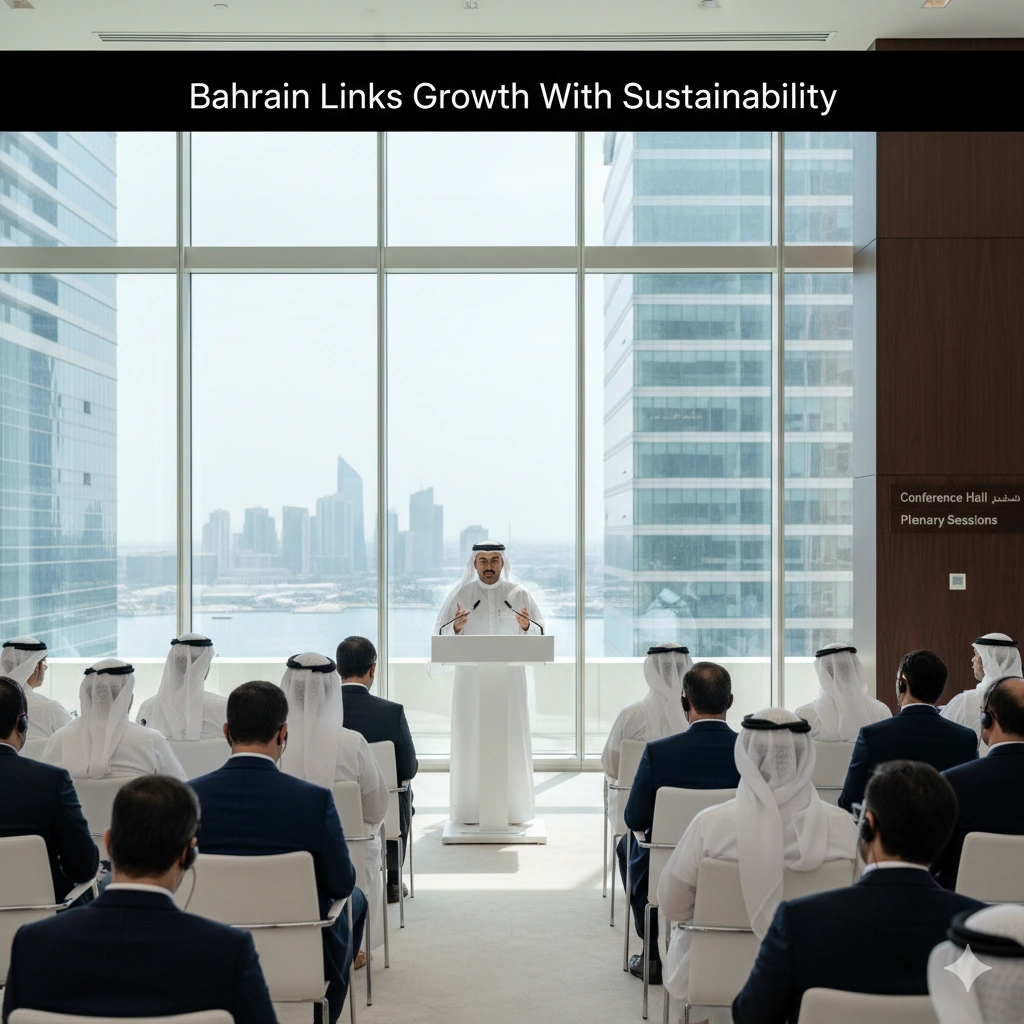
Sustainability and Growth Linked at Policy Level
Speaking at the opening of the fourth Sustainability Forum Middle East, Bahrain’s Oil and Environment Minister and Special Envoy for Climate Affairs, Dr Mohamed bin Mubarak Bin Daina, described the kingdom’s approach as deliberately “balanced.” According to the minister, the Bahrain sustainability agenda seeks to integrate environmental responsibility with economic development rather than treating the two as competing objectives.
The forum, held at the Four Seasons Hotel Bahrain Bay, attracted more than 650 participants, including:
- Cabinet-level officials
- Regional policymakers
- Business leaders and investors
- International climate and finance experts
Discussions focused on how governments can align regulation, markets, and innovation to convert climate ambition into tangible economic value.
GCC Climate Strategy Reinforces Regional Alignment
The Bahrain sustainability agenda is unfolding within a broader Gulf Cooperation Council (GCC) shift toward embedding climate action into economic policy. GCC Secretary-General Jasem Mohamed Al Budaiwi told delegates that sustainability is no longer peripheral to Gulf economies but increasingly embedded in diversification strategies.
He emphasized that:
- Regional cooperation is essential to accelerate climate progress
- Shared frameworks can reduce duplication and improve efficiency
- Sustainability policies are becoming a source of competitive advantage
For Bahrain, this regional alignment strengthens its ability to attract investment, participate in cross-border initiatives, and scale climate-related projects.
Financing and Investable Projects Take Center Stage
A recurring theme at the forum was the need to move from policy declarations to execution. Dr Mahmoud Mohieldin, the UN Special Envoy on Financing Sustainable Development, highlighted that the success of the Bahrain sustainability agenda will depend heavily on mobilizing capital and building credible pipelines of investable projects.
Key priorities discussed included:
- Climate-transition financing frameworks
- De-risking mechanisms to crowd in private capital
- Market-based tools to support decarbonisation and resilience
Mohieldin stressed that sustainability-linked growth requires not only ambition, but delivery capacity—clear regulations, bankable projects, and institutional coordination.
Technology, Regulation, and Delivery Capacity
Panels and workshops at the forum explored how technology adoption and regulatory clarity can accelerate implementation of the Bahrain sustainability agenda. Topics ranged from energy transition pathways and climate markets to digital tools that support emissions tracking and reporting.
Participants emphasized that:
- Technology must be matched with policy certainty
- Regulatory alignment reduces investor risk
- Implementation capacity is as important as strategy
Several partnership agreements were also signed during the event, signaling an intent to translate dialogue into concrete action.
Sustainability as Economic Competitiveness
Bahrain’s positioning reflects a growing recognition that sustainability can enhance, rather than constrain, economic performance. By aligning climate goals with industrial policy, investment promotion, and workforce development, the Bahrain sustainability agenda is being framed as a lever for long-term competitiveness.
This approach supports:
- Economic diversification beyond hydrocarbons
- Greater resilience to climate and market shocks
- Stronger integration into global sustainability standards
Officials argue that countries able to demonstrate credible sustainability frameworks will be better placed to attract global capital and maintain trade competitiveness.
Conclusion: Bahrain Sustainability Agenda Moves From Vision to Execution
The Bahrain sustainability agenda is entering a more pragmatic phase, focused on alignment, innovation, and implementation. As highlighted at the Sustainability Forum Middle East, Bahrain is seeking to convert climate ambition into economic opportunity by linking policy, finance, and technology.
While challenges remain—particularly around financing scale-up and execution—the kingdom’s strategy signals a shift toward sustainability as a foundational pillar of growth and resilience. If momentum is maintained, Bahrain’s approach could serve as a regional model for integrating climate action with economic strategy.
For more details, see the full report via Zawya
For more news, visit 360 News Orbit