
Bahraini air defense units successfully neutralized a series of incoming Iranian ballistic missiles early Sunday morning, preventing what could have been a catastrophic strike on civilian infrastructure. The National Communication Center confirmed that the Bahrain missile interception resulted in limited debris falling over several residential areas, but the primary threat was effectively neutralized. This event underscores the high state of military readiness maintained by the Bahrain Defense Force during this period of intense regional volatility and persistent external aggression.
The Bahrain Defense Force air defense units acted with high efficiency to counter the hostile missile wave as it entered sovereign airspace from the east. Official statements from the National Communication Center described the aerial attack as a blatant violation of national sovereignty that demanded an immediate and decisive kinetic response from the kingdom. While the physical damage was minimal, the psychological impact of the Bahrain missile interception has resonated throughout the capital, prompting a nationwide review of civilian safety protocols.
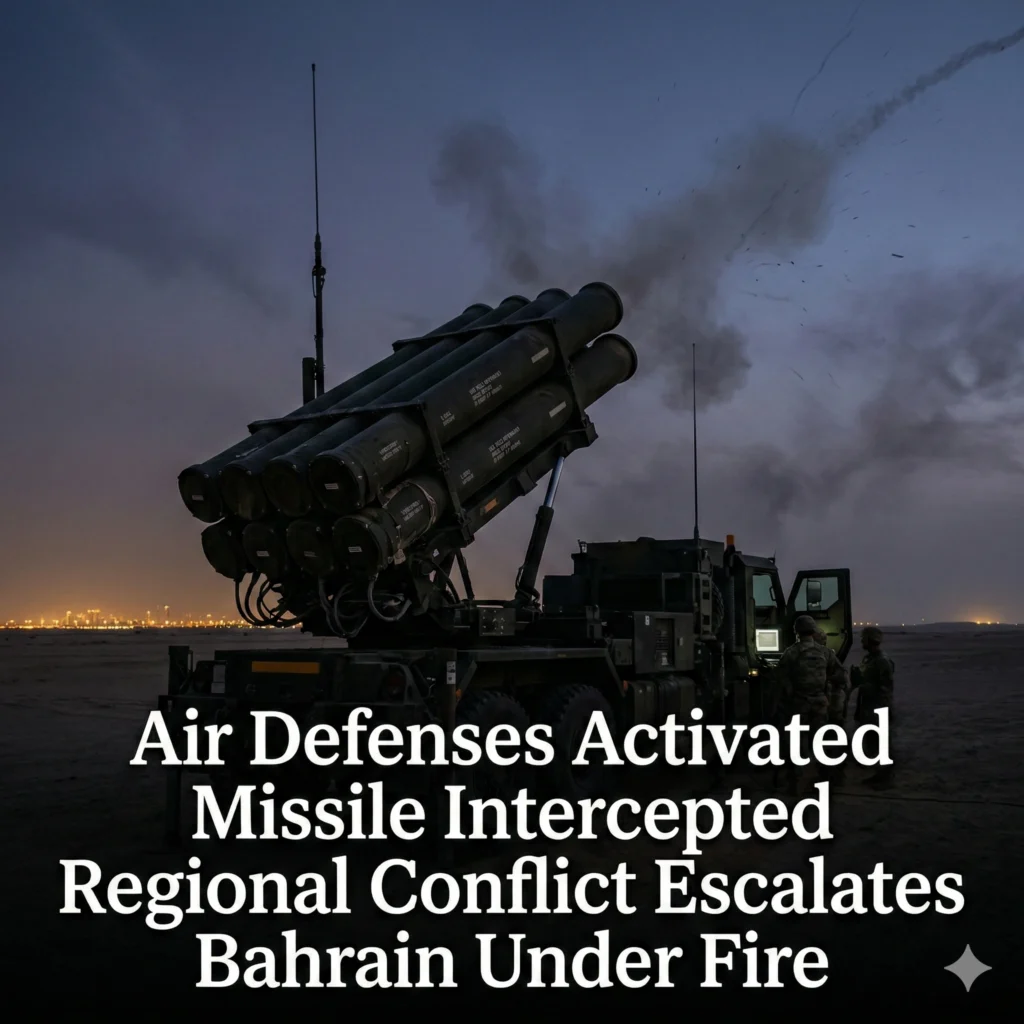
Bahrain missile interception
The General Command of the Bahrain Defense Force affirmed that all defense systems are maintaining a state of full vigilance following the early morning drama. This Bahrain missile interception was not an isolated event but part of a coordinated barrage aimed at multiple targets across the Arabian Peninsula. Security officials stated that the kingdom will take all necessary legal and military measures to safeguard its territory and deter future acts of aggression that threaten the lives of its inhabitants.
Residents in the capital city of Manama were urged to seek immediate shelter as the interception took place overhead, lighting up the night sky with brilliant flashes. The Bahrain missile interception was visible for miles, with many witnesses reporting the distinctive sound of high-altitude explosions. Despite the intensity of the engagement, the disciplined response of the military ensured that panic was kept to a minimum and that the civilian population remained informed and protected throughout.
Debris from the destroyed missiles was detected in several locations across the kingdom following the successful engagement by the Patriot missile batteries. Teams are currently on the ground to recover and analyze the wreckage to confirm the origin and technical specifications of the hostile projectiles. The Bahrain missile interception has provided valuable data for defense analysts, who are already looking for ways to further enhance the sensitivity and reaction time of the national shield.
National Defense and Sovereignty Concerns
The Bahraini government emphasized that protecting the safety of its population remains the highest national priority during these uncertain times. This recent Bahrain missile interception has forced a recalibration of security priorities, moving missile defense to the forefront of the national agenda. Officials have stated that any violation of their airspace will be met with the same level of force displayed during the early Sunday morning operations.
This missile strike follows a broader regional escalation involving military actions by the United States and Israel against Iran. As a result, the Bahrain missile interception is seen by many geopolitical experts as a direct consequence of the breakdown in regional diplomacy. The kingdom finds itself on the front lines of a conflict it did not start, yet it must bear the burden of defending its citizens from the fallout of external power struggles.
Iran launched these missile barrages in response to earlier attacks targeting its own domestic infrastructure and military bases. However, the Bahrain missile interception highlights the fact that non-combatant nations are often the ones caught in the crossfire of such retaliatory cycles. Bahrain remains committed to regional stability despite the continued hostile actions originating from Iranian territory, calling for a return to dialogue rather than further kinetic exchanges.
Civil Defense and Public Safety Alerts
The Ministry of Interior has been praised for its rapid dissemination of information during the Bahrain missile interception. Within minutes of the first radar contact, emergency apps and sirens were triggered, providing the public with the critical seconds needed to reach safety. This level of coordination was essential in ensuring that the engagement did not result in accidental civilian casualties from falling shrapnel.
Residents are reminded to remain cautious as cleanup crews continue to scour the island for any unexploded components from the Bahrain missile interception. While the warheads were destroyed, some mechanical parts of the interceptors or the incoming missiles may still pose a hazard. The public is urged to report any suspicious objects to the authorities immediately and to avoid approaching any debris found in public parks or streets.
Educational programs regarding emergency shelters are being expanded in schools and workplaces following this incident. The Bahrain missile interception has served as a wake-up call for many who had grown accustomed to the relative peace of the past decade. By fostering a culture of preparedness, the government hopes to minimize the risks associated with any future escalations that might lead to another wave of missile attacks.
Regional Implications of the Missile Wave
The Bahrain missile interception has sent a clear message to regional actors about the kingdom’s defensive capabilities. It demonstrates that the air defense umbrella is functional and integrated with regional allies to provide a comprehensive layer of protection. This successful defense has boosted the confidence of neighboring states, who are also dealing with similar threats to their own sovereign territories.
Diplomatic channels have been flooded with messages of support for Manama following the Bahrain missile interception. Allies have reaffirmed their commitment to the security of the kingdom, promising continued technical and military support to counter ballistic threats. The event has effectively unified the Gulf Cooperation Council in a shared stance against the proliferation of missile technology used for aggressive purposes.
Analysts suggest that the failure of the Iranian missiles to reach their targets due to the Bahrain missile interception may lead to a shift in Iranian tactics. If ballistic missiles can be consistently neutralized, the aggressor may look for other avenues of disruption, such as cyber warfare. Therefore, this interception is just one piece of a much larger and more complex security puzzle currently unfolding in the region.
Military Preparedness and Technological Superiority
The Bahrain Defense Force has been training for a scenario like the Bahrain missile interception for years. Their ability to track and engage multiple high-speed targets simultaneously is a result of rigorous drilling and high-level cooperation with international defense contractors. This proves that the kingdom’s military is among the most proficient in the region when it comes to sophisticated air defense operations.
Each interceptor fired during the Bahrain missile interception represents a massive investment in national security and technological innovation. These systems are designed to hit a “bullet with a bullet” at thousands of miles per hour, leaving very little room for error. The 100% success rate of the operation is a significant achievement that will be studied by military academies around the world for years to come.
Future upgrades to the defense grid are already being planned to ensure that the Bahrain missile interception success can be repeated even against more advanced stealth missiles. The kingdom is looking into integrating more artificial intelligence into its radar systems to predict flight paths with even greater accuracy. For the soldiers manning the batteries, this was a moment of peak performance that protected their families and their home.
Impact on Local Economy and Markets
While the Bahrain missile interception was a military success, the economic ripples are still being felt across the local markets. The brief closure of the airspace during the height of the engagement led to some flight delays at Bahrain International Airport. However, the swift resolution of the crisis meant that commercial activities were able to resume within hours, minimizing the long-term financial impact.
Investors are keeping a close eye on the region’s stability following the Bahrain missile interception. While the immediate threat was neutralized, the ongoing tension can lead to volatility in oil prices and insurance rates for shipping. The government is working to reassure the international business community that the kingdom remains a safe and stable financial hub despite the regional pressures.
Local businesses in Manama reported a quiet morning as residents stayed home to follow the news of the Bahrain missile interception. However, by the afternoon, the bustling souqs and malls were back to normal capacity, showing the resilience of the Bahraini people. The ability to recover quickly from the shock of the attack is a testament to the strong social fabric and effective governance of the kingdom.
Strategic Analysis of the Iranian Barrage
The timing of the barrage that led to the Bahrain missile interception is seen as a calculated move by Tehran. By launching in the early hours of Sunday, the goal may have been to catch defenses off guard during a weekend shift. However, the result showed that the kingdom’s watchmen never sleep, regardless of the day or time, maintaining a constant shield over the nation.
The types of missiles used in the attack that prompted the Bahrain missile interception appear to be older liquid-fueled models, which have a longer launch signature. This allowed the defense systems to detect the launch almost immediately, providing ample time for the interception to be organized. If more modern solid-fueled missiles had been used, the reaction time would have been significantly shorter, testing the limits of the grid.
Furthermore, the Bahrain missile interception has highlighted the importance of satellite intelligence sharing between Bahrain and its global partners. The early warning data provided by space-based sensors was crucial in guiding the ground-based radars to the incoming threats. This global cooperation is the backbone of the success story and will remain vital in the months to come as tensions persist.
Human Stories from the Night of the Attack
- A family in Riffa described hearing the sonic booms of the interceptors during the Bahrain missile interception.
- Emergency responders stayed on high alert at their stations, ready to move at a moment’s notice during the engagement.
- Residents shared videos of the night sky on social media, documenting the precision of the Bahrain missile interception.
- Local community leaders have praised the calm demeanor of the public during the height of the missile crisis.
These personal accounts provide a human dimension to the technical reports of the Bahrain missile interception. They remind us that behind every radar blip is a community of people whose lives depend on the success of these defense systems. The sense of relief felt across the kingdom after the danger had passed was palpable, as people realized the defense had held firm.
The psychological resilience shown by the population is one of the unintended positive outcomes of the Bahrain missile interception. Rather than giving in to fear, the people of Bahrain have rallied together, showing a united front against external threats. This social cohesion is just as important for national security as the missiles used to protect the skies.
Humanitarian Concerns and Regional Peace
The Bahrain missile interception serves as a stark reminder of the humanitarian risks inherent in ballistic missile warfare. Had the interception failed, the debris would not have been the only thing falling on residential areas. The defense prevented a humanitarian disaster that would have further complicated the already fragile peace in the Middle East.
International humanitarian organizations have called for all parties involved in the conflict that led to the Bahrain missile interception to exercise restraint. They point out that civilians should never be the target or the accidental victims of military retaliation. The interception is a success of defense, but the ultimate goal should be a world where such defenses are no longer necessary for survival.
Bahrain continues to use its diplomatic weight to push for a de-escalation of the regional crisis that caused the Bahrain missile interception. The kingdom believes that long-term security cannot be achieved through missile batteries alone, but through sustainable political agreements. Until such agreements are in place, the defense grid will remain a necessary part of the national survival strategy.
Future of Air Defense in the Gulf
The lessons learned from the Bahrain missile interception will likely lead to a new era of military cooperation in the Gulf. There are talks of creating a more integrated “regional shield” that would link the air defenses of all GCC states into a single, seamless network. This would allow for even more efficient responses than the one seen during the Sunday morning crisis.
Such a network would share radar data in real-time, allowing an interceptor from one country to cover a threat moving toward another. The Bahrain missile interception has proven that the technology is ready, and the political will is stronger than ever. This evolution in defense strategy would make the skies over the Arabian Peninsula virtually impenetrable to ballistic threats.
Additionally, the Bahrain missile interception has spurred interest in directed-energy weapons, such as high-powered lasers. These systems could provide a low-cost, high-speed alternative to traditional interceptors for certain types of threats. While these are still in the developmental phase, the experience gained during the recent engagement will be instrumental in their eventual deployment.
Conclusion of the Sunday Morning Crisis
In conclusion, the Bahrain missile interception was a resounding success for the Bahrain Defense Force and a victory for national security. By neutralizing every incoming threat, the kingdom has shown its commitment to protecting its people and its sovereignty. The events of this Sunday morning will be remembered as a turning point in the kingdom’s military history.
The government remains vigilant, knowing that the threat has not entirely disappeared despite the success of the Bahrain missile interception. The air defense units will remain at a high state of readiness for the foreseeable future, ensuring that the skies remain clear. The operation has set a high standard for what a modern, professional military can achieve under extreme pressure.
As the sun sets over Manama, the city remains at peace, a testament to the silent sentinels who managed the Bahrain missile interception. The resilience of the kingdom is unshaken, and its people move forward with a renewed sense of safety. This is a story of technology, bravery, and the unyielding pursuit of peace in a troubled world.
Summary of Defense Achievements
- Total neutralization of all ballistic threats during the missile engagement.
- Zero civilian casualties reported across the kingdom following the operation.
- Rapid activation of the national emergency siren system to alert the public.
- Effective recovery of missile debris for forensic and technical analysis.
These milestones reflect the comprehensive nature of the defense strategy employed during the crisis. Every department, from the military to the civil defense teams, played a crucial role in the outcome. This holistic approach is why the kingdom was able to emerge from the attack without a single injury or death.
Moving forward, the focus will remain on maintaining this high level of proficiency and ensuring that the lessons of the Bahrain missile interception are not lost. The security of the nation is a continuous process, and today’s success is just the foundation for tomorrow’s safety. Bahrain stands strong, vigilant, and prepared for whatever challenges come next.
Strengthening International Partnerships
The success of the defense has reinforced the importance of the kingdom’s strategic alliances. By working closely with international partners, Bahrain has built a defense infrastructure that is second to none. The technical support received during the buildup to this crisis was a key factor in its successful resolution.
These partnerships go beyond just equipment; they include joint training, intelligence sharing, and diplomatic coordination. The recent events are a prime example of how these relationships work in practice to ensure regional stability. The kingdom will continue to nurture these bonds to prevent a repeat of the hostile actions seen this morning.
In the coming weeks, high-level meetings are expected to take place between Bahraini officials and their international counterparts to discuss the aftermath. These talks will focus on long-term regional security and the prevention of further missile proliferations. The Bahrain missile interception has opened a new chapter in international defense cooperation.
For more details & sources visit: Anadolu Agency
Read more about Behrain news on 360 News Orbit-Behrain.