
Bahrain debt crisis pressures are accelerating, prompting the government to roll out one of its most far-reaching fiscal reform packages in years. The measures include permanently linking domestic fuel prices to global markets, introducing a corporate tax on large firms, raising commercial utility tariffs, and cutting public-sector administrative spending. Together, these steps reflect a strategic shift away from short-term fixes toward structural revenue reform as debt servicing costs mount.
Fuel Price Link Signals End to Energy Subsidy Model (H2)
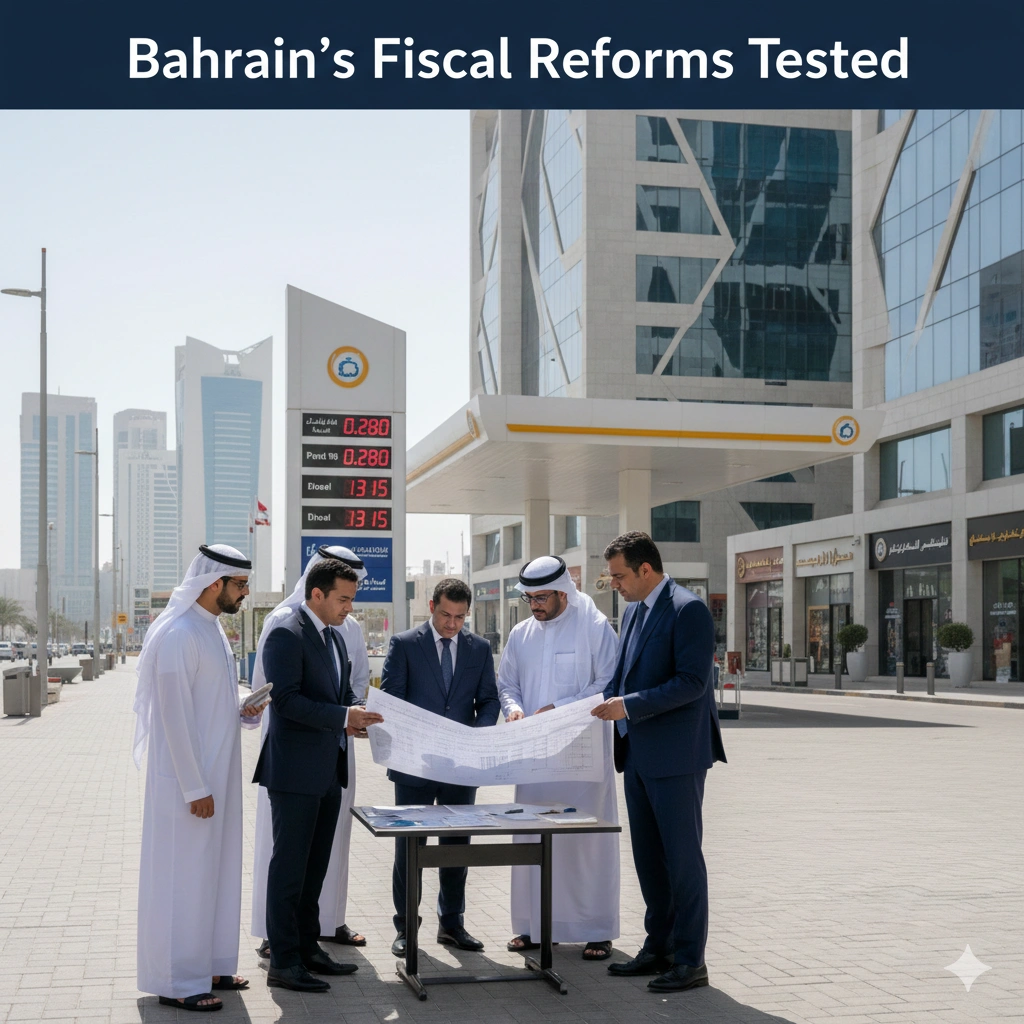
A core element of Bahrain’s response to the Bahrain debt crisis is the permanent linkage of domestic fuel prices to international benchmarks through a monthly adjustment mechanism. This policy removes the discretionary subsidy buffer that previously shielded consumers and businesses from global oil price fluctuations.
Officials and analysts say the move is designed to:
- Reduce persistent fiscal leakages from fuel subsidies
- Improve budget predictability
- Align Bahrain with broader Gulf energy-pricing reforms
By institutionalizing fuel price adjustments, Bahrain is attempting to stabilize revenues while reducing the long-term burden of subsidized consumption.
Corporate Tax Marks Structural Revenue Shift (H2)
Another major pillar of the reform package addressing the Bahrain debt crisis is the planned introduction of a 10% corporate tax on larger companies. While Bahrain has historically marketed itself as a low-tax jurisdiction, rising debt levels have narrowed policy options.
The reform package also includes:
- Higher electricity and water tariffs for commercial users
- A 20% cut in government administrative spending
According to Gulf International Forum analysis, these measures represent a structural transformation of Bahrain’s revenue model rather than temporary crisis management.
IMF Warnings Highlight Fiscal Urgency (H2)
The International Monetary Fund has repeatedly warned that the Bahrain debt crisis is becoming more acute. In its latest assessment, the IMF noted that:
- Bahrain’s fiscal deficit rose to 11% of GDP in 2024
- Government debt exceeded 133% of GDP
- Debt servicing costs are increasingly crowding out development and social spending
The IMF has urged Bahrain to adopt multi-year fiscal consolidation plans, expand corporate taxation, and continue reducing energy subsidies while protecting vulnerable households through targeted support.
Political Risks and Social Sensitivities (H3)
Implementing reforms tied to the Bahrain debt crisis carries significant political risk. Bahrain has previously experienced social unrest during periods of economic pressure, making subsidy reductions and new taxes politically sensitive.
Analysts caution that:
- Rapid cost-of-living increases could trigger public backlash
- Perceptions of unequal burden-sharing may undermine reform credibility
- Poorly targeted reforms could erode social stability
As a result, policymakers face the challenge of sequencing reforms carefully while communicating their necessity and long-term benefits.
Gulf Diversification Context (H3)
Bahrain’s fiscal overhaul mirrors broader Gulf efforts to diversify revenue and reduce dependence on hydrocarbons. In this context, addressing the Bahrain debt crisis is not only about fiscal survival but also about economic modernization.
Key objectives include:
- Strengthening non-oil revenue streams
- Improving public-sector efficiency
- Enhancing investor confidence through fiscal discipline
These reforms align with Bahrain Vision 2030, which emphasizes sustainable growth, private-sector development, and reduced vulnerability to oil price volatility.
Conclusion: Bahrain Debt Crisis Forces Hard Choices (H2)
The Bahrain debt crisis has reached a point where incremental adjustments are no longer sufficient. By linking fuel prices to global markets, introducing a corporate tax, and cutting administrative spending, Bahrain is making politically difficult but economically consequential decisions.
The success of these reforms will depend on careful implementation, social safeguards for vulnerable groups, and sustained political commitment. If managed effectively, the current reform push could stabilize public finances and reposition Bahrain for long-term economic resilience. If mishandled, it risks amplifying social and political pressures in an already fragile fiscal environment.
For deeper analysis, see the Gulf International Forum
For more news, visit 360 News Orbit