
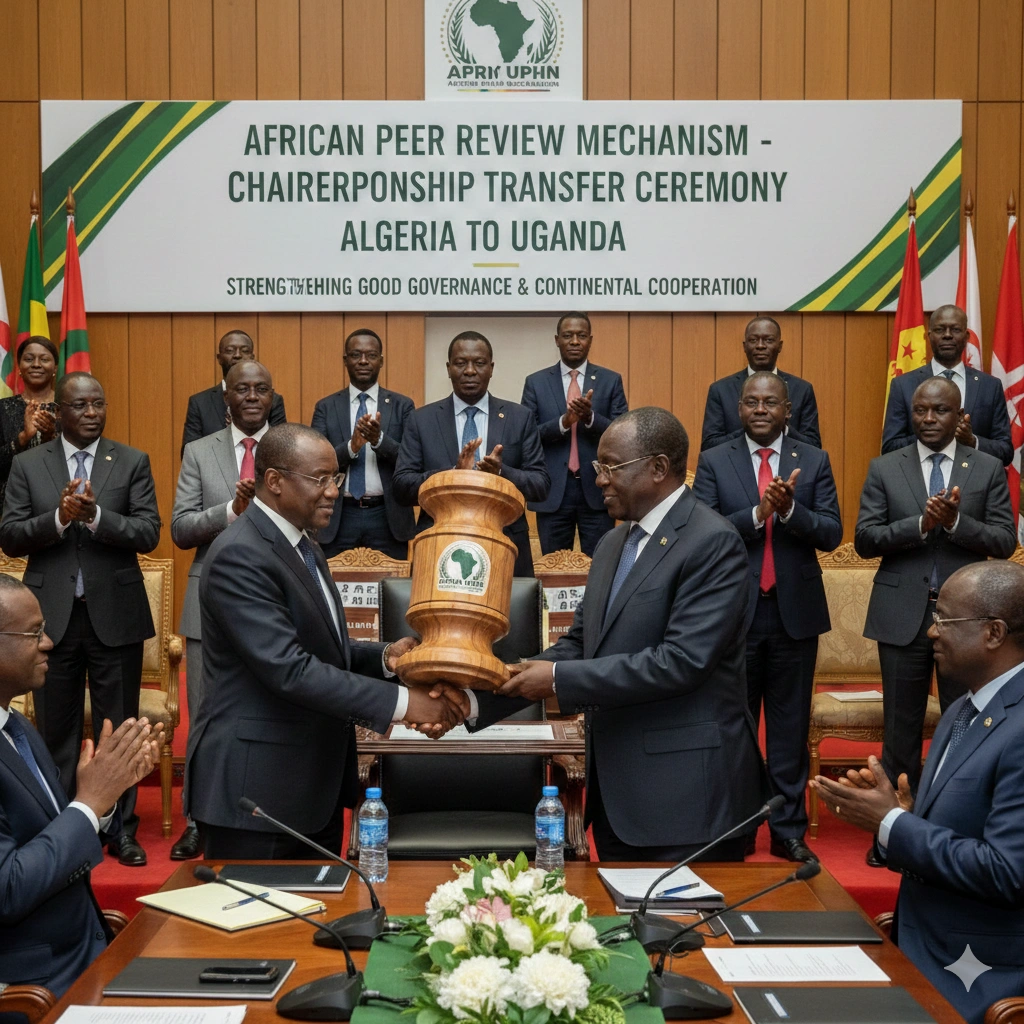
APRM governance growth took center stage in Addis Ababa, as Algeria formally handed over the chairmanship of the African Peer Review Mechanism to Uganda. This high-level transition, occurring during the 35th Forum of Heads of State and Government, represents a pivotal moment for continental cooperation. As African nations navigate complex geopolitical shifts, the steady hand of the APRM remains a cornerstone for fostering democratic stability and sustainable economic development across the African Union’s member states.
The Significance of APRM Governance Growth in 2026
The concept of APRM governance growth is rooted in the belief that African problems require African solutions. By participating in a voluntary self-assessment process, nations commit to transparency and accountability. During the forum in Ethiopia, Prime Minister Sifi Ghrieb, representing Algerian President Abdelmadjid Tebboune, emphasized that the mechanism is more than just a bureaucratic exercise; it is a vital instrument for progress. The transition to Uganda comes at a time when the continent is striving to harmonize policies under the ambitious Agenda 2063 framework.
Uganda’s Vice President, Jessica Rose Epel Alupo, accepting the mantle on behalf of President Yoweri Museveni, signaled a continued trajectory for APRM governance growth. The mechanism has historically focused on four key thematic areas: democracy and political governance, economic management, corporate governance, and socio-economic development. As Uganda takes the lead, there is a renewed expectation that these pillars will be strengthened to address the unique challenges of the post-2025 global economy, where digital transformation and climate resilience have become inseparable from good governance.
APRM Governance Growth
The term APRM governance growth encapsulates the expansion of peer review standards across a wider range of African nations. Under Algeria’s two-year mandate, the mechanism saw a “record” level of engagement from member states seeking to reform their domestic institutions. President Tebboune’s message, read by Prime Minister Ghrieb, highlighted the “trust placed in Algeria” and the collective effort required to maintain the momentum of reform. This H2 section confirms that APRM governance growth is not merely a slogan but a measurable increase in the quality of institutional oversight.
[Image Alt Text: A high-level diplomatic meeting in Addis Ababa showcasing the APRM governance growth transition between Algeria and Uganda.]
The forum members were quick to acknowledge that without Algeria’s contributions, the path toward unified African unity would be much steeper. The handover is seen as a “strong” endorsement of the rotating presidency model, ensuring that different regional perspectives influence the continent’s administrative evolution. For Uganda, the challenge will be to scale these successes and ensure that APRM governance growth reaches regions currently facing political instability or economic distress.
Key Outcomes of the 35th APRM Forum
The transition in Addis Ababa was marked by several critical discussions aimed at bolstering APRM governance growth. The leaders present identified specific sectors where peer review can yield the highest impact:
- Enhancing Judicial Independence: Ensuring that legal frameworks across the continent are robust enough to protect citizen rights and investor interests.
- Anti-Corruption Frameworks: Implementing digital tracking systems to monitor public expenditure and reduce leakages in state budgets.
- Youth Engagement: Integrating younger generations into the governance process to ensure long-term sustainability of democratic reforms.
These initiatives are essential for maintaining the pace of APRM governance growth. By focusing on these actionable goals, the new Ugandan leadership can provide a roadmap for other nations to follow, turning the peer review process into a catalyst for tangible socio-economic improvement.
Algeria’s Legacy and Uganda’s Vision
The legacy of Algeria in fostering APRM governance growth is defined by a commitment to “continental cooperation.” During its tenure, Algeria worked tirelessly to improve the mechanism’s funding structure and operational efficiency. Prime Minister Ghrieb reiterated Algeria’s unwavering support for Uganda, promising technical and diplomatic assistance to ensure the transition is seamless. This spirit of brotherhood is what drives APRM governance growth forward, as it moves away from external conditionality toward internal peer-driven excellence.
Uganda’s vision for its chairmanship involves a “strong” focus on the integration of the APRM into the African Continental Free Trade Area (AfCFTA) protocols. Vice President Alupo noted that trade cannot flourish in an environment of poor governance. Therefore, APRM governance growth is directly linked to the economic prosperity of the billion-plus people living in Africa. By aligning governance reviews with trade readiness, Uganda aims to make the mechanism indispensable to the continent’s industrialization goals.
Challenges to Sustaining APRM Governance Growth
Despite the optimistic atmosphere in Addis Ababa, several risks threaten to stall APRM governance growth. The global economic environment remains volatile, and many African nations are struggling with high debt-to-GDP ratios. When fiscal space is limited, there is often “pressure” on governments to deprioritize governance reforms in favor of immediate crisis management. However, the forum argued that the APRM governance growth model is actually a solution to these financial woes, as better governance leads to higher credit ratings and more Foreign Direct Investment (FDI).
Furthermore, the “risk” of political backsliding in some regions necessitates a more proactive APRM. Uganda’s leadership will need to handle sensitive peer reviews with a mix of “strong” diplomacy and firm adherence to democratic principles. If the mechanism is perceived as being too lenient, it risks losing its credibility; if it is too harsh, it may lose participation. Balancing these dynamics is the core challenge for the next two years of APRM governance growth.
Peer Review as an Instrument of Progress
President Tebboune’s assertion that peer review is an “instrument of progress” resonates deeply within the context of APRM governance growth. It moves the needle from passive observation to active participation. When a head of state sits across from their peer and discusses the shortcomings of their administration, it creates a unique level of accountability that international organizations often fail to achieve. This human-to-human interaction at the highest level of government is the secret sauce of APRM governance growth.
As we look toward the 2026-2028 cycle, the focus will likely shift toward “sustainable development” metrics. The APRM is increasingly being used to track progress on the UN Sustainable Development Goals (SDGs) alongside Agenda 2063. This dual-tracking system ensures that APRM governance growth contributes to a global standard of excellence while remaining uniquely African in its execution and cultural context.
Future Projections for African Leadership
The future of APRM governance growth under Ugandan leadership looks promising yet demanding. The forum concluded with a “record” number of delegates expressing their commitment to the upcoming review cycles. For Uganda, the presidency is a chance to showcase its own domestic reforms while leading the continent toward a more unified front. The international community, including major partners like the EU and the UN, will be watching closely to see if the APRM governance growth can translate into fewer conflicts and more robust economies.
The handover in Addis Ababa was not just a change of personnel; it was a reaffirmation of a collective African dream. By prioritizing APRM governance growth, nations are signaling to the world that they are ready to lead on their own terms. The success of this transition will be measured by the number of successful reviews conducted and the implementation of the resulting recommendations over the next twenty-four months.
Conclusion: A New Era for African Governance
In conclusion, the transfer of leadership from Algeria to Uganda marks a “strong” step forward for APRM governance growth. The foundation laid by President Tebboune provides a sturdy platform for President Museveni and Vice President Alupo to build upon. As the 35th Forum of Heads of State closes, the message is clear: the APRM governance growth journey is non-negotiable for a continent that seeks to be a global powerhouse by 2063.
The APRM governance growth mandate is now in the hands of East Africa, and with the support of North African allies like Algeria, the mechanism is well-positioned to tackle the governance “crisis” points that remain. Stakeholders should remain optimistic but vigilant, ensuring that the promises made in the halls of Addis Ababa are fulfilled in the capital cities across the entire continent.
For more details & sources visit: AL24 News
For more updates about Algeria, visit the Algeria News Section.