
Summary
New research in Nature Geoscience reveals that Antarctica is melting faster than expected, with increased surface melt, glacier acceleration, and sea ice decline—signs that the once-stable southern continent is now responding rapidly to global warming. Scientists warn this shift could have catastrophic implications for global sea levels and the climate system.
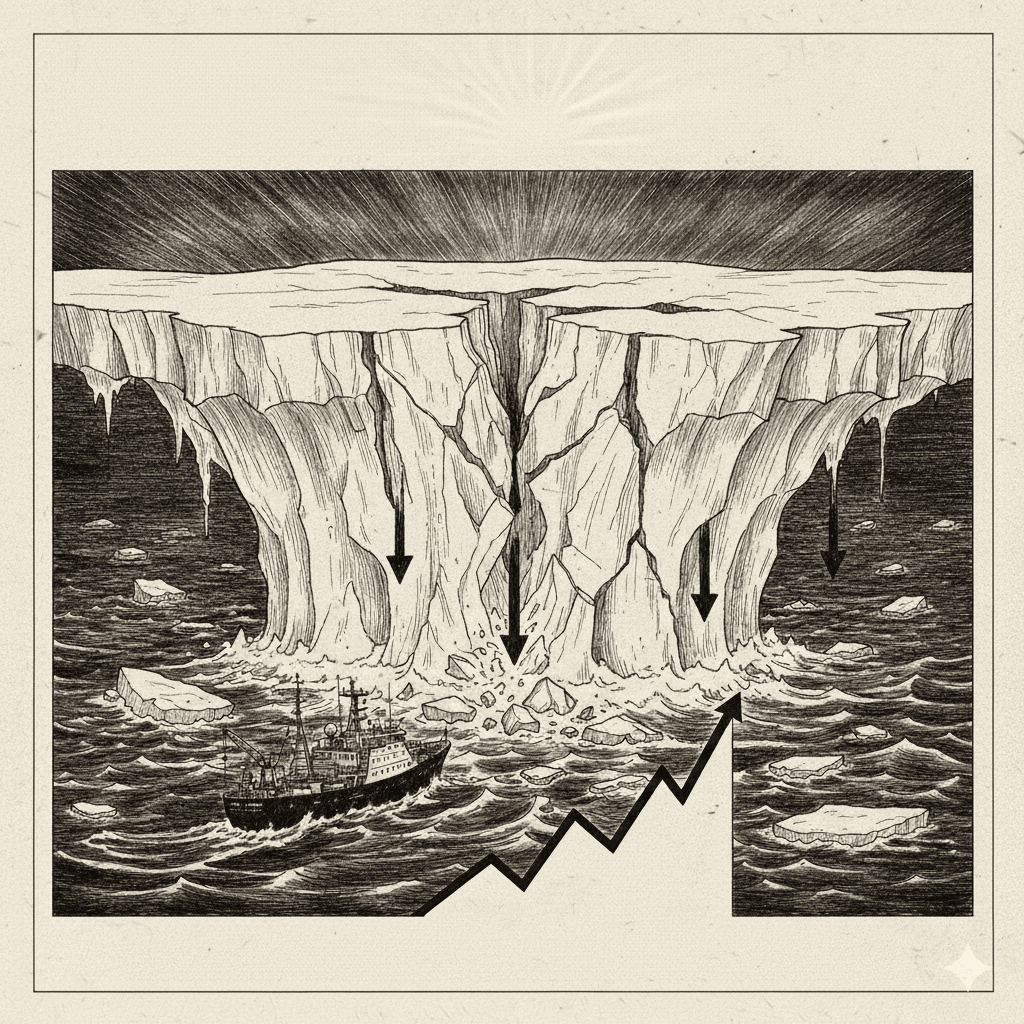
Antarctica, long considered insulated from the effects of climate change, is now showing clear signs of instability, according to a study cited by Ars Technica. Lead author Ruth Mottram of the Danish Meteorological Institute said, “We thought it would take ages for climate impacts to be seen in Antarctica — and that’s really not true.”
The continent’s massive ice sheet spans 5.4 million square miles and holds enough frozen water to raise global sea levels by 190 feet (58 meters) if fully melted. The West Antarctic Ice Sheet alone could raise sea levels by more than 10 feet.
Researchers highlighted the collapse of the Larsen B Ice Shelf in 2002 as a warning sign, with ice loss now quadrupled since the 1990s as weakened ice shelves fail to restrain outlet glaciers. “At some point, there’s no stopping it anymore,” said Helen Amanda Fricker of the Scripps Institution of Oceanography.
The study also noted an extraordinary 2022 heatwave that penetrated deep into East Antarctica — once regarded as the most stable region — driven by powerful atmospheric rivers. Meanwhile, warming ocean currents are breaching the continent’s circumpolar barrier, delivering heat to the base of ice shelves and accelerating melt.
Eric Rignot, an Earth system scientist at UC Irvine, warned that Greenland’s rapid changes are now being mirrored in the south: “There is no new physics in Greenland that does not apply to Antarctica and vice versa.”
Though Antarctica’s temperature rise is slightly below the global average, Mottram stressed that the region is no longer isolated from global dynamics. “What happens there will affect the rest of the global climate system,” she said, calling for urgent reductions in greenhouse gas emissions to slow the accelerating melt.