
The Antarctica’s Blood Falls mystery has long fascinated scientists and the public because of its striking red color flowing from the icy surface of Taylor Glacier. New research now suggests that the unusual phenomenon is linked to iron-rich nanospheres present in salty subglacial water, offering a clearer explanation for why the waterfall suddenly turns deep red.
Blood Falls appears when pressurized, iron-rich brine trapped beneath the glacier escapes onto the ice. The water initially emerges clear but rapidly changes color after exposure to air. This dramatic transformation has puzzled researchers for decades and led to multiple theories about its origin.
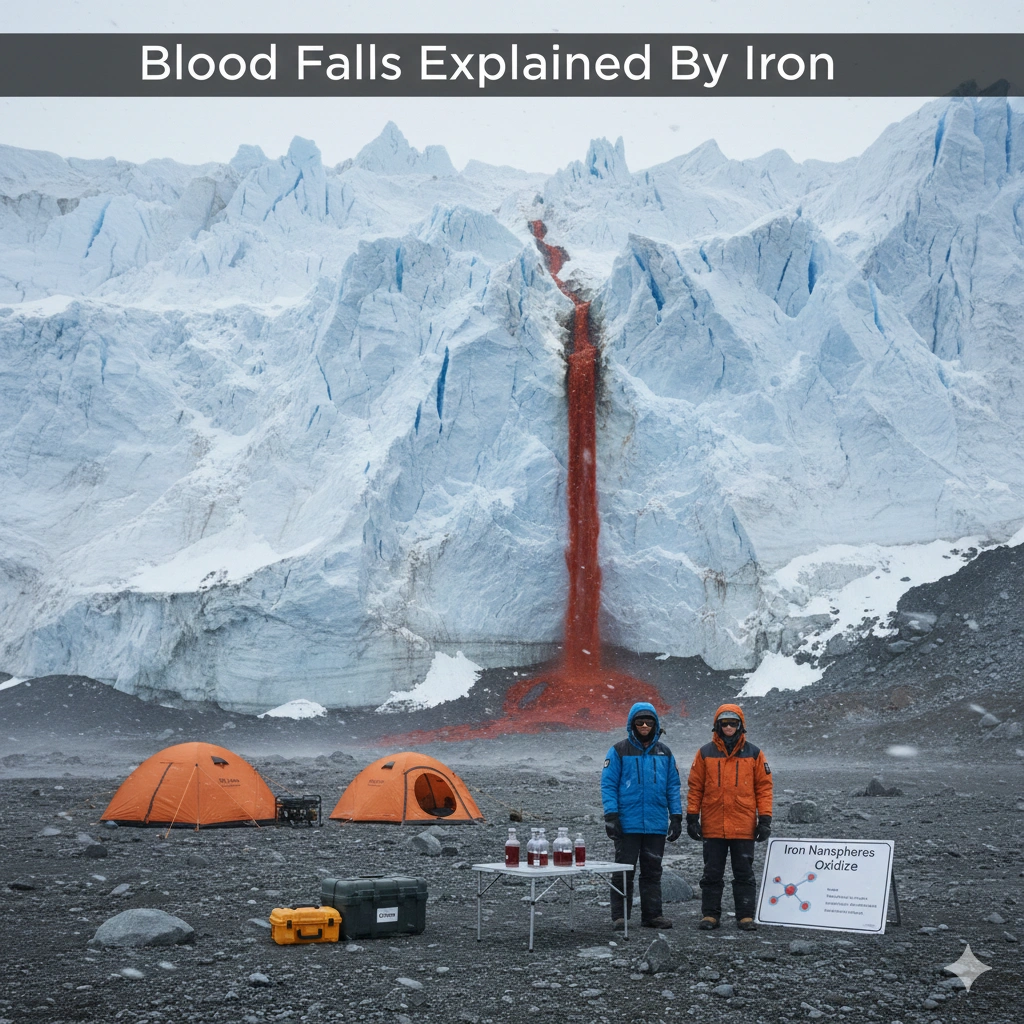
What Is Antarctica’s Blood Falls mystery?
Antarctica’s Blood Falls mystery centers on a rare natural feature located at Taylor Glacier in the McMurdo Dry Valleys. The red stream flows intermittently from cracks in the glacier, creating the appearance of blood spilling across the white ice.
Scientists now understand that the source is not biological. Instead, the color comes from iron-laden salty water that has remained trapped beneath the glacier for long periods. Because the water is extremely salty, it can stay liquid even in freezing Antarctic conditions.
When this subglacial brine reaches the surface and interacts with oxygen, a rapid chemical reaction occurs, producing the characteristic rust-red coloration.
Iron Nanospheres: The Key Discovery
Antarctica’s Blood Falls Mystery and Iron Nanospheres
A major breakthrough came when researchers used transmission electron microscopy to examine the brine more closely. They discovered abundant iron-rich amorphous nanospheres, particles so tiny and non-crystalline that earlier detection methods, such as X-ray diffraction, failed to identify them.
These nanospheres contain iron along with other elements, including:
- Silicon
- Calcium
- Aluminum
- Sodium
Because of their extremely small size and structure, the particles react very quickly when exposed to oxygen. This rapid oxidation process is what produces the waterfall’s deep red color within moments of reaching the surface.
The discovery helps explain why earlier studies struggled to fully account for the intensity and speed of the color change.
How Subglacial Brine Reaches the Surface
The reservoir feeding Blood Falls exists beneath the glacier in a pressurized, hypersaline environment. Over time, pressure forces the brine upward through cracks in the ice.
Key characteristics of this hidden water system include:
- Very high salt concentration
- Low oxygen levels
- Isolation from sunlight
- Extremely cold conditions
Salt lowers the freezing point, allowing liquid water to persist beneath the glacier despite Antarctica’s harsh climate. When the brine escapes, it initially appears clear but quickly turns red as iron oxidizes.
Extreme Environment Capable of Supporting Life
Another important aspect of the Antarctica’s Blood Falls mystery is its potential to host microorganisms. Researchers describe the subglacial reservoir as an extreme habitat where life may survive without sunlight.
Instead of relying on photosynthesis, microbes can use chemical energy from iron and sulfur compounds. This type of survival strategy is known as chemosynthesis and is found in other extreme environments on Earth.
The presence of such organisms demonstrates how life can persist in conditions once thought uninhabitable.
Why Blood Falls Matters for Space Exploration
Scientists consider Blood Falls an important astrobiology analogue. The combination of cold temperatures, salty water, and low oxygen resembles environments that might exist beneath the surface of Mars or icy moons such as Europa.
Studying how microorganisms survive in these Antarctic conditions helps researchers:
- Understand potential extraterrestrial habitats
- Improve models for life in extreme environments
- Develop strategies for detecting biosignatures on other planets
This makes Blood Falls more than a geological curiosity. It is also a natural laboratory for understanding how life could exist beyond Earth.
A Window Into Hidden Antarctic Water Systems
The explanation of the Antarctica’s Blood Falls mystery also provides insight into complex subglacial water networks beneath the Antarctic ice sheet. These hidden systems play a role in glacier movement, climate research, and long-term environmental monitoring.
By studying the chemistry and behavior of these brines, scientists gain valuable data about Earth’s past climate conditions and the evolution of extreme ecosystems.
Conclusion
The long-standing Antarctica’s Blood Falls mystery is now better understood thanks to the discovery of iron-rich nanospheres in salty subglacial water. When this pressurized brine reaches the surface and reacts with oxygen, rapid oxidation produces the waterfall’s dramatic red color.
Beyond explaining its appearance, the finding highlights the existence of resilient microbial life and offers important clues for astrobiology research. Blood Falls continues to serve as a powerful example of how hidden environments beneath Earth’s ice can reshape scientific understanding of both our planet and the possibility of life elsewhere.
For more details & sources visit: Futura (with Johns Hopkins University research summary)
Read more on Antarctica news: 360 News Orbit – Antarctica