
A new Chinese-led study warns that Antarctica warming will occur faster than expected under human-driven climate change, with the continent projected to heat 1.4 times more than the Southern Hemisphere average in a 2°C global warming scenario. The findings, published in Geophysical Research Letters, highlight a previously underestimated component of human influence on the Antarctic climate, a phenomenon researchers are calling “Antarctic amplification.”
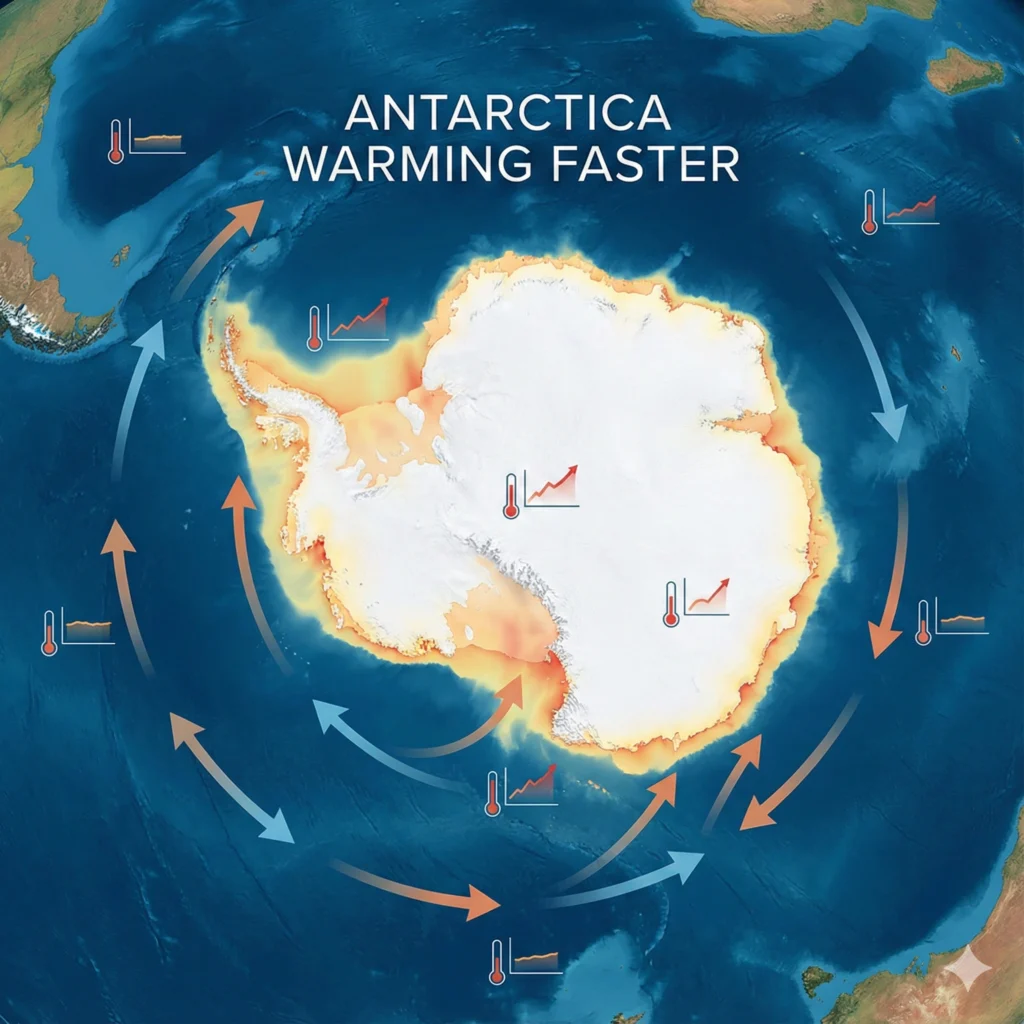
Human Influence Accelerates Antarctica Warming
Scientists from the Institute of Global Change and Polar Meteorology under the Chinese Academy of Meteorological Sciences analyzed data from over 200 Antarctic stations combined with new Chinese reanalysis products. Their work identified, for the first time, a clear continent-wide warming signal across Antarctica, overturning previous assumptions that the region would lag behind global temperature increases.
Lead researcher Ding Minghu explained that Antarctica’s strong circumpolar westerly winds insulate the continent, limiting direct atmospheric warming. Instead, the primary driver of accelerated warming is rising sea-surface temperatures, which gradually transfer heat across the westerlies and onto Antarctic land areas.
What is Antarctic Amplification?
The study introduces the concept of Antarctic amplification, a pattern in which the continent warms disproportionately relative to surrounding Southern Hemisphere averages. Under the Paris Agreement’s 2°C warming scenario, Antarctic land areas are projected to heat 1.4 times faster than the rest of the hemisphere.
Researchers emphasize that the process is gradual but accelerating. Rising ocean temperatures act as a conveyor belt, transferring heat slowly to the continent and intensifying as global warming continues. This effect adds a significant human-driven component to the future climate trajectory of Antarctica, previously underestimated in climate models.
Methodology Behind the Findings
The Chinese research team combined multiple sources to ensure robust results:
- Observations from over 200 Antarctic stations
- Advanced reanalysis products developed in China
- Climate projections aligned with the Paris Agreement 2°C scenario
Their approach allowed the scientists to distinguish human-driven warming from natural variability across the continent. By correlating oceanic heat transport with land temperature increases, the study demonstrates a direct link between anthropogenic warming and Antarctic climate acceleration.
Implications for Global Climate and Sea Levels
The accelerated warming of Antarctica carries serious implications for global climate patterns and sea-level rise. As ice sheets experience higher temperatures, melting rates could increase, contributing more rapidly to rising oceans. Scientists warn that the amplification may also influence:
- Southern Hemisphere weather systems, including precipitation and wind patterns
- Ocean circulation changes that affect global heat distribution
- Long-term ice sheet stability, with potential feedback loops exacerbating global warming
The study underscores that Antarctica will no longer remain a cold outlier, and its warming will be a crucial factor in global climate models moving forward.
Urgency for Climate Mitigation and Policy Action
The findings from this Chinese-led study highlight the urgent need for climate mitigation efforts. If Antarctica warming continues at the projected accelerated rate, even moderate global warming scenarios could trigger faster ice loss, rising sea levels, and broader impacts on global climate stability. Scientists warn that ignoring the Antarctic amplification effect could lead to underestimated risks for coastal communities and ecosystems worldwide.
Researchers emphasize that reducing greenhouse gas emissions, adhering to international climate agreements, and enhancing monitoring of polar regions are critical steps to slow this trend. Policymakers and global leaders are urged to incorporate the effects of Antarctic amplification into climate planning, reinforcing that the future of Antarctica is deeply connected to the resilience of the planet’s climate system.
What Researchers Recommend
Lead author Ding Minghu highlighted the importance of continuous monitoring and improved modeling to track the acceleration of Antarctic warming. Key recommendations include:
- Expansion of ground-based observational networks
- Enhanced satellite monitoring of ice sheets and sea-surface temperatures
- Integration of ocean-atmosphere interactions into predictive climate models
The research emphasizes that human actions will directly shape the trajectory of Antarctic warming, making mitigation efforts critical in limiting extreme outcomes.
Final Thoughts
This Chinese study provides a stark warning that Antarctica warming may outpace previous projections, adding urgency to global climate action. With the continent projected to heat 1.4 times faster than Southern Hemisphere averages, the findings challenge assumptions about polar climate resilience and highlight the interconnected nature of human-driven climate change. As global temperatures continue to rise, Antarctic amplification could have far-reaching consequences for sea-level rise, regional weather patterns, and planetary climate stability.
For more details & sources visit: CGTN
Read more on Antarctica news: 360 News Orbit – Antarctica