
Antarctica Solar Eclipse stands as the definitive celestial highlight of early 2026, marking a rare moment where the moon’s shadow graced the most remote continent on Earth. On February 17, 2026, the sun was transformed into a breathtaking “ring of fire,” a phenomenon known as an annular eclipse.
This occurs because the Moon, situated near its apogee (the farthest point in its elliptical orbit), appears slightly smaller than the Sun in the sky. Consequently, it cannot completely obscure the solar disk, leaving a thin, brilliant outer boundary of light. While the path of annularity was primarily confined to the Antarctic wilderness, its partial phases stretched across parts of the southern Atlantic and Indian Oceans, captivating the handful of researchers stationed at outposts like the Concordia Research Station.
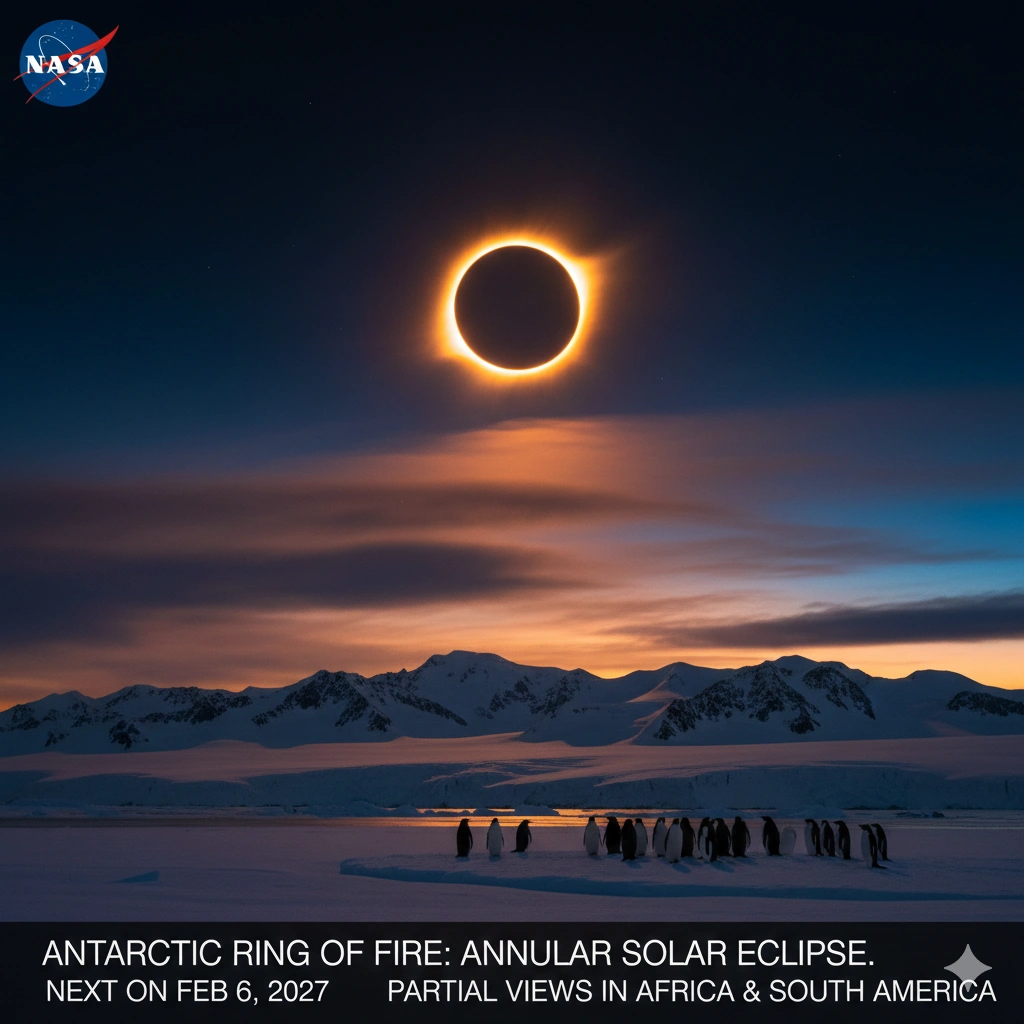
The mechanics of the Antarctica Solar Eclipse are a masterclass in orbital geometry. Unlike a total solar eclipse, where the moon is close enough to Earth to cover the sun entirely, an annular eclipse relies on the moon’s increased distance to create its signature halo. This specific event was part of Solar Saros 121, a series of eclipses that has been repeating every 18 years for over a millennium. For those within the narrow 383-mile-wide path, the “ring” was visible for approximately 2 minutes and 20 seconds. This event also signaled the beginning of a new eclipse season, traditionally paired with a lunar counterpart—in this case, a total lunar eclipse scheduled for March 3, 2026.
Antarctica Solar Eclipse
The primary significance of the Antarctica Solar Eclipse lies in its geographical rarity and the specific light conditions it produces. Because the sun is never fully blocked, the sky does not plunge into the deep “totality” darkness typical of a total eclipse; instead, observers describe the light as an eerie, sharpened twilight. Shadows during an annular event become exceptionally crisp, and the atmosphere often experiences a noticeable drop in temperature. For the wildlife and few human inhabitants of Antarctica, the event provided a unique interplay of light against the white expanse of the ice sheets, highlighting the moon’s silhouette in a high-contrast solar frame.
Furthermore, the Antarctica Solar Eclipse serves as a vital reminder of the Sun’s power and the necessity of proper eye protection. Even at 96% obscuration, the remaining “ring of fire” is bright enough to cause permanent retinal damage if viewed without certified solar filters. Astronomers and space agencies utilized satellite imagery, such as that from NOAA’s GOES-East, to broadcast the event to a global audience. This digital access allowed millions of people in the Northern Hemisphere, who were outside the visibility zone, to witness the moon’s transit in real-time. The data collected from these observations helps scientists further refine our understanding of the moon’s precise orbital variations over centuries.
The Role of Celestial Mechanics in Annularity
Understanding the Antarctica Solar Eclipse requires a deep dive into the concept of “annularity,” a term derived from the Latin annulus, meaning ring. The varying distance between the Earth and the Moon is the deciding factor in whether an eclipse is total or annular. Because the moon’s orbit is an ellipse rather than a perfect circle, its apparent size fluctuates by about 14% throughout the month. When an eclipse coincides with the moon’s distant position, the result is the stunning halo effect witnessed this February. This geometric dance ensures that no two eclipses are exactly alike, as the thickness of the ring changes based on the precise lunar distance at the moment of alignment.
The specific path of the Antarctica Solar Eclipse was determined by the tilt of the Earth’s axis and the location of the lunar nodes—the points where the moon’s orbit crosses the ecliptic plane. In 2026, these factors aligned perfectly over the South Pole region, a location that only sees a “path of annularity” once every few decades. This isolation makes the event a “holy grail” for dedicated eclipse chasers, many of whom joined specialized Antarctic cruises or flights to get a glimpse of the ring. The logistical challenge of reaching the path of annularity underscores the dedication required to witness one of nature’s most precise and fleeting alignments in person.
Future Perspectives on Solar Phenomena
Following the Antarctica Solar Eclipse, the astronomical community is already looking forward to a “golden age” of solar events. Just months after the ring of fire, a total solar eclipse will sweep across Greenland, Iceland, and Spain on August 12, 2026. This rapid succession of major eclipses is a result of the repeating nature of eclipse seasons, which occur roughly every six months when the moon’s orbit aligns with the sun and Earth. For those who missed the 2026 Antarctic event, another annular eclipse is predicted for February 6, 2027, though its path will move toward the South Pacific and South America.
The study of the Antarctica Solar Eclipse also contributes to our long-term understanding of the Earth-Moon system. Over millions of years, the moon is slowly drifting away from Earth at a rate of about 3.8 centimeters per year. Eventually, in about 600 million years, the moon will be too far away to ever produce a total solar eclipse again. At that point, all solar eclipses will be either partial or annular. By documenting current events like the 2026 ring of fire, scientists are effectively creating a record of a transitionary period in our solar system’s history, where both total and annular eclipses are still possible for inhabitants of Earth.
Eclipse Seasons and bi-weekly Pairings
One of the most fascinating aspects of the Antarctica Solar Eclipse is its relationship with the upcoming lunar eclipse. Eclipses rarely happen in isolation; they typically occur in pairs during a two-to-three-week window known as an eclipse season. During this time, the moon is at the correct orientation to cross the ecliptic twice—once as a new moon (solar eclipse) and once as a full moon (lunar eclipse). The February 17 solar event is the “opening act” for the total lunar eclipse on March 3, 2026, which will be visible across much of the Americas, Asia, and Australia.
This pairing of events is a direct consequence of celestial mechanics and the moon’s 29.5-day synodic cycle. Because the moon stays near the “eclipse node” for several weeks, it is highly likely to trigger both types of phenomena within the same month. For skywatchers, this means that an Antarctica Solar Eclipse is often a signal to prepare for a “blood moon” just fourteen days later. These cycles are so predictable that NASA and other space agencies can calculate them thousands of years in advance, allowing humanity to track the movements of our solar system with incredible precision and foresight.
- Ensure you use ISO 12312-2 certified solar glasses for any part of the eclipse.
- Never use standard sunglasses, as they do not block infrared or ultraviolet radiation.
- If using a telescope or binoculars, attach a specialized solar filter to the front lens.
- Consider using indirect viewing methods, like a pinhole projector, for a safe experience.
Regional Visibility and Partial Phases
While the full ring of the Antarctica Solar Eclipse was limited to the frozen continent, partial views were accessible to millions in the Southern Hemisphere. In the southern reaches of Africa, including South Africa and Madagascar, the sun appeared as a “bitten” crescent as the moon’s penumbral shadow passed overhead. Similar partial views were reported in the southern tips of Chile and Argentina. These partial phases lasted significantly longer than the brief moment of annularity, offering a broader window for photography and scientific measurement of solar radiation changes during the event’s progression.
The visibility of the Antarctica Solar Eclipse in these regions provided an educational opportunity for local schools and science centers. Many organizations hosted “eclipse parties” where the public could learn about the solar saros cycle and the importance of our sun. Even a 20% or 30% partial eclipse can create interesting visual effects, such as the crescent-shaped shadows cast by tree leaves, which act as natural pinhole cameras. These moments of collective observation help demystify the heavens and encourage a new generation of scientists to explore the fields of astronomy and physics through first-hand experience.
Impact on Scientific Research Stations
For the personnel at Antarctica’s research stations, the Antarctica Solar Eclipse was more than just a visual spectacle; it was a rare opportunity for localized atmospheric study. The sudden, albeit partial, reduction in solar energy allows researchers to study the ionosphere’s response to rapid changes in radiation. Because the eclipse occurred during the Antarctic summer, the sun was already high in the sky for many stations, providing ideal conditions for solar telescopes. Data gathered at Concordia and Mirny stations will be used to analyze how the “ring of fire” affects the magnetic field and upper atmosphere in a region with very little human interference.
The logistical coordination required to capture the Antarctica Solar Eclipse at these remote outposts is immense. Equipment must be tested to withstand extreme cold and potential winds, even during the relatively milder summer months. International collaborations often share data from multiple stations across the path of annularity to create a comprehensive map of the eclipse’s shadow as it moves across the ice. This collaborative spirit is a hallmark of Antarctic research, where the pursuit of knowledge transcends national boundaries and technical challenges to document one of the most elusive sights in the solar system.
The Spiritual and Cultural History of Eclipses
The Antarctica Solar Eclipse, while observed through a modern scientific lens, also connects us to a long history of human fascination with celestial omens. In many ancient cultures, an annular eclipse—where the sun is not fully extinguished but transformed—was seen as a sign of transition or divine warning. The “ring of fire” has appeared in the folklore of numerous civilizations, often representing a marriage between the sun and moon or a celestial battle. Even in the 21st century, these events evoke a sense of wonder and humility, reminding us of our small place within a vast and clockwork universe.
Today, the cultural impact of the Antarctica Solar Eclipse is largely felt through digital media and the “eclipse tourism” industry. The event inspires artists, photographers, and writers to explore themes of light, shadow, and the remote beauty of the Antarctic landscape. As high-definition images of the 2026 ring of fire circulate on social media, they foster a global conversation about the preservation of our natural world and the importance of scientific literacy. The eclipse serves as a bridge between the ancient human need for wonder and the modern desire for precise, empirical understanding of the cosmos.
- Follow NASA’s official eclipse live streams for high-definition aerial footage.
- Join online forums like “Space.com” to share photos and observer reports.
- Use mobile apps like “The Eclipse App” to track the precise timing for your location.
- Participate in citizen science projects that collect temperature and light data.
Conclusion and the March Toward Totality
The Antarctica Solar Eclipse of February 17, 2026, will be remembered as a masterfully timed celestial event that showcased the cold beauty of the South Pole. Its successful observation, both in-person and via satellite, has added another chapter to our records of the Saros 121 cycle. As the shadow departed the Earth over the southern Indian Ocean, it left behind a wealth of data and a global community already anticipating the next major alignment. The “ring of fire” was not just a fleeting moment in the sky, but a powerful demonstration of the predictability and majesty of our solar system’s mechanics.
As we move forward into the rest of 2026, the Antarctica Solar Eclipse serves as the perfect prologue for the total solar eclipse coming this August. The transition from an annular ring to a total blackout will provide a dramatic contrast for astronomers and the public alike. Whether viewed from the deck of an icebreaker or the screen of a smartphone, these eclipses continue to draw our eyes upward, sparking curiosity and providing a rare moment of global unity under the shared light of our star. The journey of the moon across the sun remains one of the most potent symbols of the enduring rhythm of the natural world.
For more details & sources visit: Dawn
Read more on Antarctica news: 360 News Orbit – Antarctica.