
Antarctica microbial ecosystem research has reached a new milestone as NASA’s Landsat 9 satellite provides unprecedented high-resolution imagery of Lake Unter-See in Queen Maud Land. This permanently frozen body of water serves as one of the most significant Earth analogues for astrobiologists studying the potential for life on Mars and icy moons like Europa. By analyzing the subsurface dynamics through advanced imaging, scientists can now observe the delicate balance of life surviving under several meters of permanent ice. This breakthrough offers a rare glimpse into how biological entities persist in extreme alkaline environments characterized by high oxygen levels and minimal carbon dioxide.
The significance of the Antarctica microbial ecosystem lies in its ability to mirror conditions from Earth’s earliest biological history, dating back over 3 billion years. As researchers delve deeper into the satellite data, they are uncovering how seasonal meltwater from the Anuchin Glacier sustains this isolated world. The stability of the ice cover creates a sanctuary, protecting rare formations from the erosive forces of wind and waves. This discovery not only enhances our understanding of terrestrial biology but also sharpens the search parameters for extraterrestrial life within our solar system.
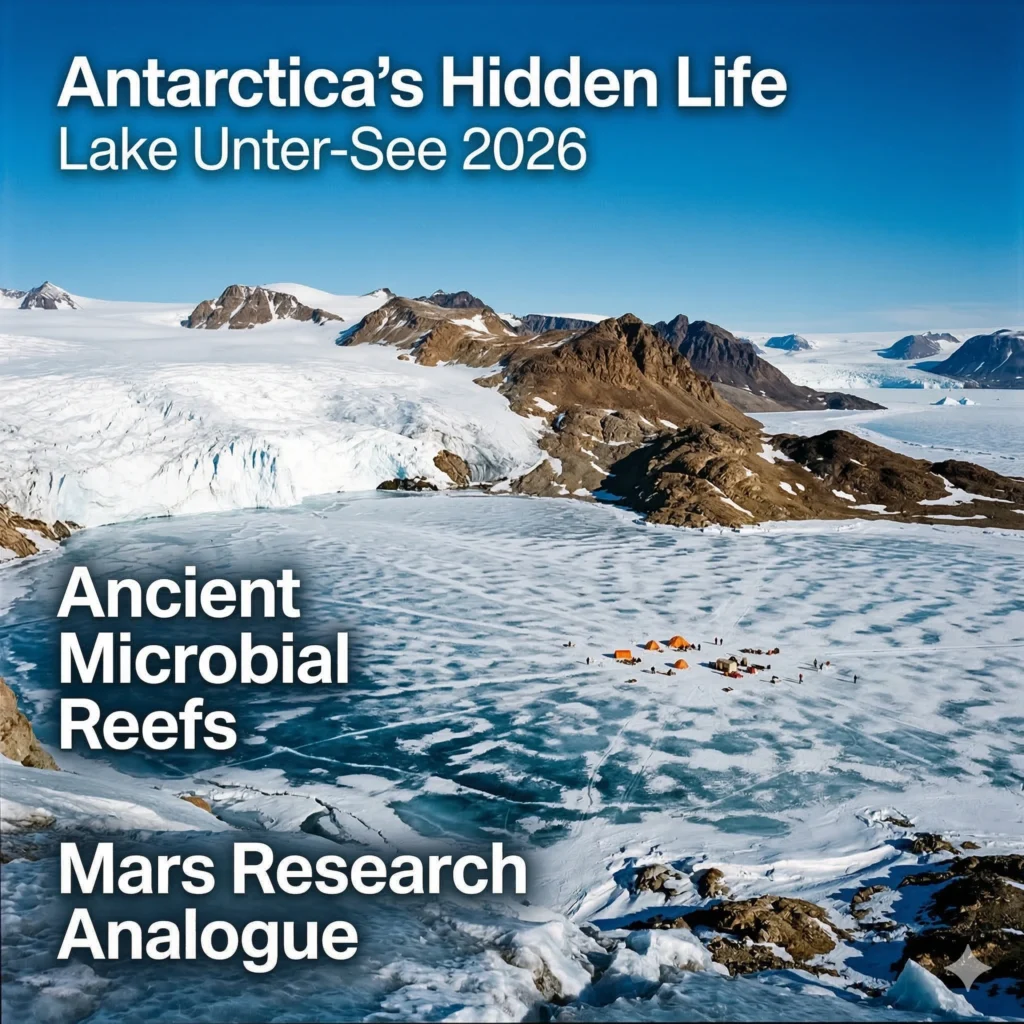
Antarctica Microbial Ecosystem
The most striking feature of the Antarctica microbial ecosystem is the presence of large, conical stromatolites formed by ancient lineages of cyanobacteria. These modern living reefs reach heights of up to half a meter, making them significantly larger and more complex than those found in any other Antarctic lake. Because the lake is sealed off from the atmosphere, these structures grow in a highly controlled, high-oxygen environment that has remained stable for millennia. Scientists view these modern stromatolites as living fossils that provide a direct link to the primitive organisms that first oxygenated our planet.
Understanding the growth patterns within the Antarctica microbial ecosystem requires a close look at the lake’s unique chemical signature. The water exhibits extreme alkalinity and a notable lack of dissolved carbon dioxide, creating a challenging environment for most known life forms. However, the cyanobacteria have adapted to these precise conditions, utilizing subsurface sunlight to fuel their slow but steady expansion. This resilience demonstrates the incredible tenacity of life, suggesting that similar microbial structures could exist in the subsurface oceans of distant, icy celestial bodies.
Glacial Floods and Biological Stimulation
Recent analysis of the Antarctica microbial ecosystem has revealed that the environment is not entirely static, as previously believed by some researchers. Data shows a two-meter rise in water levels following a massive glacial lake outburst flood from the nearby Lake Ober-See. This event introduced a sudden influx of carbon dioxide-rich water into the typically carbon-poor depths of Lake Unter-See. This periodic infusion of nutrients acts as a biological catalyst, stimulating productivity and growth within the microbial reef structures in a dramatic display of environmental adaptation.
These flood events are critical for the long-term health of the Antarctica microbial ecosystem, providing the necessary elements for the cyanobacteria to continue their architectural work. The interplay between the Anuchin Glacier and the Gruber Mountains ensures a steady, albeit cold, supply of seasonal meltwater. Researchers are now focusing on how these intermittent floods influence the morphological development of the stromatolites over decades. By tracking these changes via satellite, NASA can monitor the pulse of this hidden world without disturbing its delicate and ancient internal balance.
Astro-Biological Parallels to Icy Moons
The Antarctica microbial ecosystem serves as a primary laboratory for scientists looking toward the moons of Jupiter and Saturn. The subsurface conditions of Lake Unter-See, specifically its isolation under thick ice, provide a physical model for the oceans of Enceladus. Astrobiologists are particularly interested in how the high dissolved oxygen levels affect the metabolic rates of the resident microbes. If life can thrive in the cold, dark, and alkaline depths of Antarctica, the probability of finding similar signatures in the outer solar system increases significantly.
- High-resolution Landsat 9 imagery allows for non-invasive monitoring of remote sites.
- The lake’s depth of 170 meters creates a pressurized environment similar to deep-sea vents.
- Oxygen saturation levels provide clues about potential metabolic pathways for alien life.
- The absence of sediment disruption preserves the structural integrity of microbial mats.
Studying the Antarctica microbial ecosystem helps refine the sensors and instruments that will be sent on future space missions. By identifying the specific spectral signatures of these cyanobacteria, NASA can better calibrate cameras to look for biological pigments on other worlds. This terrestrial research ensures that when we finally reach the icy moons, we will know exactly what patterns to look for. The lake is essentially a training ground for the next generation of robotic explorers designed to seek out life beyond Earth.
Geological Stability and Ice Protection
The permanent ice cover is the unsung hero of the Antarctica microbial ecosystem, providing a shield against the harsh polar climate. This ice shell prevents mechanical weathering and keeps the water column stratified, which is essential for the slow growth of the stromatolites. Unlike open-water lakes where waves can break apart delicate microbial mats, Lake Unter-See offers a serene environment for architectural biology. This stability allows the cyanobacteria to build layers upon layers of mineralized structures without the threat of physical destruction.
This protective barrier also filters the sunlight, allowing only specific wavelengths to reach the Antarctica microbial ecosystem at the bottom. This selective light environment has likely influenced the evolution of the specific cyanobacteria species found in the lake. Scientists are investigating how these organisms maximize energy capture in such low-light conditions, a feat that is critical for any life form existing under kilometers of ice. The relationship between the ice thickness and the biological health of the lake is a key focus of current climate monitoring efforts.
Chemical Extremes in the Sub-Surface
The chemical composition of the water within the Antarctica microbial ecosystem is a puzzle that continues to fascinate geochemists worldwide. With very low levels of dissolved carbon dioxide, the organisms have developed unique carbon-concentrating mechanisms to survive. This extreme alkalinity would be toxic to most complex life, yet the microbial community here has turned it into a competitive advantage. By thriving where others cannot, these microbes have successfully dominated the lake bed for thousands of years without competition from higher organisms.
- The average regional temperature remains at a staggering -10 degrees Celsius.
- Water chemistry is characterized by high pH levels and extreme clarity.
- Microbial reefs are primarily composed of calcium carbonate and organic matter.
Researchers believe that the Antarctica microbial ecosystem could hold secrets to new enzymes and proteins that function at cold temperatures and high pH levels. These discoveries often have industrial applications, ranging from laundry detergents that work in cold water to new medical breakthroughs. The study of Lake Unter-See is therefore not just about looking into the past or the stars, but also about finding solutions for the present. Every sample analyzed from this remote location provides a wealth of data for the broader scientific community.
Mapping the Future of Antarctic Research
The use of satellite imagery to study the Antarctica microbial ecosystem marks a shift toward more sustainable and less invasive polar science. Traditional field expeditions are expensive and can inadvertently introduce contaminants into these pristine environments. By utilizing Landsat 9, researchers can observe the lake’s water levels and ice thickness from thousands of miles away. This remote sensing capability ensures that the delicate balance of the lake remains undisturbed while still providing high-quality data for climate and biological models.
Future missions to the Antarctica microbial ecosystem will likely involve autonomous underwater vehicles (AUVs) that can navigate the lightless depths. These drones will be able to map the stromatolites in 3D, providing a more detailed view than even the best satellite can offer. The goal is to create a digital twin of the lake’s interior to simulate how it might react to changing global temperatures. As the Antarctic ice sheets continue to shift, understanding the resilience of these isolated ecosystems becomes a priority for conservationists and scientists alike.
Evolutionary Significance of Stromatolites
The stromatolites found in the Antarctica microbial ecosystem are more than just rocks; they are the architects of the world we know today. By studying how these modern versions form, scientists can better interpret the fossil record of the Proterozoic and Archean eons. The fact that they are still growing in Lake Unter-See suggests that the conditions there have remained remarkably consistent for an immense period of time. This continuity provides a rare opportunity to observe evolutionary processes that have largely vanished from the rest of the planet.
Each layer within the Antarctica microbial ecosystem tells a story of a specific season or a particular flood event from the glacier. By taking core samples, researchers can read the history of the lake like a book, tracking changes in the Earth’s atmosphere and climate over millennia. These biological towers are monuments to the endurance of life, proving that even in the most inhospitable corners of the globe, nature finds a way to build something magnificent. The ongoing study of these structures remains one of the most exciting frontiers in modern geology.
Preserving a Pristine Scientific Frontier
Protecting the Antarctica microbial ecosystem is a matter of international importance, as it is one of the few places on Earth that remains largely untouched by human activity. The Antarctic Treaty System provides a framework for this protection, but the rise in tourism and research interest requires constant vigilance. Ensuring that Lake Unter-See stays uncontaminated is vital for the integrity of future astrobiological studies. If we are to use this site as a proxy for other planets, we must ensure that the signals we detect are purely indigenous and not the result of human interference.
- Strict protocols are in place for any equipment entering the lake water.
- International cooperation is required for data sharing and site management.
- Long-term monitoring helps identify early signs of environmental stress.
The Antarctica microbial ecosystem is a shared heritage of humanity, offering insights into our origins and our potential future in the stars. As we continue to gaze at the imagery from Landsat 9, we are reminded of the fragility and the strength of our planet’s hidden life. The work being done in Queen Maud Land today will inspire the explorers of tomorrow, whether they are searching for life in a frozen lake or on a distant moon. The mystery of Lake Unter-See is a testament to the fact that there is still so much left to discover on our home planet.
Conclusion: Lessons from the Frozen Deep
The discovery and ongoing monitoring of the Antarctica microbial ecosystem at Lake Unter-See have fundamentally changed our perspective on biological limits. From the towering microbial reefs to the strange chemical balance of the water, every element of this lake challenges our understanding of life. The integration of satellite technology and ground-level microbiology has created a powerful tool for exploring the unknown. As we move into 2026 and beyond, the data gathered from this site will continue to inform our search for life across the cosmos.
Ministering to the needs of the scientific community while preserving the environment is the ultimate goal for those studying the Antarctica microbial ecosystem. The lessons learned here about resilience, adaptation, and geological history are invaluable. Lake Unter-See remains a beacon of mystery, a silent witness to the passage of eons, and a hopeful sign that life is far more creative and enduring than we ever imagined. The journey into the heart of Antarctica is, in many ways, a journey into the very essence of life itself.
For more details & sources visit: Open Access Government
Read more on Antarctica news: 360 News Orbit – Antarctica.