
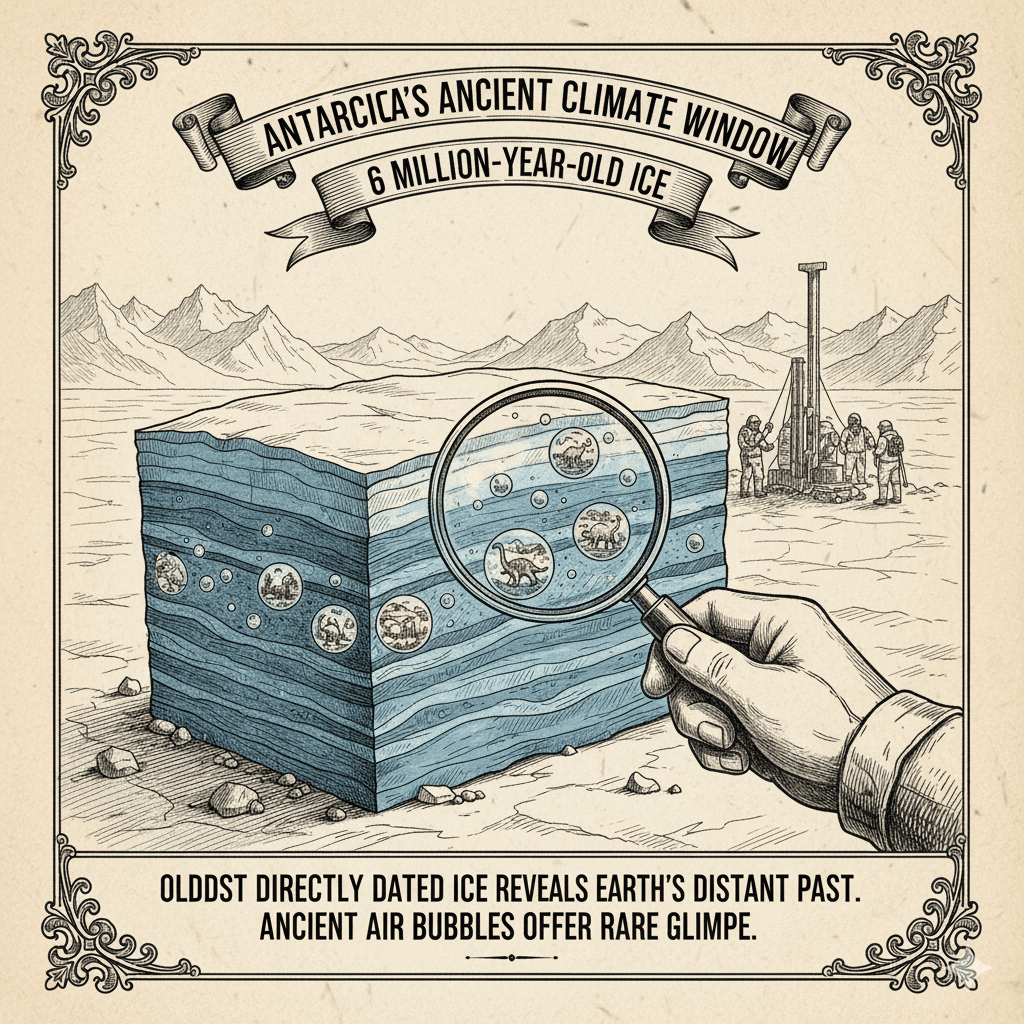
In a groundbreaking Antarctic ice discovery, researchers have unearthed a 6-million-year-old sample of ice — the oldest directly dated ice ever found on Earth. The discovery, made in the Allan Hills region of Antarctica, provides an unprecedented glimpse into the planet’s distant climate history and could revolutionize how scientists understand natural temperature and atmospheric changes over millions of years.
Historic Antarctic Ice Discovery in Allan Hills
The Antarctic ice discovery was made by an international research team supported by the U.S. National Science Foundation’s Center for Oldest Ice Exploration (COLDEX). Their findings, published in PNAS, reveal that the ancient ice is more than twice as old as the previously oldest ice cores, which dated back about 2.7 million years.
Lead researcher Dr. Sarah Shackleton of the Woods Hole Oceanographic Institution described the discovery as “a true time capsule of Earth’s climate system.” Trapped within the ice are microscopic air bubbles — tiny pockets of atmosphere preserved for millions of years — offering direct evidence of greenhouse gas concentrations long before humans existed.
Why the Antarctic Ice Discovery Matters
This 6-million-year-old Antarctic ice is more than a scientific curiosity — it’s a vital record of how Earth’s climate responded to ancient natural forces. By analyzing the chemical composition and gas content of the trapped air, scientists can reconstruct temperature patterns, carbon dioxide levels, and atmospheric circulation from a time when global climates were drastically different.
Dr. Shackleton explained that these insights could improve modern climate models, helping scientists predict future warming trends based on the planet’s natural rhythms:
“This ancient ice gives us a window into Earth’s climate before ice sheets expanded across Antarctica — a world far warmer than today.”
How the World’s Oldest Ice Was Found
The research team drilled shallow ice cores in the Allan Hills Blue Ice Area, a site known for pushing older ice toward the surface through glacial movement. Using radiometric dating techniques, scientists confirmed the ice’s age at approximately 6 million years, making it the oldest directly dated sample of its kind.
Unlike deep ice cores that capture layered records of annual snowfall, this surface ice offers fragments of much older material, carried upward by ancient glacial flow.
Next Steps: Searching Deeper Beneath Antarctica
The success of this Antarctic ice discovery is fueling plans for deeper drilling projects under the COLDEX initiative, which aims to locate continuous ice records stretching back beyond 10 million years. Such discoveries could reveal how carbon dioxide levels and global temperatures interacted during past warm periods — information essential for predicting future climate change.
Researchers say this milestone pushes the limits of paleoclimate science and demonstrates the immense value of Antarctica as Earth’s natural climate archive.
Source:
Live Science – 6 Million-Year-Old Ice Discovered in Antarctica Shatters Records (Nov 4, 2025)
Read more on Antarctica news: 360 News Orbit – Antarctica