
Scientists have recently confirmed that a massive Antarctic gravity hole is currently reshaping our understanding of planetary physics and deep-seated geological movements. This phenomenon, characterized by a significantly weaker gravitational pull, serves as a direct window into the complex behavior of Earth’s mantle and its long-term impact on the frozen continent. By utilizing advanced seismic data and complex computer simulations, geophysicists have successfully mapped the origins of this anomaly to ancient rock shifts occurring millions of miles beneath the surface. This discovery provides a vital link between deep-earth processes and the surface climate, offering new perspectives on how the Antarctic gravity hole influenced the initial formation of massive ice sheets.
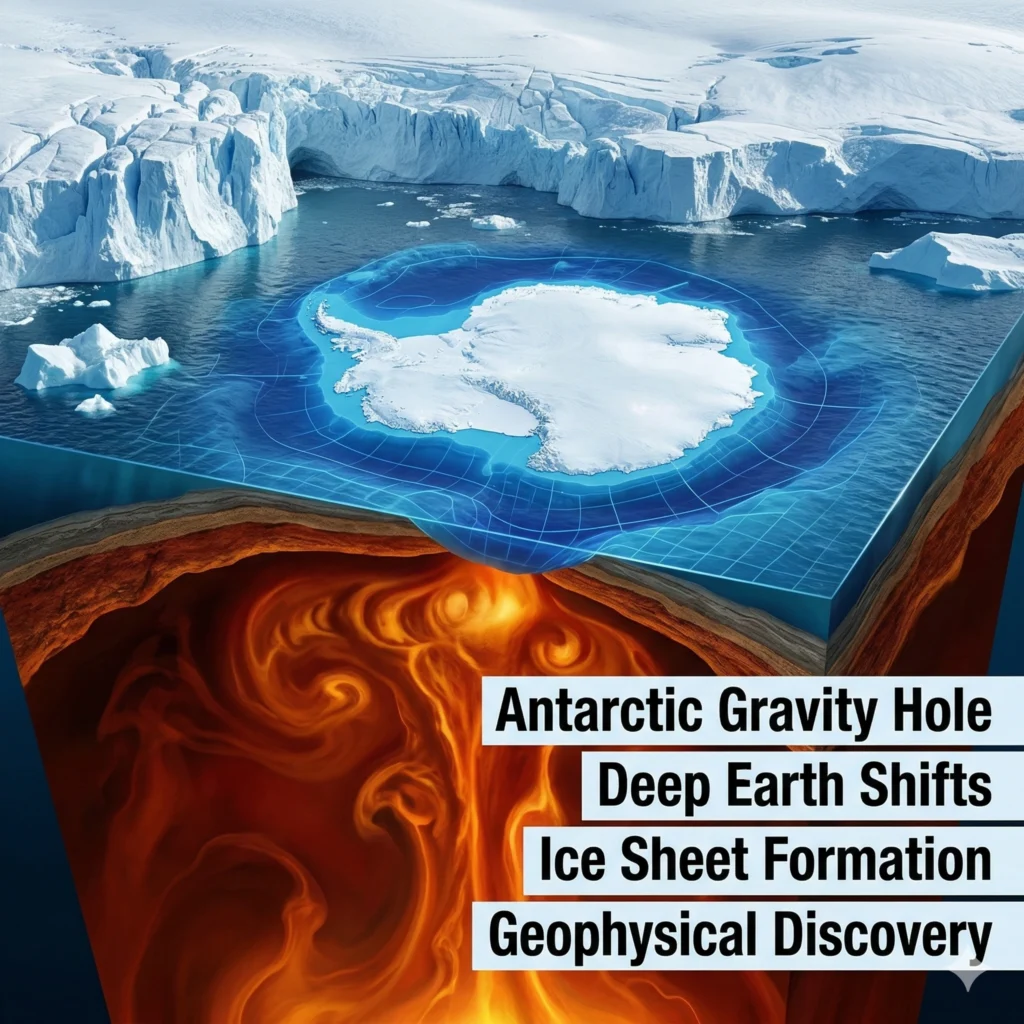
Understanding the Origin of the Antarctic Gravity Hole
The presence of the Antarctic gravity hole is not a result of modern climate change but rather a product of deep-seated planetary evolution over tens of millions of years. Geophysicists Alessandro Forte and Petar Glišović reconstructed the anomaly’s evolution using advanced physics-based computer models that simulate rock density variations. These researchers discovered that the gravitational low is caused by the slow, churning movement of the Earth’s interior, which creates areas where the mass is less concentrated than in surrounding regions.
The study indicates that the Antarctic gravity hole formed during a period when the planet’s internal convection currents shifted significantly, altering the density of the rock far beneath the Antarctic crust. This reduction in density translates directly to a weaker gravitational pull at the surface, a find that has profound implications for global oceanography. Because gravity dictates the level of the sea, the ocean surface in this specific region actually sits lower relative to the Earth’s center than in other parts of the world.
Antarctic Gravity Hole
The formation of the Antarctic gravity hole is a testament to the dynamic nature of our planet’s hidden interior layers. As rock moves slowly within the mantle, it creates a “CT scan” effect when analyzed via global earthquake recordings, allowing scientists to see through the crust. These seismic waves reveal that the gravity hole is not a static feature but a growing anomaly that has been developing since the continent first began to freeze over.
- Global earthquake recordings were used to map the three-dimensional interior of the planet.
- Variations in gravity are caused by differences in rock density located deep beneath the crust.
- The research utilized advanced physics-based computer models to track these density changes.
- Deep-seated rock shifts occurring over tens of millions of years gradually formed this low.
Seismic Mapping and Planetary Density Variations
Mapping the Antarctic gravity hole required the integration of massive datasets spanning decades of seismic activity. Scientists used these recordings to detect how energy travels through different layers of the Earth, noting that waves slow down or speed up based on the temperature and density of the rock. This data confirmed that the region beneath Antarctica contains a unique composition of mantle material that contributes to the weakened gravitational pull observed today.
These variations in density are the primary drivers of the Antarctic gravity hole, acting as the fundamental cause for the dips in the geoid, or the hypothetical shape of the ocean surface. When the internal mass is lower, there is less pull on the water above, causing it to disperse toward areas of higher density. This movement of water away from the Antarctic gravity hole has likely influenced the surrounding oceanic currents for millennia.
The Role of Mantle Convection in Gravity Shifts
Mantle convection is the engine behind the Antarctic gravity hole, driving the slow-motion dance of tectonic plates and internal rock shifts. Over geological timescales, the heat from the Earth’s core causes the mantle to circulate, bringing lighter material toward the crust in some areas while pushing denser material down in others. In the case of Antarctica, the rising of less dense rock has created a persistent “hole” in the gravity field.
The study published in Scientific Reports highlights that the Antarctic gravity hole is a direct consequence of these convection patterns. By understanding how the mantle moves, researchers can better predict how the surface of the planet will react to internal changes. This discovery emphasizes that the Antarctic gravity hole is a crucial piece of the puzzle in understanding the long-term stability of the Earth’s poles and their geographical features.
Impact of the Antarctic Gravity Hole on Sea Levels
One of the most striking effects of the Antarctic gravity hole is its direct influence on regional sea levels and the topography of the Southern Ocean. Because the gravitational pull is weaker, the seawater naturally flows away from this gravity hole toward regions where the pull is stronger, such as the mid-latitudes. This creates a physical depression in the ocean’s surface that must be accounted for in modern climate modeling.
If the Antarctic gravity hole were to shift or deepen further, it could lead to significant changes in how ice sheets interact with the surrounding water. Current models suggest that the lower sea level caused by the Antarctic gravity hole may have actually provided a stable base for early ice growth. Understanding this relationship is essential for scientists who are trying to determine how future changes in the Earth’s interior might affect modern ice stability.
- Seawater naturally flows away from the gravitational low toward areas with higher pull.
- The ocean surface sits lower relative to the Earth’s center within the anomaly.
- This displacement of water influences the path of deep-sea currents around the continent.
- Gravity anomalies are critical factors in calculating the “true” sea level across the globe.
Overlap with the Formation of Polar Ice Sheets
The timing of the development of the Antarctic gravity hole is particularly fascinating to paleoclimatologists. The research suggests that the anomaly began to reach its current magnitude just as the continent’s massive ice sheets were first starting to form. This suggests that the Antarctic gravity hole and the cooling of the planet may be linked through complex feedback loops involving the Earth’s crust and mantle.
As the Antarctic gravity hole lowered the local sea level, it potentially exposed more land for ice to accumulate upon. This geological assist could have been a deciding factor in why Antarctica became the icy fortress it is today. Future studies will continue to investigate if the growth of the Antarctic gravity hole actively encouraged the development of these vast and ancient ice layers.
Advanced Simulations of Deep Planetary Processes
To prove the existence and history of the Antarctic gravity hole, the team utilized some of the most complex simulations ever created in the field of geophysics. These models incorporate fluid dynamics, thermodynamics, and seismic observations to recreate the past 100 million years of Earth’s history. Through these simulations, the Antarctic gravity hole appears not as a fluke, but as a predictable outcome of planetary cooling.
The accuracy of these models in predicting the current state of the Antarctic gravity hole gives scientists confidence in their ability to forecast future changes. By looking deep into the planet’s hidden history, we are gaining a better understanding of the forces that keep our world in balance. The Antarctic gravity hole remains a primary focus for researchers looking to bridge the gap between deep-earth physics and surface-level environmental science.
The Future of Gravitational Research in Antarctica
Ongoing research into the Antarctic gravity hole is expected to reveal even more about the hidden structures of our planet. As technology improves, scientists hope to gain higher-resolution images of the rock shifts that continue to fuel the Antarctic gravity hole. These updates will allow for more precise measurements of how the Antarctic gravity hole changes over shorter periods, perhaps even within a human lifespan.
- Future research will investigate if gravitational changes encouraged ice layer development.
- Global scientific efforts combine seismic data with high-fidelity simulations.
- New satellites are being designed to measure the Antarctic gravity hole with extreme precision.
- Understanding the Earth’s interior provides vital insights into long-term continental stability.
Geoid Anomalies and Global Climate Insights
The Antarctic gravity hole is categorized as a geoid anomaly, which is a variation in the Earth’s gravitational field that deviates from a perfect sphere. By studying the Antarctic gravity hole, scientists can learn about the viscosity of the mantle and how quickly rock flows under immense pressure. This information is vital for understanding the overall heat budget of the Earth and how it dissipates over time.
Furthermore, the Antarctic gravity hole serves as a reminder that the Earth is a connected system. Changes deep within the core can manifest as the Antarctic gravity hole, which in turn affects the oceans and the atmosphere. This holistic view of the planet is becoming increasingly important as we face global challenges that require a deep understanding of every layer of our world.
Conclusion on the Antarctic Gravity Anomaly
The discovery and mapping of the Antarctic gravity hole mark a significant milestone in the field of earth sciences. This anomaly, driven by the ancient movement of rock, shows that our planet is still a work in progress, constantly being reshaped by forces far beneath our feet. The Antarctic gravity hole will continue to be a subject of intense study as we work to protect and understand the fragile environment of the southernmost continent.
By recognizing the influence of the Antarctic gravity hole, we can better appreciate the complex history of our world. The Antarctic gravity hole is more than just a scientific curiosity; it is a fundamental part of the Earth’s structure that has shaped its geography for millions of years. As we move forward, the lessons learned from the Antarctic gravity hole will undoubtedly inform our approach to planetary science and climate preservation.
For more details & sources visit: ScienceDaily
Read more on Antarctica news: 360 News Orbit – Antarctica.