
The Algerian Government Reviews initiative marks a pivotal moment in the nation’s economic trajectory as Prime Minister Sifi Ghrieb leads a high-level executive council. This comprehensive evaluation focuses on the 2026–2028 sectoral roadmaps, aiming to accelerate the activation of a modern real estate management system. By prioritizing industrial land access, the administration seeks to attract significant domestic and international investment to diversify the economy. Prime Minister Sifi Ghrieb, a technocrat with a background in materials science, has emphasized that these structural reforms are the backbone of Algeria’s future prosperity.
The Wednesday session served as a critical platform for cabinet members to present detailed blueprints for the country’s most vital non-hydrocarbon sectors. The Algerian Government Reviews process ensures that every ministry is aligned with the broader national investment promotion framework to reduce energy dependency. With a focus on mining, healthcare, and social solidarity, the government is building a multi-year strategy for sustainable development. This transition toward a digitized and transparent management system is expected to eliminate bureaucratic hurdles that previously hindered large-scale industrial projects across the various provinces.
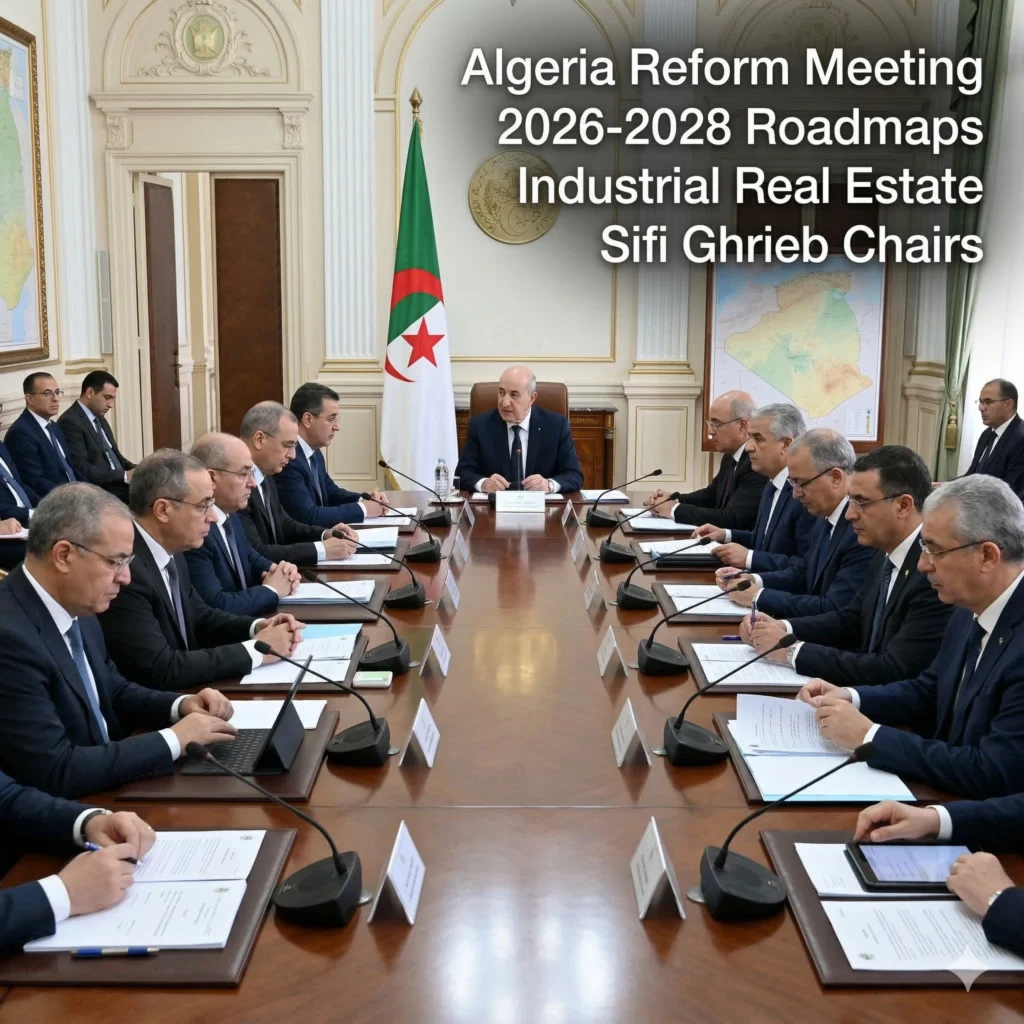
The Algerian Government Reviews Industrial Real Estate
Central to the meeting was a presentation regarding the current operations of the National Agency for Industrial Real Estate. This agency is the primary vehicle for the government’s strategy to streamline land access for both local and foreign project holders. During the Algerian Government Reviews, officials highlighted the importance of a fully digitized system to manage land assets with maximum transparency. By modernizing how industrial land is allocated, Algeria aims to create a more competitive environment for manufacturing and heavy industry.
The Prime Minister oversaw the transition to this new economic real estate management system, which is designed to accommodate a surge in new investment. The Algerian Government Reviews identified specific geographic zones that are ready for immediate industrial deployment to support the national supply chain. This move is seen as a direct response to the increasing demand for high-quality industrial space from global investors looking at North Africa. The goal is to provide a seamless experience for businesses, from the initial land application to the final project implementation phase.
Algerian Government Reviews
The executive council performed a deep dive into the Mining sector’s development plan, which extends through the year 2028. This roadmap is designed to unlock the vast mineral potential of the Saharan regions, focusing on iron ore, phosphate, and gold extraction. Through the Algerian Government Reviews, the cabinet established clear milestones for infrastructure development to support these remote mining sites. The government believes that a robust mining sector will provide the raw materials necessary for a burgeoning domestic manufacturing industry.
In addition to resource extraction, the Health sector roadmap received significant attention during the Wednesday session. The Algerian Government Reviews emphasized improving healthcare infrastructure and service delivery over the next three years to meet growing population needs. Plans include the construction of specialized hospitals and the modernization of existing medical facilities across the country. By investing in healthcare, the Sifi Ghrieb administration aims to improve the quality of life for all citizens while creating high-value jobs in the medical services field.
Labor and Social Solidarity Frameworks
The Algerian Government Reviews also covered comprehensive plans for the Labor, Employment, and Social Security sectors. These discussions were aimed at addressing national workforce requirements and ensuring that the education system produces graduates with relevant industrial skills. The roadmap for 2026–2028 includes initiatives to boost youth employment and formalize more sectors of the economy. By aligning labor policies with industrial goals, the government hopes to create a more resilient and versatile national workforce.
- New vocational training programs will be launched to support the expanding mining and industrial sectors.
- Social security reforms are being evaluated to provide better coverage for workers in the private sector.
- The Algerian Government Reviews highlighted the need for data-driven labor market analysis to predict future needs.
- National solidarity programs will be strengthened to support vulnerable families during this economic transition.
Furthermore, the strategies for National Solidarity, Family, and Women’s Affairs were evaluated to ensure a strong social safety net. The Algerian Government Reviews prioritized the empowerment of women in the workforce as a key driver of economic growth. By providing better support systems for families, the government aims to foster a more inclusive economic environment where all citizens can contribute to national development.
Strategic Economic Diversification Goals
The 2026–2028 roadmaps serve as a multi-year blueprint to reduce Algeria’s long-term economic dependence on the hydrocarbon industry. Since his appointment in 2025, Prime Minister Sifi Ghrieb has made diversification the centerpiece of his governing philosophy. During the Algerian Government Reviews, it was noted that the success of these roadmaps depends on the seamless integration of different sectoral goals. The synergy between mining, industry, and labor is essential for creating a self-sustaining economic ecosystem that can withstand global energy price fluctuations.
The Prime Minister’s Office confirmed that these regular reviews are essential for monitoring the progress of major structural reforms. The Algerian Government Reviews process allows the executive branch to identify bottlenecks in real-time and adjust policies accordingly. This agile approach to governance is a departure from previous bureaucratic models and reflects the Prime Minister’s technocratic background. Officials believe that this rigorous monitoring will ensure that the 2028 targets for industrial growth and social development are met on schedule.
Digitization of the Investment Process
A major theme of the Algerian Government Reviews was the total digitization of the investment promotion framework. The National Agency for Industrial Real Estate is leading the charge by launching an online portal for land acquisition. This digital shift is intended to reduce the time it takes for an investor to secure a project site from months to weeks. By removing the human element from the initial allocation phases, the government is significantly reducing the risk of administrative corruption and inefficiency.
- The online platform will provide real-time data on available industrial plots across all 58 provinces.
- Investors will be able to track the status of their applications through a transparent digital dashboard.
- The Algerian Government Reviews mandated that all regional investment offices be linked to the central database by mid-2026.
- Digital signatures and electronic document submission will become the standard for all industrial real estate transactions.
This modernization effort is expected to boost Algeria’s ranking in international “ease of doing business” indices. The Algerian Government Reviews emphasized that digital transparency is the best way to build trust with international partners. As more sectors move toward digital roadmaps, the government anticipates a significant increase in foreign direct investment into the non-oil sectors of the economy.
Infrastructure and Mining Logistics
To support the 2026–2028 mining roadmap, the government is planning a massive expansion of the national railway network. The Algerian Government Reviews highlighted that transporting bulk minerals from the deep south to northern ports requires a modernized logistics backbone. Significant investments are being diverted toward high-capacity rail lines and specialized ports to handle increased mineral exports. This infrastructure push will also benefit other industrial sectors by lowering the overall cost of domestic inland transport.
The healthcare roadmap also includes a logistical component, focusing on the distribution of pharmaceuticals and medical supplies. During the Algerian Government Reviews, the cabinet discussed the creation of regional medical hubs to ensure that even remote areas have access to life-saving treatments. This decentralization of healthcare services is a key part of the social solidarity program aimed at reducing regional inequalities. By building infrastructure that serves both the economy and the people, the government is ensuring a balanced development path for the nation.
Workforce Training and Education Reforms
The Algerian Government Reviews recognized that an industrial revolution requires a highly skilled workforce. Consequently, the labor and employment roadmap is being closely integrated with the Ministry of Higher Education. New curricula are being developed to focus on engineering, materials science, and digital management to support the new economic real estate system. The government is also encouraging partnerships between universities and industrial companies to provide students with practical, hands-on experience before they enter the job market.
- Technical colleges will receive additional funding to modernize their labs and workshops.
- The Algerian Government Reviews suggested tax incentives for companies that invest in employee training programs.
- A national registry of skilled workers will be created to help industrial project holders find the right talent.
- International exchange programs will be expanded to bring global technical expertise to Algerian industrial zones.
By focusing on human capital, the Sifi Ghrieb administration is ensuring that the economic reforms have a lasting impact. The Algerian Government Reviews stressed that the transition to a non-hydrocarbon economy is not just about building factories, but about empowering the people who will run them. This holistic approach to development is intended to create a stable and prosperous society for future generations of Algerians.
Social Safety Nets and Solidarity Programs
While the focus is on economic growth, the Algerian Government Reviews did not ignore the importance of social stability. The roadmap for National Solidarity and Family Affairs includes specific measures to protect the most vulnerable during the transition period. This includes targeted subsidies, improved social housing programs, and enhanced support for people with disabilities. The Prime Minister emphasized that no citizen should be left behind as the country moves toward its 2028 economic goals.
The social solidarity programs also focus on the economic empowerment of rural families. Through the Algerian Government Reviews, the cabinet evaluated small-scale credit programs that help families start artisanal or agricultural businesses. By supporting small-scale entrepreneurship, the government is creating a more diverse and resilient local economy. These programs are viewed as a vital complement to the large-scale industrial projects managed by the National Agency for Industrial Real Estate.
Future Outlook and 2028 Projections
As the Algerian Government Reviews concluded, the Prime Minister expressed confidence in the nation’s ability to achieve its ambitious targets. The 2026–2028 period is expected to be a time of rapid transformation, with the new real estate system serving as the engine of growth. If the sectoral roadmaps are executed as planned, Algeria will emerge in 2028 with a much more balanced economy and a modernized public administration. The focus on transparency, digitization, and human capital is already showing positive signs in the investment community.
The international community is closely watching the Algerian Government Reviews as a signal of the country’s commitment to reform. By moving away from the “rentier” model of the past, Algeria is positioning itself as a key economic player in the Mediterranean region. The success of Prime Minister Sifi Ghrieb’s technocratic approach could serve as a model for other resource-rich nations looking to diversify. With a clear vision and a rigorous review process, the Algerian government is well on its way to building a new economic reality.
For more details & sources visit: Radio Algérienne
For more updates about Algeria, visit the Algeria News Section.