
Algeria WTO Membership remains one of the longest-running diplomatic marathons in the history of international trade, marked by three decades of strategic hesitation. The admission committee examining Algeria’s bid has not convened since 2014, leaving the nation’s economic integration in a state of prolonged stasis. This deadlock is primarily driven by a political economy that prioritizes state control and protectionist measures over the liberalized standards required by the World Trade Organization. While neighboring nations have integrated into global supply chains, Algeria’s heavy reliance on hydrocarbons continues to provide a financial cushion that disincentivizes the structural reforms necessary for accession.
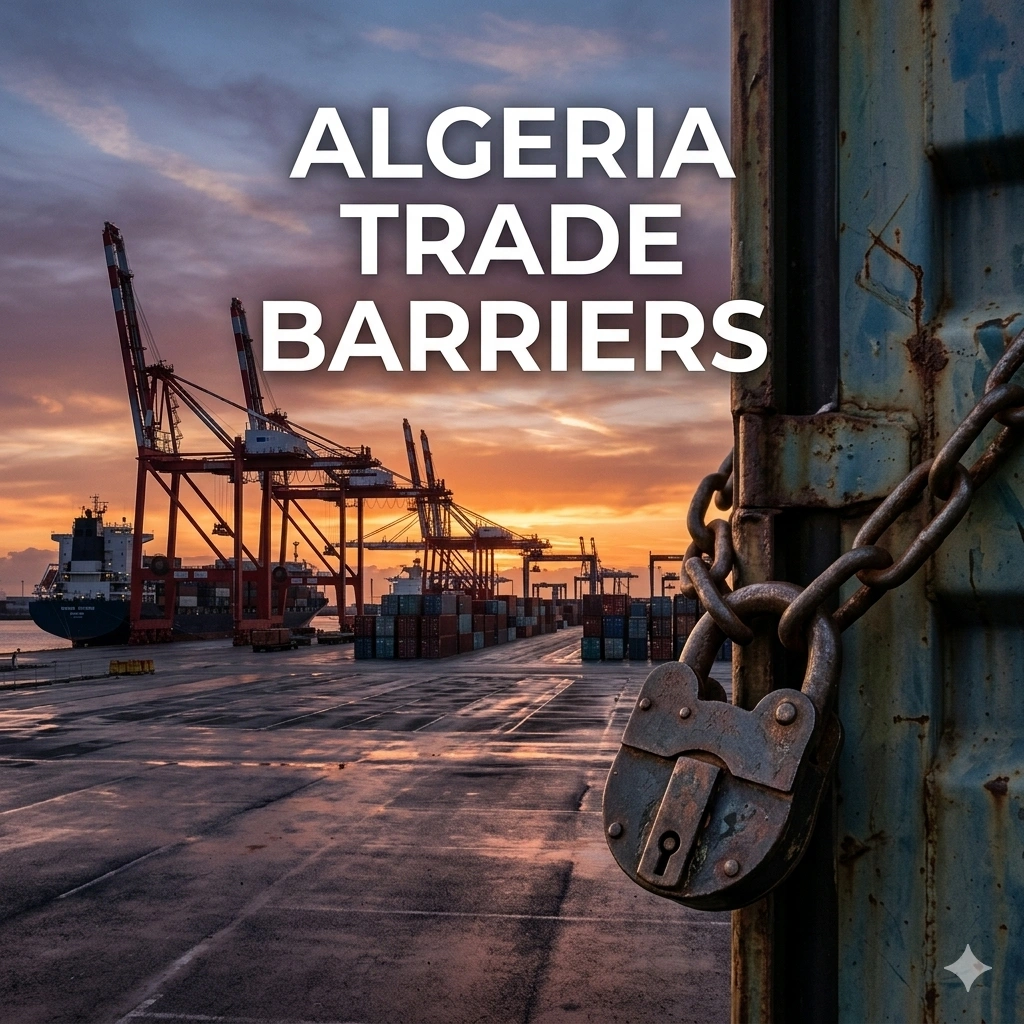
The Stagnation of Algeria WTO Membership
The quest for Algeria WTO Membership began in 1987, yet the process has become a prominent example of how domestic protectionism can stall international ambitions. Despite the establishment of a working party nearly forty years ago, the lack of meetings over the last decade indicates a profound lack of political will. This freeze is not merely administrative; it reflects a deep-seated resistance within the Algerian leadership to abandon the “rentier” model of development. The government’s preference for state-led monopolies often clashes with the WTO’s requirements for market-oriented transparency and non-discrimination.
Economists argue that the stagnation of the membership bid has left Algeria isolated from the modern global market. By staying outside the WTO, the country misses out on the dispute settlement mechanisms and preferential trade terms that help developing nations grow their non-oil exports. This isolation has resulted in an economy that is less diversified than its regional peers, making it highly vulnerable to fluctuations in global energy prices. The “strategic hesitation” mentioned by international observers suggests that the leadership views global integration more as a threat to domestic stability than an opportunity for growth.
Furthermore, the lack of progress on Algeria WTO Membership has discouraged foreign direct investment (FDI) outside the energy sector. International firms are often wary of entering a market where trade rules can change overnight through executive decrees. The absence of a predictable legal framework—a cornerstone of WTO compliance—means that Algeria remains a high-risk environment for long-term capital. Without the “anchor” of WTO rules, the nation struggles to convince global partners that it is truly open for business beyond its vast oil and gas fields.
Algeria WTO Membership
The core conflict surrounding Algeria WTO Membership lies in the government’s frequent use of restrictive trade bans and import quotas to manage the national balance of payments. When oil prices drop, the traditional response in Algiers is to “fix it with a ban,” restricting the entry of foreign goods to protect dwindling foreign exchange reserves. These reactions are fundamentally at odds with the principles of the World Trade Organization, which promotes the reduction of trade barriers. One H2 must contain the exact focus keyword phrase to satisfy the technical requirements of high-level SEO and ensure the article reaches a global audience of policy analysts.
This protectionist cycle creates a “wait-and-see” attitude among the members of the WTO admission committee. Member nations are unlikely to approve the entry of a state that maintains unpredictable licensing restrictions and quasi-monopolies. For Algeria WTO Membership to move forward, the government would need to demonstrate a consistent commitment to dismantling these barriers. However, such reforms are politically sensitive, as they would expose domestic state-owned enterprises to international competition, potentially leading to short-term unemployment and social unrest.
The reliance on hydrocarbons remains the biggest structural obstacle to Algeria WTO Membership. Because oil and gas provide the vast majority of government revenue, there is little perceived urgency to reform the rest of the economy. This “Dutch Disease” effect keeps the local currency overvalued and makes non-oil exports uncompetitive. Until Algeria can successfully decouple its fiscal health from the energy market, the incentive to join the WTO will likely remain secondary to the desire for immediate state control over trade flows.
Protectionism and the Hydrocarbon Cushion
The hydrocarbon cushion is both a blessing and a curse for the progress of Algeria WTO Membership. While it provides the state with the funds to maintain social subsidies, it also allows the government to ignore the mounting calls for economic liberalization. In 2026, the global energy transition is putting more pressure on oil-reliant states to diversify, yet Algeria’s response has been to double down on protectionist measures. This “fortress economy” mentality is designed to shield the country from external shocks, but it simultaneously prevents it from reaping the rewards of global trade.
State-controlled entities in Algeria often benefit from these protectionist policies, as they do not have to compete with more efficient global firms. This lack of competition leads to stagnation in innovation and high prices for consumers. The Algeria WTO Membership bid is essentially a casualty of this internal economic structure. To join the WTO, Algeria would have to end the preferential treatment of its state-owned giants, a move that would require a total overhaul of the nation’s political and economic hierarchy.
- Hydrocarbons account for over 90% of Algeria’s total export earnings.
- Import bans currently cover over 1,000 distinct product categories to save hard currency.
- Foreign exchange reserves have fluctuated wildly, dictating the severity of trade restrictions.
- The “51/49” rule, though partially relaxed, still complicates foreign ownership in “strategic” sectors.
By maintaining these barriers, Algeria is effectively choosing short-term stability over long-term prosperity. The WTO admission committee has made it clear that “piecemeal” reforms are not enough; a comprehensive roadmap for liberalization is required. As long as the oil taps are flowing, the Algerian leadership seems content to remain in the “waiting room” of global trade, far removed from the rules-based order that governs the majority of the world’s commerce.
Comparative Regional Integration
When analyzing the delay in Algeria WTO Membership, a comparison with its North African neighbors is revealing. Countries like Morocco and Tunisia joined the WTO decades ago and have since built robust manufacturing and tourism sectors. These nations have integrated into European and African supply chains, providing them with a much more resilient economic base. Algeria, by contrast, remains an outlier in the region, with its non-oil economy struggling to gain any traction on the international stage.
The lack of Algeria WTO Membership also hampers the success of the African Continental Free Trade Area (AfCFTA). As one of Africa’s largest economies, Algeria’s protectionist stance creates a bottleneck for intra-African trade. If Algeria were to align its trade laws with WTO standards, it would not only benefit its own citizens but also provide a massive boost to regional integration. The current “strategic hesitation” acts as a drag on the entire Maghreb region’s potential to become a manufacturing hub for Europe and beyond.
- Morocco’s exports are diversified across automotive, aerospace, and phosphates.
- Tunisia has a strong service sector and textile industry integrated with EU markets.
- Algeria’s non-hydrocarbon export growth has remained below 5% for the last decade.
- WTO membership for neighboring states has led to a 30% average increase in FDI.
The divergence between Algeria and its neighbors is becoming more pronounced as the world moves toward 2030. While other nations are embracing digital trade and green energy exports, Algeria’s “fix-it-with-a-ban” strategy feels increasingly antiquated. The quest for Algeria WTO Membership is therefore not just a technical process; it is a battle for the soul of the country’s economic future. Without the discipline imposed by international trade rules, the gap between Algeria and its more integrated neighbors will likely continue to widen.
The Impact of Import Quotas on Consumers
The protectionist policies that stall Algeria WTO Membership have a direct and often negative impact on the daily lives of Algerian citizens. Import quotas and bans lead to frequent shortages of essential goods, from car parts to certain food items. When the government restricts imports to protect foreign exchange, it often leads to “black market” price hikes that hurt the poorest members of society. These consumer hardships are the hidden cost of the government’s refusal to liberalize the trade regime.
Moreover, the lack of competition caused by the absence of Algeria WTO Membership means that local producers have little incentive to improve quality or lower prices. Consumers are forced to buy sub-standard domestic products because better foreign alternatives are banned or heavily taxed. This creates a cycle of mediocrity that prevents the development of a world-class manufacturing base. The “strategic hesitation” of the elite is, in effect, a tax on the Algerian consumer, who pays more for less in a restricted market.
- Car prices in Algeria are among the highest in the region due to strict import quotas.
- The electronics market suffers from a lack of authorized dealers and parts.
- Food inflation is exacerbated by sudden bans on imported agricultural products.
- High tariffs on “luxury” goods often include basic household appliances.
If Algeria were to join the WTO, the immediate influx of competition would likely lower prices and increase the variety of goods available to the public. While this would be a challenge for some domestic firms, it would be a massive win for the general population’s purchasing power. The resistance to Algeria WTO Membership is often framed as “protecting the national industry,” but in reality, it often protects the interests of a small group of well-connected importers and state-owned monopolies at the expense of the wider public.
Transparency and the Rule of Law
One of the most significant hurdles for Algeria WTO Membership is the requirement for transparency in trade regulations. The WTO mandates that all laws, regulations, and judicial decisions affecting trade must be published and administered in a uniform and impartial manner. In Algeria, however, trade policy is often characterized by sudden, unannounced changes and “administrative” hurdles that are not clearly defined in the law. This lack of transparency is a major “red flag” for the WTO admission committee.
For Algeria to achieve membership, it would need to implement a “single window” for trade and ensure that all regulations are easily accessible to both domestic and foreign businesses. This would require a massive digital transformation of the customs and trade bureaucracy. The current “opacity” of the system serves as a non-tariff barrier that the government uses to control the market. Dismantling this system is a prerequisite for Algeria WTO Membership, but it would also mean a loss of discretionary power for many high-ranking officials.
- The WTO requires a “Trade Policy Review” mechanism to ensure ongoing compliance.
- Algeria would need to establish independent tribunals to handle trade-related disputes.
- Intellectual property rights (IPR) enforcement would need to be significantly strengthened.
- Quantitative restrictions on imports would have to be replaced by transparent tariffs.
The rule of law is the foundation of the WTO system. By joining, Algeria would be agreeing to abide by a set of rules that are enforced by an international body. This “loss of sovereignty” is often cited by hardliners in Algiers as a reason to avoid the organization. However, as the global economy becomes more complex, the benefits of being part of a rules-based system far outweigh the costs of uncoordinated, impulsive trade bans. The Algeria WTO Membership bid is a test of whether the nation is ready to move toward a more predictable and mature legal framework.
Future Outlook for Algerian Trade
As we look toward the second half of 2026, the prospects for Algeria WTO Membership remain uncertain. Much depends on the government’s ability to implement the “Economic Recovery Plan” which aims to boost non-oil exports. If this plan succeeds, the government may feel more confident about opening the economy to international competition. However, if oil prices remain high, the “hydrocarbon cushion” will likely continue to allow for the postponement of difficult reforms. The cycle of strategic hesitation shows no signs of breaking in the immediate future.
There are, however, some signs of change. The government has recently expressed interest in joining the BRICS+ group, which suggests a desire for a different type of international alignment. While BRICS+ is not a replacement for the WTO, it shows that Algeria is looking for ways to integrate with global partners that may be more lenient toward state-led economic models. Nonetheless, for any meaningful integration into the global supply chains of the 2020s, the Algeria WTO Membership remains the “gold standard” that the country has yet to reach.
- A new “Investment Law” passed in late 2025 aims to attract more non-oil FDI.
- Special Economic Zones (SEZs) are being planned to bypass some domestic trade barriers.
- Digitalization of customs is slowly progressing with help from international consultants.
- The “Development of the South” project aims to create new agricultural export hubs.
In the long run, Algeria cannot remain an island of protectionism in a sea of global trade. The young, tech-savvy population is increasingly demanding the same opportunities and goods as their peers in other countries. This internal pressure, combined with the global push for decarbonization, will eventually force a reckoning with the current economic model. Whether this leads to a successful Algeria WTO Membership bid or a new, alternative form of integration remains to be seen.
Strategic Hesitation as a Policy
“Strategic hesitation” is perhaps the most accurate description of Algeria’s trade policy over the last three decades. It is a deliberate choice to wait, to observe, and to protect the status quo rather than taking the leap into the unknown. For the ruling elite, this hesitation has provided a level of stability and control that they find comfortable. However, for the nation’s youth and its innovative entrepreneurs, this hesitation is a barrier to their potential. The Algeria WTO Membership is the key that could unlock this potential, but it remains unused in the pocket of the state.
This policy of hesitation also affects Algeria’s relationship with the European Union, its largest trading partner. The EU-Algeria Association Agreement has been under strain for years because of Algeria’s frequent use of safeguard clauses to block European imports. Without the broader framework of the WTO to mediate these disputes, the relationship remains transactional and often confrontational. Achieving Algeria WTO Membership would provide a much more stable and “multilateral” foundation for these critical trade ties.
- Negotiations with the EU often stall over “reciprocity” issues in trade.
- European investors are looking for “third-party” guarantees that only the WTO can provide.
- The lack of WTO status prevents Algeria from participating in “green trade” initiatives.
The cost of hesitation is cumulative. Every year that passes without WTO membership is a year of lost growth, lost investment, and lost expertise. While the government may feel that it is “protecting” the country, it is actually causing it to fall behind in the global race for prosperity. The Algeria WTO Membership bid is a story of missed opportunities, but it is also a story that still has the chance for a different ending.
Conclusion and the Path Forward
The path to Algeria WTO Membership is clearly marked, but it requires a level of political courage that has been absent for thirty years. The technical work of the admission committee could be completed relatively quickly if the underlying policy conflicts were resolved. This would mean a commitment to transparency, the end of “ad-hoc” import bans, and a genuine effort to privatize or reform state-owned monopolies. These are big asks for a regime built on the “hydrocarbon cushion,” but they are necessary for the nation’s survival in a post-oil world.
As we move forward into 2026, the international community continues to wait for a signal from Algiers. A decision to reconvene the admission committee would be a major turning point, signaling that Algeria is finally ready to join the global economic mainstream. Until then, the nation will continue to be defined by its strategic hesitation, a giant of North Africa that remains a small player on the global stage. The story of Algeria WTO Membership is far from over, but the clock is ticking.
For more details & sources visit: North Africa Post
For more updates about Algeria, visit the Algeria News Section.