
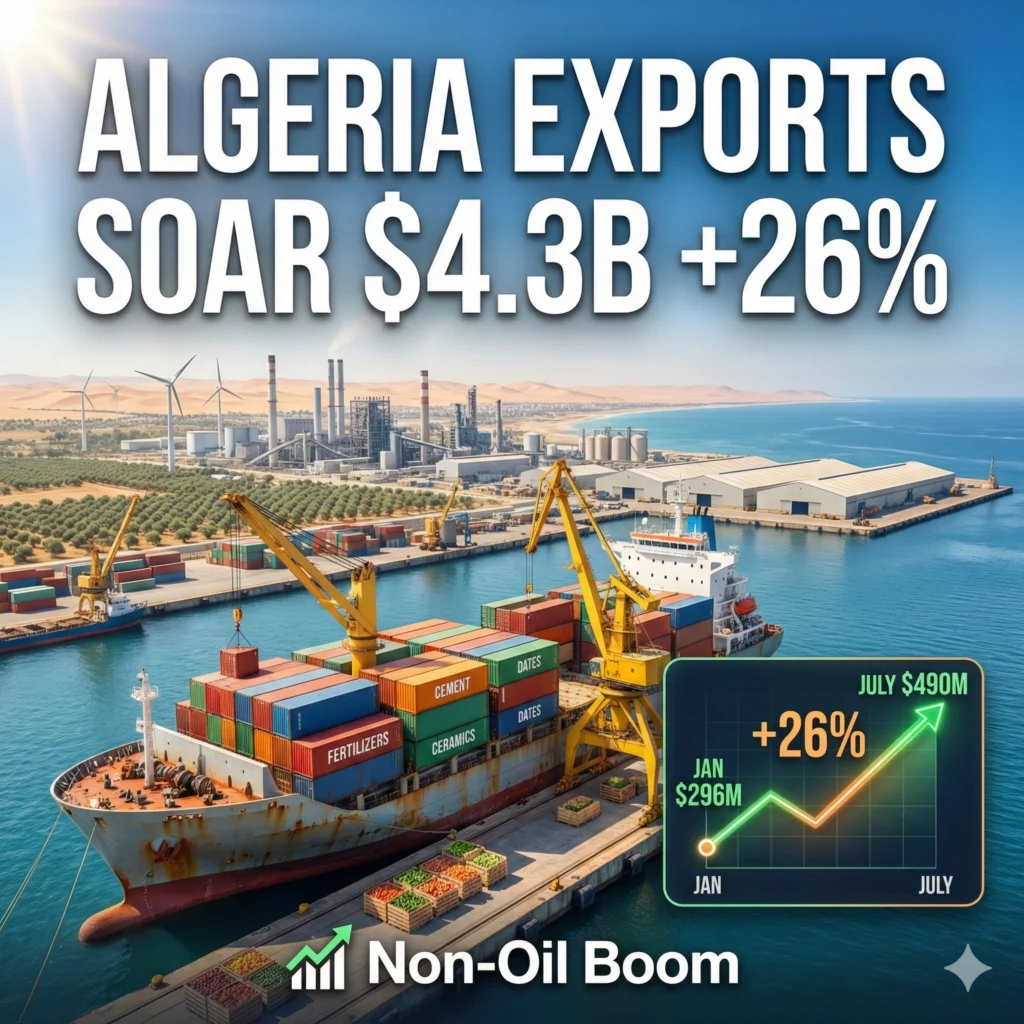
Algeria non-hydrocarbon exports have reached a historic milestone, surging past $4.3 billion in the first nine months of 2025, according to official figures presented this week before the country’s parliament. The 26 percent year-on-year increase signals one of Algeria’s strongest diversification performances to date and reflects growing momentum in sectors long overshadowed by oil and gas.
The figures were disclosed by Foreign Trade and Export Promotion Minister Kamel Rezig during a session of the People’s National Assembly’s Economic Affairs Committee, where he highlighted steady monthly gains and record-breaking export volumes that point to a structural shift in Algeria’s trade strategy.
Algeria Non-Hydrocarbon Exports Show Strong Monthly Momentum
While the year began on a slow note, Algeria non-hydrocarbon exports gained pace as 2025 progressed. January recorded exports of $296 million, reflecting a 12 percent decline compared to the same month in 2024. However, that early dip was followed by consistent growth in the months that followed.
By mid-year, export activity had accelerated significantly. July emerged as a standout month, with non-oil exports hitting $490 million, representing a dramatic 74 percent increase year-on-year. Officials described the July performance as unprecedented, surpassing all previous monthly records in the sector.
Momentum continued into the autumn. October exports climbed to $452 million, marking a 42 percent increase compared to October 2024. According to the ministry, these gains demonstrate improved production capacity, stronger logistics coordination, and rising demand for Algerian goods in regional and international markets.
Key Sectors Driving Algeria’s Export Growth
The surge in Algeria non-hydrocarbon exports has been driven by a diverse mix of industries. Minister Rezig pointed to strong performances across multiple sectors, particularly:
- Fertilizers and chemical products
- Construction materials
- Mining and semi-finished industrial goods
- Agricultural products and foodstuffs
- Household appliances and manufactured goods
These sectors have benefited from targeted government support, improved access to export financing, and expanded trade partnerships. Semi-finished products, in particular, have become a major contributor, helping Algeria move beyond raw material exports toward higher-value goods.
Reducing Algeria’s Heavy Reliance on Hydrocarbons
For decades, hydrocarbons have accounted for nearly 90 percent of Algeria’s export revenues, leaving the economy highly exposed to fluctuations in global oil and gas prices. The recent rise in Algeria non-hydrocarbon exports is therefore seen as a strategic breakthrough rather than a short-term boost.
Officials argue that expanding non-oil exports will help stabilize foreign exchange earnings, create sustainable jobs, and strengthen domestic industrial capacity. The government has framed export diversification as a central pillar of its long-term economic resilience plan.
Rezig told lawmakers that current export figures already exceed totals recorded during the previous two years, reinforcing confidence in Algeria’s diversification strategy.
Trade Agreements and Global Market Expansion Plans
Looking ahead, Algeria aims to push non-hydrocarbon exports even further. Authorities are targeting $5 billion in annual non-oil exports by year-end, supported by more than 80 international trade agreements and participation in major trade fairs across Africa, Europe, and other emerging markets.
Between 2026 and 2028, Algeria plans to expand export activity to 22 global destinations, with a focus on African markets where demand for construction materials, fertilizers, and food products continues to rise. Trade promotion offices are also being strengthened to help local producers meet international standards and certification requirements.
Challenges and Outlook for Algeria Non-Hydrocarbon Exports
Despite the positive trajectory, challenges remain. Exporters still face logistical bottlenecks, fluctuating shipping costs, and the need for consistent quality control to remain competitive abroad. Analysts note that sustaining growth will require continued investment in infrastructure, port efficiency, and export-oriented manufacturing.
Nonetheless, the latest data suggests Algeria non-hydrocarbon exports are no longer a secondary pillar of the economy. Instead, they are emerging as a credible alternative revenue stream with long-term potential.
A Turning Point for Algeria’s Economic Strategy
The record-breaking export figures mark a significant turning point in Algeria’s economic narrative. As non-oil sectors gain strength, the country appears better positioned to weather global energy market volatility while carving out a broader role in regional and international trade.
If current trends hold, Algeria’s push beyond hydrocarbons may soon shift from ambition to lasting economic transformation.
Conclusion
The sharp rise in Algeria non-hydrocarbon exports is more than a statistical success. It reflects a deliberate policy shift aimed at reshaping the country’s economic foundations after decades of oil dependence. Consistent monthly growth, record-breaking figures, and expanding sectoral contributions suggest that diversification is moving from planning to execution.
If Algeria can maintain this momentum through infrastructure upgrades, market expansion, and sustained support for exporters, non-oil trade could become a lasting pillar of national growth. The $4.3 billion milestone not only strengthens short-term trade performance but also positions Algeria for greater stability and competitiveness in an increasingly uncertain global economy.
For more details & sources visit: AL24 News
For more updates about Algeria, visit the Algeria News Section.