
Algeria Mobilizes National Emergency Plan is the current headline as the government initiates a massive coordination effort to protect the agricultural heartland. Prime Minister Sifi Ghrieb recently chaired a high-level interministerial meeting designed to synchronize a massive government mobilization against desert locust infestations in the southwest. This strategic shift moves the nation from a reactive swarm treatment model to a preventive framework focused on monitoring breeding zones across the Grand South and Sahel regions.
The Algerian government launched this comprehensive action plan following specific directives from the nation’s president to protect strategic agricultural investments. Consequently, authorities are now utilizing the Alsat satellite to monitor two million square kilometers of cross-border territory for moist terrain. This high-tech surveillance allows teams to identify areas conducive to locust breeding before swarms can form. By integrating satellite data with ground intelligence, the state aims to neutralize threats at their source.
Currently, the emergency framework includes a strategic stockpile of over 500,000 liters of insecticides and a dedicated fleet of 15 specialized aircraft. One hundred operational teams remain on round-the-clock standby across 23 different wilayas to ensure a rapid response to any localized outbreaks. Logistical support for this mission is being provided by the National People’s Army and the National Institute for Plant Protection. This collaboration ensures that every million dollars invested in regional monitoring can prevent up to 20 million dollars in domestic crop losses.
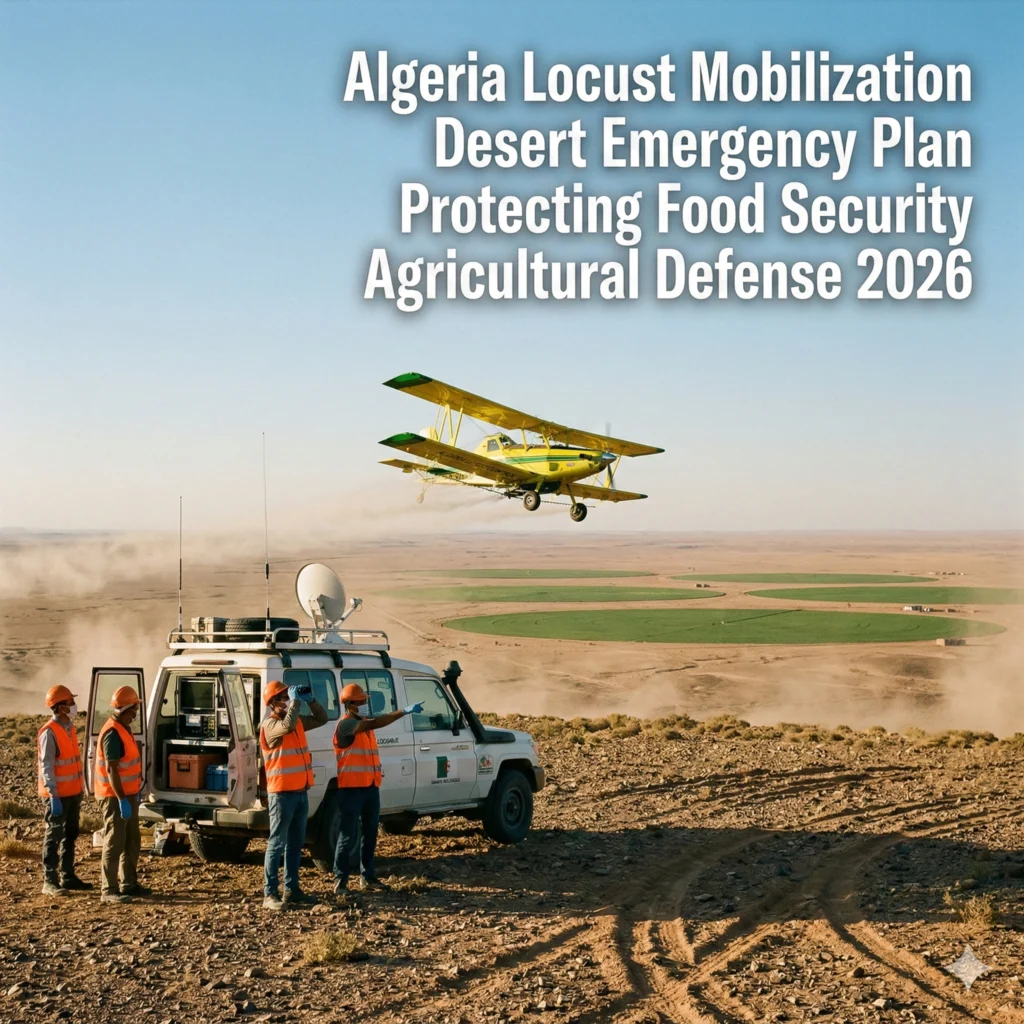
Algeria Mobilizes National Emergency Plan
The current mobilization serves as a critical test for the durability of Algeria’s long-term agricultural development strategy in the Sahara. Because the Grand South region has become a vital cereal production hub, the stakes for food security have never been higher. Thousands of hectares under modern center-pivot irrigation systems are now at risk from migrating swarms. Therefore, the government has prioritized the protection of these specific zones through increased aerial patrols.
Regional cooperation remains a top priority as Algiers hosts the FAO-affiliated Desert Locust Control Committee for the Western Region. This hosting duty allows Algeria to coordinate effectively with neighboring countries in the Sahel. Furthermore, Algeria recently supplied 30,000 liters of pesticides and several four-wheel-drive vehicles to Mali and Mauritania. These donations bolster Sahelian surveillance efforts, which acts as a first line of defense for the entire Maghreb region.
Officials emphasize that maintaining a proactive posture is essential due to the cyclical nature of locust threats. Shifting climatic dynamics and unusual rainfall patterns in the desert can trigger rapid breeding cycles. An uncontrolled locust invasion poses a significant risk to national food security indicators and could place immense strain on public finances. As a result, the interministerial committee meets weekly to review satellite imagery and ground reports.
Satellite Surveillance and the Alsat Program
The use of the Alsat satellite system marks a turning point in how Algeria Mobilizes National Emergency Plan protocols are executed. By scanning two million square kilometers, the military and scientific agencies can detect vegetation growth in remote desert pockets. These “green spots” are often the primary breeding grounds for the desert locust. Once detected, ground teams are deployed to these specific coordinates to conduct soil samples and egg-pod surveys.
This technological advantage allows for a precision strike capability that was previously impossible. Instead of spraying vast tracts of land indiscriminately, the 15 specialized aircraft can target specific clusters. This method is not only more cost-effective but also significantly reduces the environmental impact of chemical insecticides. The National Institute for Plant Protection oversees the calibration of these spraying missions to ensure maximum efficacy.
Moreover, the integration of satellite data helps in predicting the flight paths of existing swarms based on wind patterns. Meteorologists work alongside entomologists to create simulation models that forecast where a swarm might land next. This predictive capability gives the 100 operational teams enough lead time to set up defensive perimeters. Consequently, the agricultural investments in the southwest remain shielded from sudden, devastating incursions.
Logistics of the National People’s Army
The National People’s Army provides the backbone of the logistical framework as Algeria Mobilizes National Emergency Plan operations scale up. Military transport planes move equipment and personnel to remote outposts in the Grand South within hours. This rapid deployment capability is essential when dealing with a biological threat that can travel 150 kilometers in a single day. The army also maintains the fuel supply chains required for the specialized aircraft fleet.
In addition to transport, the army assists in the communication network that links the 23 affected wilayas. Secure radio frequencies and satellite phones ensure that even the most isolated scouting teams can report sightings instantly. This real-time data flow is channeled into a central command center in Algiers. From there, the interministerial committee makes informed decisions about resource allocation and emergency funding.
The synergy between civilian agricultural experts and military logistics creates a formidable barrier against the locust threat. While the scientists focus on the biology and behavior of the insects, the military focuses on the “how” of the intervention. This partnership has been refined over decades of fighting previous invasions. Today, it stands as one of the most sophisticated pest control operations in the African continent.
Protecting Strategic Cereal Production
Protecting the massive investments in Saharan agriculture is the primary reason why Algeria Mobilizes National Emergency Plan measures today. The government has spent billions of dollars developing center-pivot irrigation systems that turn golden sands into green wheat fields. These fields are vital for reducing the national import bill and achieving self-sufficiency. A single large swarm can consume as much food as 35,000 people in one day, making them a direct threat to the economy.
Cereal production in the Grand South is particularly vulnerable because the lush, irrigated crops are an oasis for hungry insects. If a swarm reaches these hubs, the damage could be instantaneous and total. Therefore, the protective “ring” around these production zones includes ground-based sprayers and physical barriers. Farmers are also being trained on how to identify early signs of hopper bands before they take flight.
Furthermore, the economic implications extend beyond just the loss of the current harvest. An invasion could disrupt the planting cycles for the following year and cause a spike in local food prices. By maintaining a strategic stockpile of 500,000 liters of insecticide, the government ensures it can fight a prolonged campaign if necessary. This financial and logistical commitment provides confidence to the private investors who are backing Saharan farming ventures.
Regional Leadership and the FAO Partnership
Algeria’s role as a regional leader is evident in how Algeria Mobilizes National Emergency Plan resources for neighboring states. By hosting the Desert Locust Control Committee for the Western Region, Algiers facilitates a unified front against the pest. The migratory nature of the locust means that a failure in Mali or Mauritania is eventually a problem for Algeria. Thus, the donation of 30,000 liters of pesticides to these nations is a strategic act of self-defense.
This regional cooperation is supported by the Food and Agriculture Organization (FAO) of the United Nations. The FAO provides technical expertise and helps standardize the reporting methods used across the Sahel. When Algeria shares its satellite data with its neighbors, it creates a transparent and collaborative environment. This “early warning system” is the most effective way to prevent the formation of massive, unstoppable swarms.
The 30,000 liters of pesticides sent to Mali and Mauritania were accompanied by 4×4 vehicles equipped with specialized spraying gear. These tools allow Sahelian teams to reach remote areas where locusts typically congregate after seasonal rains. By stopping the breeding process in the Sahel, Algeria reduces the number of swarms that eventually cross its southern borders. This proactive diplomacy is a cornerstone of the national security strategy.
Impact on National Food Security
The success of the current mission determines the stability of national food security indicators for the coming year. As Algeria Mobilizes National Emergency Plan protocols, the focus remains on the long-term viability of the agricultural sector. The nation cannot afford a return to the days of massive crop failures and high dependency on international markets. Therefore, the interministerial meeting emphasized the need for “zero tolerance” toward locust outbreaks.
Food security is not just about the availability of wheat; it is about the stability of the entire supply chain. If the locusts destroy the forage crops in the south, the livestock industry will also suffer. This would lead to higher meat and dairy prices, impacting the average Algerian household. The 500,000 liters of insecticide act as a form of national insurance against such a multi-sector collapse.
Furthermore, the government’s ability to manage this crisis reflects on its broader administrative competence. Successfully repelling a locust invasion proves that the state can protect its citizens from non-traditional security threats. This builds trust between the agricultural community and the central government. As the teams remain on round-the-clock standby, the message to the public is one of vigilance and preparedness.
Technical Training for Operational Teams
A key component of why Algeria Mobilizes National Emergency Plan efforts are so effective is the high level of training. The 100 operational teams are not just sprayers; they are trained technicians who understand insect life cycles. They are taught how to differentiate between harmless local grasshoppers and the dangerous desert locust. This knowledge prevents the unnecessary use of chemicals and protects the local ecosystem.
Training sessions are conducted by the National Institute for Plant Protection in collaboration with international experts. These sessions cover the use of GPS tracking, drone surveillance, and the proper handling of hazardous materials. Because the teams operate in 23 different wilayas, a standardized training manual is used to ensure consistency. This ensures that a team in the far west operates with the same efficiency as a team in the deep south.
- Ground teams utilize handheld tablets to upload real-time data to the central database.
- Specialized mechanics are embedded with each fleet to maintain the 15 aircraft in desert conditions.
- Environmental scientists monitor the impact of spraying on local water sources and non-target species.
- Logistics experts manage the “cold chain” required for certain biological control agents used in the field.
The Role of Shifting Climatic Dynamics
Climate change has altered the traditional patterns of locust movement, which is why Algeria Mobilizes National Emergency Plan strategies must be adaptive. In recent years, the Sahara has experienced unusual rainfall events that create temporary “green corridors.” These corridors allow locusts to migrate further and breed more frequently than in previous decades. The current mobilization takes these shifting dynamics into account by expanding the surveillance zone.
The interministerial committee has noted that the “cyclical nature” of these threats is becoming less predictable. What used to be a ten-year cycle is now occurring more frequently due to warmer winters. Consequently, the 24/7 standby status of the operational teams is no longer a temporary measure but a permanent fixture. The government is investing in climate modeling software to better understand these long-term trends.
By staying ahead of the climate curve, Algeria positions itself as a continental leader in disaster preparedness. The use of the Alsat satellite is part of a larger push toward “smart agriculture” that uses data to mitigate environmental risks. While the locust is an ancient plague, the tools being used to fight it are firmly rooted in the 21st century. This blend of experience and technology is what keeps the swarms at bay.
Financial Efficiency in Pest Control
The government’s mantra as Algeria Mobilizes National Emergency Plan resources is that “prevention is cheaper than cure.” Official estimates suggest that every million dollars spent on monitoring saves twenty million in potential losses. This 20:1 return on investment makes the locust control program one of the most efficient uses of public funds. The Prime Minister emphasized this point during the interministerial meeting to justify the emergency budget.
The 500,000 liters of insecticide and the fleet of 15 aircraft represent a significant upfront cost. However, when compared to the price of importing millions of tons of wheat, the costs are negligible. The mobilization also protects the livelihoods of thousands of farmers and laborers in the southwest. By preventing a crisis, the government avoids the need for expensive social safety nets and emergency food aid.
- Investment in satellite monitoring reduces the need for expensive and fuel-intensive ground patrols.
- Bulk purchasing of insecticides through the National Institute for Plant Protection lowers the unit cost.
- Collaboration with the National People’s Army eliminates the need for private security or transport contractors.
Operational Readiness Across 23 Wilayas
The sheer scale of the operation is evident in the fact that 23 wilayas are involved as Algeria Mobilizes National Emergency Plan protocols. This geographic spread ensures that no matter where a swarm enters the country, a response team is nearby. Each wilaya has its own localized command center that reports back to the national headquarters. This decentralized structure allows for rapid decision-making at the local level.
In the southwest, where the threat is most acute, the teams are equipped with heavy-duty off-road vehicles. These units can traverse the dunes to reach breeding sites that are inaccessible to standard transport. The presence of these teams also serves as a reassuring sight for local communities. It demonstrates that the state is present and active even in the most remote corners of the territory.
The round-the-clock standby status means that teams can be in the air or on the road within thirty minutes of a sighting. This speed is the difference between a small hopper band and a massive flying swarm. The National Institute for Plant Protection conducts regular “fire drills” to ensure that the response times remain sharp. This culture of readiness is what has kept Algeria relatively free of major infestations in recent years.
Scientific Advancements in Locust Control
While the current strategy relies heavily on insecticides, the research wing of the National Institute for Plant Protection is looking for alternatives. As Algeria Mobilizes National Emergency Plan efforts continue, scientists are testing fungal pathogens that specifically target locusts. These biological control agents could eventually replace chemical sprays, making the process even more environmentally friendly. Research is also being done on pheromone traps to disrupt the swarming behavior.
These scientific advancements are shared with the FAO and other regional partners. Algeria’s commitment to research ensures that it stays at the forefront of entomological science. During the interministerial meeting, the importance of supporting national universities and research centers was highlighted. This long-term investment in human capital is just as important as the immediate stockpiling of chemicals.
- Bio-pesticides are currently being trialed in controlled zones within the Grand South.
- New drone technology is being developed for autonomous scouting in high-heat desert environments.
- Genetic mapping of locust populations helps track the origin of various swarms entering the country.
Future Outlook for Saharan Agriculture
The future of Saharan agriculture depends entirely on how effectively Algeria Mobilizes National Emergency Plan initiatives. If the state can prove that it can protect the desert “greenhouse,” more investors will be drawn to the region. The goal is to turn the Grand South into a global example of desert farming excellence. This vision requires a permanent and robust defense against the desert locust.
The Prime Minister’s recent meeting was not just about the current emergency; it was about the next fifty years. By building a sustainable and tech-driven defense system, Algeria is securing its economic independence. The desert locust may be a persistent threat, but the national resolve is even more enduring. As long as the satellite eyes in the sky and the teams on the ground remain vigilant, the wheat fields of the Sahara will continue to thrive.
The integration of the National People’s Army into this civilian mission shows a holistic approach to national security. In the 21st century, security is not just about borders; it is about protecting the resources that feed the people. This mobilization is a clear statement of that philosophy. With 500,000 liters of pesticide and a fleet of aircraft ready, Algeria is prepared for whatever the desert may bring.
For more details & sources visit: APA News
For more updates about Algeria, visit the Algeria News Section.