
The Gas Power Plant Auctions In Germany initiative marks a decisive step in the nation’s ambitious Energiewende, or energy transition. By approving this draft law, the German cabinet is addressing the critical need for a stable and resilient power grid. As the country shifts away from traditional coal and nuclear power, these auctions serve as a necessary bridge to maintain electricity supply when renewable outputs fluctuate. This strategy ensures that the industrial heart of Europe remains powered even during periods of low wind and solar intensity, commonly referred to as “Dunkelflaute.”
The legislation is not just about immediate stability; it is a long-term investment in the country’s energy infrastructure. By subsidizing the construction of new gas-fired facilities, the government is incentivizing private investment in flexible capacity that might otherwise be economically unviable in a market dominated by renewables. This move is essential for balancing the intermittency of green energy sources. Consequently, the first tenders for a massive nine gigawatts of capacity are already being planned for late 2026 to meet urgent energy demands.
Energy security has become a paramount concern for German officials following the global shifts in fuel availability and pricing. This program, which is expected to reach a cost of three billion euros annually by 2031, reflects the high price of maintaining a reliable grid. However, the government views this as a non-negotiable cost for a successful industrial transition. The following sections will explore the intricate details of these auctions and their impact on the future of European energy.
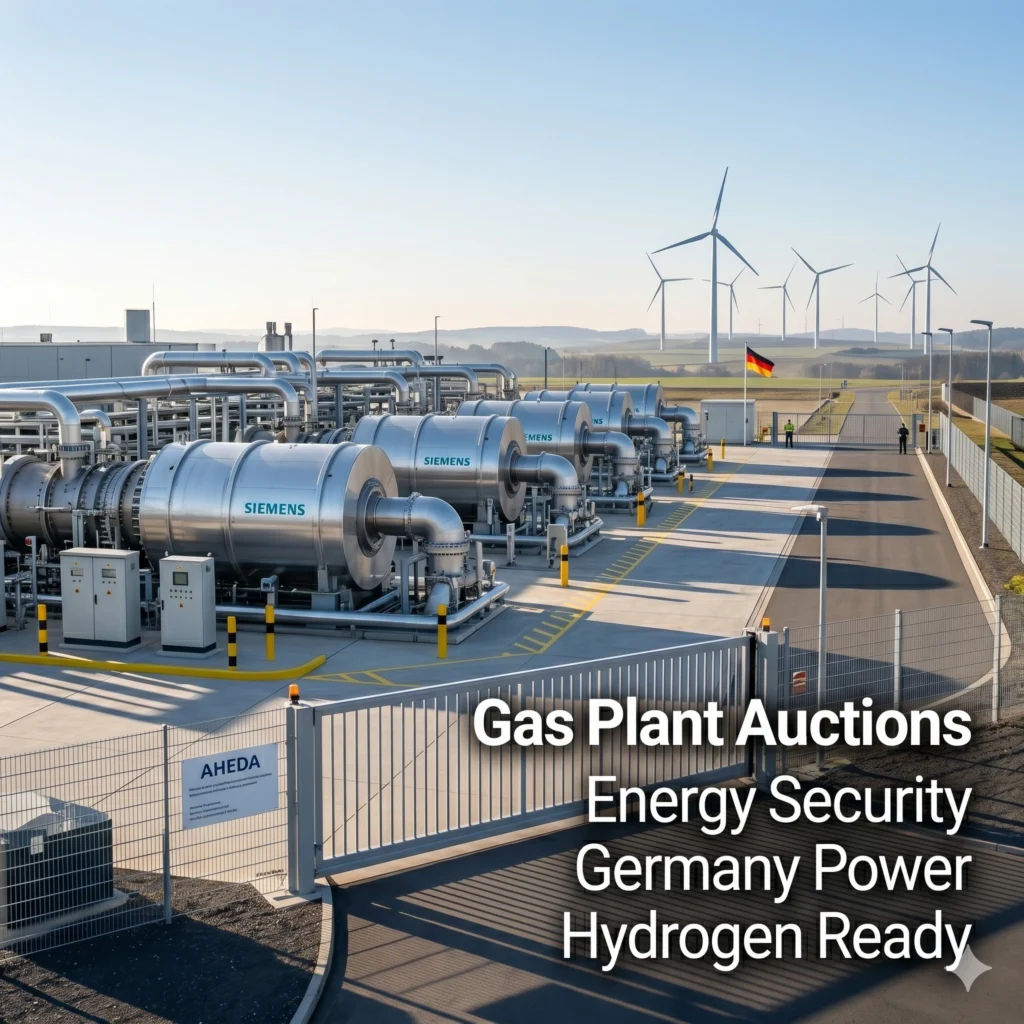
Gas Power Plant Auctions In Germany
The Gas Power Plant Auctions In Germany are specifically designed to create a “safety net” for the national grid. These facilities will act as backup generators that can be fired up quickly whenever wind turbines and solar panels fail to produce sufficient electricity. This flexibility is the cornerstone of the government’s plan to phase out coal without risking blackouts. By providing a guaranteed income stream for these plants, the state ensures they remain on standby.
Successful bidders in these auctions will receive financial remuneration for simply being available to generate power. This “capacity” payment model is a departure from traditional energy markets where plants are only paid for the electricity they actually sell. This shift is necessary because these new plants may only run for a few hundred hours a year. Without state support, the high capital costs of building such sophisticated machinery would be impossible for private firms to justify.
Furthermore, the timing of these auctions is critical for the 2030 coal phase-out target. Industry leaders have stressed that the construction timeline is extremely tight, and any delays in the legislative process could jeopardize the 2031 operational goal. The government is currently working to streamline the permitting process to ensure that these massive engineering projects can break ground as soon as the tenders are finalized.
Hydrogen Readiness as a Mandatory Requirement
A key feature of the Gas Power Plant Auctions In Germany is the mandate for “hydrogen readiness.” This means that every new plant built under this scheme must be capable of switching from natural gas to climate-neutral hydrogen in the future. This requirement ensures that these assets do not become “stranded” as Germany moves toward its goal of climate neutrality by 2045. It aligns the immediate need for security with the long-term necessity of decarbonization.
The transition to hydrogen is expected to happen gradually as the national hydrogen core network expands. Initially, these plants will burn conventional gas to ensure reliability, but they will be retrofitted to burn green hydrogen as it becomes more available and affordable. This dual-fuel capability makes the investment palatable to environmental advocates who are wary of locking in fossil fuel infrastructure. It represents a pragmatic compromise between energy realism and climate idealism.
- Plants must demonstrate a clear technical pathway for a 100% hydrogen conversion.
- The proximity to the planned hydrogen core pipeline network will be a factor in auction scoring.
- Government subsidies may be adjusted based on the speed at which a plant transitions to green fuels.
- Hydrogen-ready designs help lower the overall carbon footprint of the backup fleet over its lifecycle.
Financial Implications and Industry Reaction
The financial scale of the Gas Power Plant Auctions In Germany is significant, with an estimated annual cost of three billion euros by the start of the next decade. This funding will be drawn from the Climate and Transformation Fund, a special federal budget dedicated to green initiatives. While the cost is high, industry representatives argue that the cost of an unstable power grid would be exponentially higher for German manufacturers and households.
Major energy utility companies have welcomed the news, noting that the legislative clarity allows them to begin preliminary engineering and site selection. However, some industry voices remain concerned about the strict “hydrogen-ready” deadlines. They argue that the availability of hydrogen at competitive prices is still uncertain, which adds a layer of risk to these long-term projects. Despite these concerns, the level of interest in the upcoming 2026 tenders remains high.
Investors are also looking at the broader “capacity market” that the government intends to introduce by 2027. This market will provide a more permanent framework for managing energy supply security beyond the initial auction phase. The goal is to create a predictable environment where energy firms can invest in various technologies—from storage to flexible generation—with confidence in their long-term return on investment.
Environmental Concerns and the Path to 2045
Despite the hydrogen requirements, some environmental organizations remain critical of the Gas Power Plant Auctions In Germany. They argue that building new gas infrastructure, even if “ready” for hydrogen, could extend the country’s reliance on fossil fuels longer than necessary. These groups are calling for more investment in large-scale battery storage and demand-side management as alternatives to thermal power plants. They worry that “gas-ready” might just be a label that masks a lack of real progress.
In response, the government has emphasized that the law includes a hard deadline: all subsidized facilities must be climate-neutral by 2045. This legal “sunset clause” for fossil fuels is intended to guarantee that the transition remains on track. Energy Minister Katherina Reiche has consistently argued that there is no path to a 100% renewable grid without some form of controllable, high-capacity backup that can run for days at a time during peak winter demand.
The debate highlights the tension between the immediate need for grid stability and the long-term goal of total decarbonization. By choosing gas as the backup fuel, Germany is betting that hydrogen technology will mature fast enough to take over before the 2045 deadline. The success of this bet will determine whether Germany can serve as a global model for a large, industrialized nation transitioning to a fully green energy system.
EU Approval and State Aid Compliance
The Gas Power Plant Auctions In Germany required significant negotiation with the European Commission to ensure compliance with state aid rules. Brussels gave preliminary approval to the scheme earlier this year, recognizing that the subsidies are necessary to achieve common European climate goals. The Commission’s involvement ensures that the auctions do not unfairly distort competition within the internal EU energy market.
One condition of the EU approval is that the auctions must be transparent and non-discriminatory. This means that companies from across the European Union can bid on the projects, provided they meet the technical requirements. This international competition is expected to drive down the costs for German taxpayers while bringing in the best engineering expertise from across the continent. It also ensures that the German grid remains well-integrated with its neighbors.
The coordination with the EU also involves aligning the gas auctions with the broader reform of the European Electricity Market. These reforms aim to make the entire continent’s power system more resilient to price shocks and supply disruptions. By taking the lead with these auctions, Germany is helping to set a standard for how other EU nations might handle their own transitions away from coal and toward a more flexible, renewable-based future.
Accelerating the Coal Phase-Out Timeline
The primary driver for the Gas Power Plant Auctions In Germany is the political commitment to exit coal-fired power generation. In some regions, the government hopes to pull this deadline forward to 2030. To do so, the replacement capacity must be ready and tested well before the coal plants are decommissioned. The nine gigawatts of gas capacity planned in the first phase are essential pieces of this puzzle, providing the confidence needed to shut down the older, dirtier plants.
Coal still provides a significant portion of Germany’s baseline electricity, particularly during the winter months. Replacing this with wind and solar alone is not yet feasible because of current limitations in storage technology. Therefore, these gas plants represent a “bridge” that allows the coal exit to happen faster than would otherwise be possible. Without these auctions, the risk of energy shortages would likely force the government to keep coal plants running indefinitely.
- New gas plants can ramp up to full power in a fraction of the time required for coal plants.
- The geographical distribution of the new plants will be optimized to support grid stability in southern Germany.
- By 2031, the modern gas fleet will significantly reduce the CO2 intensity of Germany’s backup power.
- The auctions encourage the development of brownfield sites where old coal plants were once located.
Managing Costs for the German Taxpayer
The projected three billion euro annual cost of the Gas Power Plant Auctions In Germany is a significant fiscal commitment. To manage this, the government has designed the auction process to be as competitive as possible. Bidders will have to compete on the “availability price,” meaning the firm that can offer the most reliable capacity for the lowest subsidy will win. This market-based approach is intended to protect taxpayers from overpaying for energy security.
Furthermore, the government is exploring ways to recover some of these costs through a levy on energy consumers, similar to the previous renewable energy surcharge. However, this is a sensitive political issue, as energy prices in Germany are already among the highest in Europe. Balancing the books while keeping industrial electricity prices competitive is a major challenge for the current administration.
Long-term savings are expected to come from the decreased need for emergency grid interventions, which currently cost the system hundreds of millions of euros each year. By having a planned, flexible fleet of gas plants, the grid operator can manage supply and demand more efficiently. This “system-wide” perspective suggests that while the auctions are expensive, they may actually lower the total cost of energy transition over the coming decades.
Technical Innovation in Hydrogen-Ready Turbines
The Gas Power Plant Auctions In Germany are driving a new wave of innovation in turbine technology. Global engineering firms are racing to perfect large-scale gas turbines that can burn a mix of natural gas and hydrogen, and eventually 100% hydrogen. This technical challenge is significant because hydrogen burns hotter and faster than natural gas, requiring different materials and burner designs. The German auctions provide a guaranteed market for these advanced technologies.
Research and development centers across Germany are collaborating with the winning bidders to test these new systems. The goal is to ensure that when the time comes to flip the switch to hydrogen, the transition is seamless and safe. This focus on high-tech manufacturing also benefits the German economy by keeping its domestic engineering firms at the forefront of the global energy equipment market.
In addition to the turbines themselves, the auctions are encouraging the development of integrated energy hubs. These sites may combine gas generation with large-scale electrolyzers and heat recovery systems. By capturing the waste heat from the gas plants to power local district heating networks, the overall efficiency of the system can be greatly improved. This “sector coupling” is a key part of the broader strategy to make the German energy system more circular and efficient.
Preparing for the 2027 Comprehensive Capacity Market
While the current Gas Power Plant Auctions In Germany are a focused, immediate measure, they are also a precursor to a more comprehensive capacity market expected in 2027. This future market will be designed to handle all types of flexible resources, including battery storage, demand-side response, and potentially even carbon capture and storage (CCS) facilities. The lessons learned from the 2026 gas auctions will be vital in shaping this long-term framework.
The transition to a full capacity market marks a fundamental shift in how the German electricity system is managed. It recognizes that in a world of 100% renewables, “flexibility” is just as valuable as the energy itself. By starting with gas-fired plants, the government is securing the most reliable form of flexibility first, before expanding the market to include more experimental or smaller-scale technologies.
This phased approach allows the grid operator to maintain control while the market evolves. It also provides a clear signal to investors about the direction of German energy policy. The stability offered by these auctions is expected to attract billions in private capital, not just into gas plants, but into the entire green energy ecosystem. As 2027 approaches, the focus will shift toward ensuring that this new market remains open to innovation while maintaining the ironclad security established by the initial gas auctions.
Conclusion: Securing a Green Industrial Future
The approval of the Gas Power Plant Auctions In Germany is a landmark moment for the European energy sector. It demonstrates that even the most committed green transition requires a pragmatic approach to reliability and grid stability. By funding hydrogen-ready gas plants, Germany is building the necessary infrastructure to bridge the gap between the fossil fuel past and a renewable future. The billions of euros invested today are the price of ensuring that the lights stay on as the nation moves toward its 2045 climate goals.
The success of these auctions will depend on swift legislative action, technical innovation, and continued cooperation with the European Union. While environmental concerns persist, the mandatory transition to climate-neutral operations provides a clear path forward. The 2026 tenders will be a major test for the industry, but they also represent a significant opportunity to redefine the role of thermal power in a green economy. Ultimately, these auctions are about more than just electricity; they are about securing the future of Germany as a leading industrial power in a decarbonized world.
For more details & sources visit: Clean Energy Wire
Read more about Germany news on 360 News Orbit – Germany.