
The global fishing industry is facing a significant shift as Norway and China join forces to propose a massive increase in Antarctic Krill Harvests. This strategic move aims to nearly double the existing catch limits within the delicate Southern Ocean ecosystem, raising immediate alarms among international conservation groups. The proposal has sparked a fierce debate over the balance between industrial expansion and the preservation of one of the world’s most vital marine food webs.
The push for increased Antarctic Krill Harvests represents a pivotal moment for marine resource management, as the Norwegian government advocates for a move away from fixed catch limits. By transitioning to a more dynamic management system, proponents argue that the industry can better utilize the vast biomass of krill. However, the environmental stakes are incredibly high, with the proposed quotas reaching levels that many scientists believe could jeopardize the survival of Antarctic apex predators like whales and penguins.
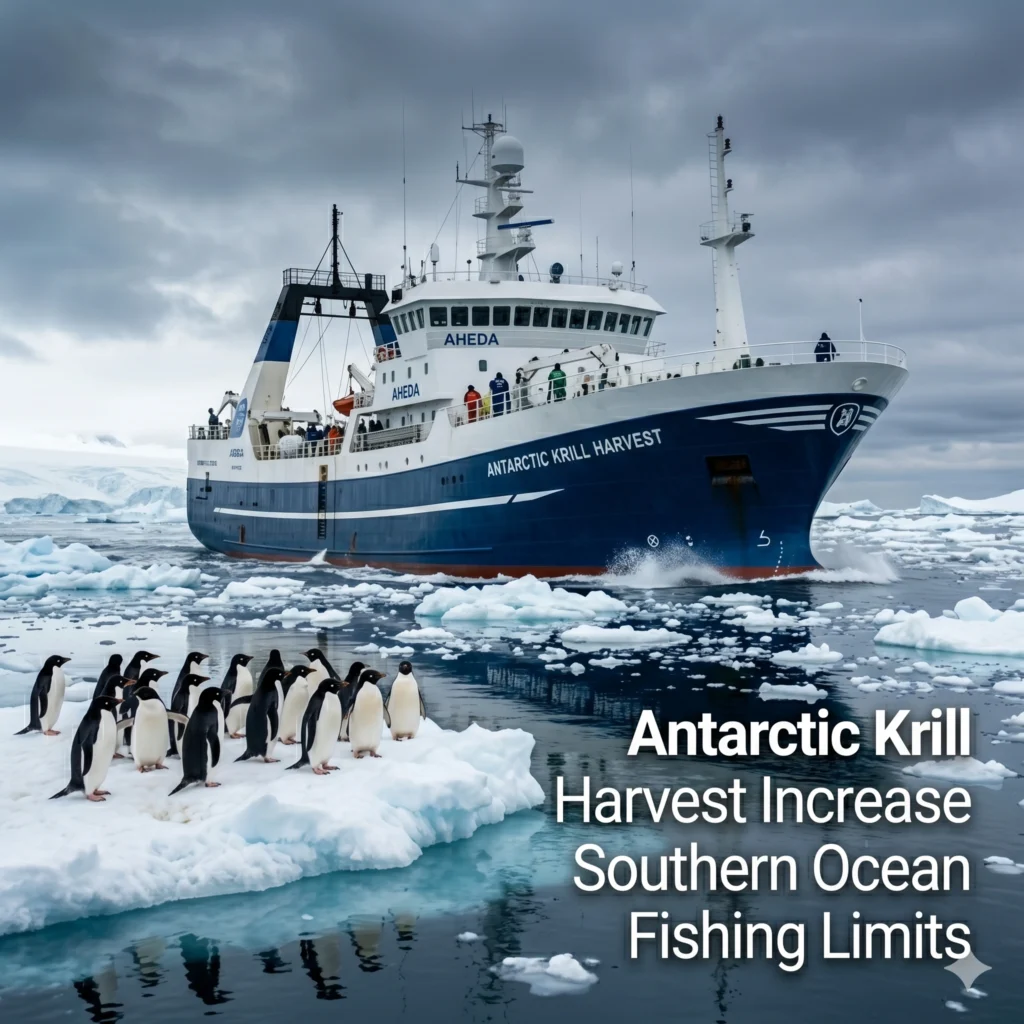
Antarctic Krill Harvests
The central focus of the current multilateral discussions is the controversial proposal to expand Antarctic Krill Harvests from the current 620,000 metric tons to 1.1 million metric tons. This staggering increase is being championed by major industry players and backed by powerful state actors who see krill as a goldmine for omega-3 oils and aquaculture feed. The economic potential of this expansion is immense, yet it remains tethered to the complex geopolitical landscape of Antarctic diplomacy.
Stakeholders involved in the Antarctic Krill Harvests debate are currently locked in negotiations that will determine the health of the Southern Ocean for decades. Norway, a pioneer in krill harvesting technology, and China, a rapidly expanding player in the polar regions, are leading the charge for these new quotas. Their combined influence suggests a significant shift in how the Commission for the Conservation of Antarctic Marine Living Resources (CCAMLR) might operate in the near future.
Furthermore, the Antarctic Krill Harvests are being used as a bargaining chip in wider environmental negotiations. Reports suggest that China has linked its potential support for Antarctic marine protected areas to the successful approval of these higher fishing limits. This “quid pro quo” approach has drawn criticism from non-governmental organizations that argue conservation measures should not be sacrificed for industrial gain in such a sensitive region.
Industrial Diplomacy and State-Backed Fleets
Aker BioMarine, the leading Norwegian operator in the sector, is currently at the forefront of the diplomacy surrounding Antarctic Krill Harvests. The company argues that their fishing methods are science-driven and that the requested increase represents only a tiny fraction of the total estimated krill biomass. By engaging directly with international policymakers, they hope to secure a future where krill harvesting can grow sustainably alongside global demand for marine proteins.
However, the rapid expansion of Antarctic Krill Harvests is bolstered by significant state support that many critics find troubling. Both Norwegian and Chinese fleets benefit from various forms of financial assistance and subsidies, allowing them to operate expensive, high-tech vessels in the remote Southern Ocean. A new Chinese vessel joined the fleet in 2025, with another scheduled to start during the 2026 season, marking a clear trajectory of industrial growth.
- Norway and China propose increasing limits to 1.1 million metric tons.
- State subsidies are fueling the construction of massive new “super-trawlers.”
- Industry leaders claim the harvest is a small fraction of the 60-million-ton biomass.
These state-backed initiatives are designed to secure long-term food security and market dominance in the high-value krill oil sector. As the fleets grow in size and capability, the concentration of Antarctic Krill Harvests near sensitive feeding grounds becomes a primary concern for researchers. The proximity of these vessels to the Antarctic Peninsula means they are competing directly with local wildlife for the same essential nutrients.
Environmental Risks and the Antarctic Food Web
Environmental organizations are highlighting the extreme risks associated with expanding Antarctic Krill Harvests at such a rapid pace. Krill are the “keystone” species of the Southern Ocean, acting as the primary food source for almost all Antarctic wildlife. Any disruption to their population levels could have a cascading effect, leading to a collapse in the populations of seals, seabirds, and the already endangered great whales.
The concentration of Antarctic Krill Harvests in specific, nutrient-rich areas like the Antarctic Peninsula is particularly problematic. Even if the overall biomass remains large, localized depletion can be devastating for colonies of Adélie and Chinstrap penguins that cannot travel long distances for food. Scientists warn that the industry’s focus on efficiency is blind to the ecological requirements of these localized wildlife populations.
In response to these threats, the European Parliament recently approved a request for a five-year moratorium on Southern Ocean krill fishing. This move highlights the growing international pressure to pause the expansion of Antarctic Krill Harvests until more comprehensive environmental impact assessments can be completed. The clash between European conservation ideals and the industrial ambitions of Norway and China is setting the stage for a heated CCAMLR summit in October.
Geopolitical Tensions in the Southern Ocean
The debate over Antarctic Krill Harvests is not just about fishing; it is about geopolitical influence in one of the world’s last frontiers. As nations look for new sources of resources, Antarctica has become a theater for soft power and strategic positioning. The ability to harvest krill at scale is seen by some nations as a way to assert presence and rights within the Antarctic Treaty System.
The push for higher Antarctic Krill Harvests by Norway and China reflects a broader trend of challenging established conservation norms in favor of “blue economy” growth. While the Antarctic Treaty is intended for peace and science, the commercial interests of the fishing industry are increasingly dictating the pace of diplomatic discussions. This tension makes the requirement for consensus among the 27 member nations of CCAMLR a difficult hurdle to clear.
- Consensus is required among all 27 CCAMLR member nations.
- Russia and China have previously blocked marine protected areas.
- The October 2026 meeting will be a critical test for Antarctic diplomacy.
The strategic alignment between a Western nation like Norway and an Eastern power like China on the issue of Antarctic Krill Harvests is a rare occurrence. This partnership could potentially break previous deadlocks or, conversely, alienate other member nations that are committed to a “precautionary approach” to resource extraction. The outcome of these negotiations will signal whether the Southern Ocean remains a protected sanctuary or becomes a primary industrial zone.
Scientific Uncertainty and Management Challenges
Critics of the expanded Antarctic Krill Harvests point to the high level of scientific uncertainty regarding krill population dynamics in a warming climate. Climate change is already reducing sea ice, which is essential for krill larvae to survive during the winter months. Proposing a near-doubling of the catch while the base of the food chain is under environmental stress is seen by many as a reckless gamble.
The industry claims that Antarctic Krill Harvests are the most well-managed in the world, utilizing real-time data to adjust fishing efforts. However, independent researchers argue that our understanding of krill recruitment and movement is still too limited to support such high quotas. They advocate for a management system that prioritizes the needs of the ecosystem over the demands of the market, especially given the rapid changes occurring at the poles.
As the CCAMLR review approaches, the call for more rigorous, independent monitoring of Antarctic Krill Harvests is growing louder. Currently, much of the data used for management comes from the fishing vessels themselves, which can lead to biased results. Establishing a network of truly independent scientific observers is seen as a necessary step before any discussion of increasing the catch can be considered legitimate by the international community.
Conclusion: The Future of the Southern Ocean
The battle over Antarctic Krill Harvests is a defining conflict of the modern era, pitting the immediate demands of industrial growth against the long-term health of the planet. Norway and China have laid out a bold vision for an expanded harvest, but the global response suggests that they will face significant resistance. The Southern Ocean remains a symbol of global cooperation, and its future depends on the ability of nations to prioritize ecological stability.
The upcoming CCAMLR meeting in October 2026 will be the final arena for this struggle. Whether the Antarctic Krill Harvests are allowed to double or are curtailed by a moratorium will depend on the strength of the scientific evidence and the political will of the member states. For the whales, penguins, and seals that call the Antarctic home, the stakes could not be any higher.
In the end, the management of Antarctic Krill Harvests must reflect a commitment to the “precautionary principle.” This means that in the face of scientific uncertainty and a changing climate, the world should err on the side of caution. Only by protecting the smallest creatures in the Southern Ocean can we hope to preserve the majesty and diversity of the entire Antarctic ecosystem for generations to come.
For more details & sources visit: Mongabay
Read more on Antarctica news: 360 News Orbit – Antarctica.