
UAE Exit From OPEC marks a significant turning point for the global energy sector as the nation seeks independent control over its crude resources. The decision follows years of internal friction within the organization regarding production quotas that many Emirati officials felt were stifling national economic growth. By choosing this path, the United Arab Emirates has signaled its intention to prioritize its own massive infrastructure investments over collective cartel strategies. Market analysts are now scrambling to adjust their long-term price forecasts as the geopolitical landscape of the Middle East shifts toward a more competitive framework.
The UAE Exit From OPEC is not a decision made in haste but rather the culmination of a decade-long strategy to maximize hydrocarbon wealth. For years, the leadership in Abu Dhabi has funneled billions of dollars into the Abu Dhabi National Oil Company to enhance its drilling and refining capabilities. These investments were designed to bring the nation’s production capacity well above five million barrels per day, a target hindered by strict adherence to restrictive quotas. Consequently, the exit represents a liberation of sorts for a country that is ready to flood the market with high-quality crude.
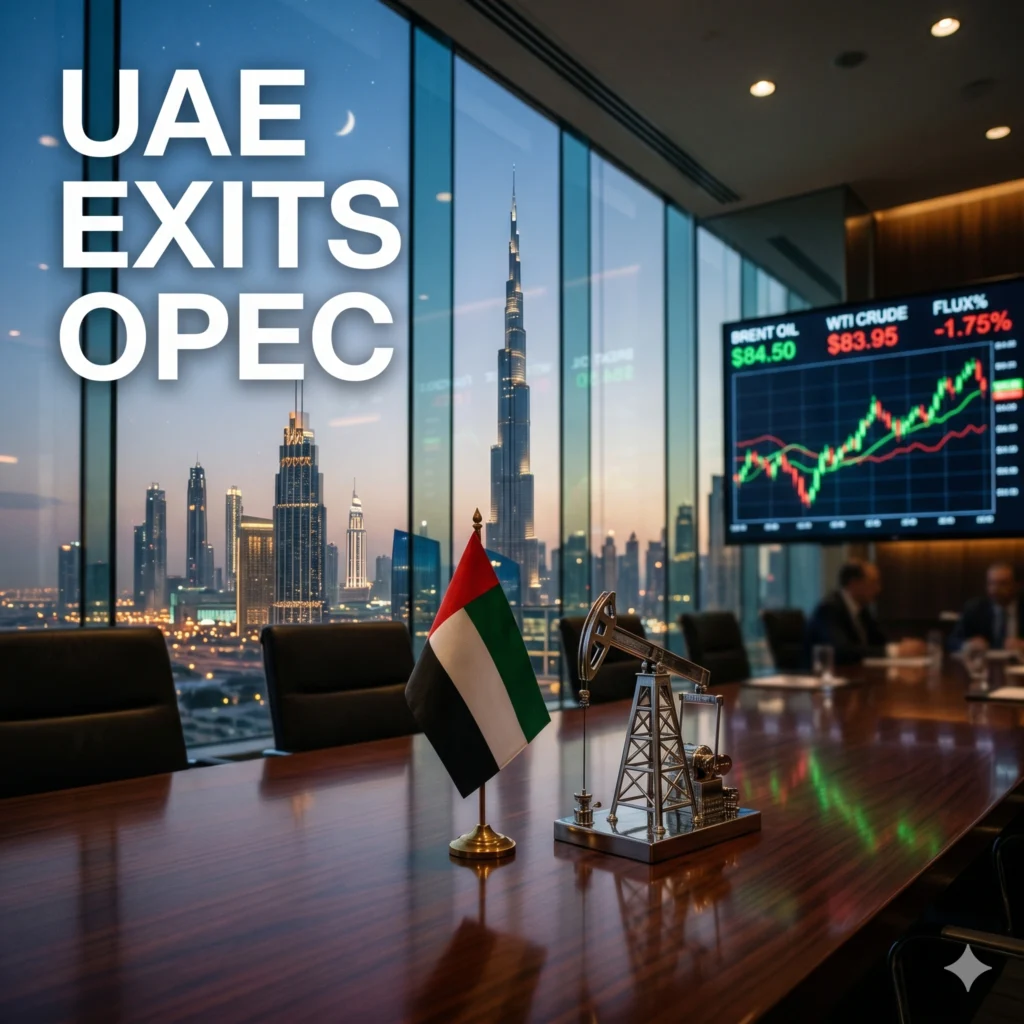
UAE Exit From OPEC
The immediate impact of the UAE Exit From OPEC has sent ripples through the international financial markets and commodity exchanges. Investors are currently weighing the potential for a localized price war between former allies who once stood united under the banner of market stability. While the organization has faced departures in the past, the loss of such a technologically advanced and high-capacity producer is unprecedented. This move essentially removes a cornerstone of the group’s ability to maintain a unified front against non-member producers like the United States and Brazil.
Furthermore, the UAE Exit From OPEC aligns the nation more closely with the energy interests of Western consumers who have long sought relief from high fuel costs. By operating outside the constraints of the cartel, the Emirates can now negotiate bilateral trade agreements that were previously complicated by collective membership. This strategic pivot is expected to foster deeper economic ties with Washington and various European capitals. Such a transition highlights the evolving nature of global energy diplomacy where individual national interests are increasingly outweighing traditional institutional loyalties.
Historical Tensions and Quota Disputes
The journey toward the UAE Exit From OPEC began with subtle disagreements during various ministerial meetings held in Vienna over the last three years. Emirati representatives frequently argued that their baseline production figures did not accurately reflect their true capacity, leading to unfair restrictions. While other members were content with higher prices at lower volumes, the UAE remained focused on high-volume exports to fund its “Giga-projects.” This fundamental difference in economic philosophy created a rift that proved impossible to bridge through standard diplomatic channels.
The persistence of these disputes eventually led to a breakdown in communication between key regional players who had historically coordinated their efforts. The UAE Exit From OPEC serves as a formal acknowledgment that the consensus-based model of the organization is no longer viable for modern producers. As the world transitions toward renewable energy, the Emirates believe they must monetize their oil reserves as quickly as possible. This “first to market” mentality is a stark departure from the traditional “conservation for price” strategy favored by older members of the group.
Impact on Global Crude Supply Chains
Logistically, the UAE Exit From OPEC will allow for a more flexible response to global supply disruptions caused by regional instability. With the ability to ramp up production without waiting for a ministerial vote, Abu Dhabi can act as a stabilizing force during times of crisis. The current blockages in the Strait of Hormuz have made this flexibility even more valuable to the international community. Diversifying the sources of “swing” production is a primary goal for many energy-importing nations facing domestic inflation.
The logistical advantages of the UAE Exit From OPEC are also tied to the country’s strategic location and advanced maritime infrastructure. New pipelines that bypass sensitive maritime choke points are now being utilized to their full potential without the fear of overstepping a collective limit. This allows for a more consistent flow of energy to Asian markets, which remain the largest growth area for crude demand. Consequently, the global supply chain is becoming more decentralized and less dependent on the whims of a single governing body.
Economic Diversification and Oil Revenue
A major driver behind the UAE Exit From OPEC is the need to fund the nation’s ambitious “Vision 2031” economic diversification plan. Developing sectors like tourism, technology, and renewable energy requires immense capital that is currently generated through the sale of fossil fuels. By increasing oil exports, the government can accelerate the transition toward a post-oil economy while the demand for crude is still high. It is a pragmatic approach to a future where the role of hydrocarbons will inevitably diminish over the coming decades.
The UAE Exit From OPEC provides the financial headroom necessary to subsidize new industries that will sustain the country for generations. Many critics argued that staying within the cartel was actually a risk to long-term national security by limiting the available cash flow. Now, the government has the freedom to manage its sovereign wealth fund with greater predictability and scale. This shift illustrates a sophisticated understanding of market dynamics and the closing window of opportunity for traditional oil producers.
- National production capacity targets have been raised to 5 million barrels per day.
- Investment in carbon capture technology is being accelerated to maintain “green” crude status.
- New trade corridors are being established with emerging economies in Southeast Asia.
- Domestic energy consumption is being shifted toward nuclear and solar power to maximize export volumes.
Geopolitical Realignments in the Middle East
The UAE Exit From OPEC has significant implications for the traditional balance of power within the Gulf Cooperation Council. Historically, energy policy was a unifying factor for these nations, but the recent split suggests a move toward individualistic foreign policies. This could lead to a more competitive atmosphere where each state vies for market share and foreign direct investment independently. Such a change might redefine the political alliances that have governed the region since the mid-20th century.
Observers note that the UAE Exit From OPEC might encourage other members who feel marginalized to reconsider their own positions. If a major producer can thrive outside the group, the perceived benefits of membership begin to dissolve for others. This creates a potential domino effect that could eventually render the original mission of the organization obsolete. The geopolitical map is being redrawn by economic necessity, and the Emirates are leading the way in this new era of sovereign energy management.
Technological Advancements in Oil Extraction
The UAE Exit From OPEC is supported by massive leaps in drilling technology and data analytics that have made extraction more efficient. By utilizing artificial intelligence to optimize reservoir management, the country can produce oil at a significantly lower cost than many of its neighbors. This competitive advantage is wasted when production is artificially capped by external organizations. The ability to leverage technology to undercut competitors is a key component of the new national strategy.
Furthermore, the UAE Exit From OPEC allows for faster implementation of experimental recovery techniques that were previously deemed too risky under strict quota regimes. Innovation thrives in a free-market environment where producers are incentivized to maximize their assets. The Abu Dhabi National Oil Company is now free to partner with global tech firms to further refine these processes. This focus on efficiency ensures that Emirati oil remains the most attractive option for global buyers in a competitive market.
Long Term Effects on Energy Transition
While it might seem counterintuitive, the UAE Exit From OPEC could actually speed up the global energy transition by lowering prices. Cheaper oil reduces the immediate pressure on developing nations to switch to unproven technologies before they are ready. However, the excess revenue generated from increased production is being funneled directly into massive solar and hydrogen projects. The Emirates are essentially using their oil wealth to build the infrastructure of the future.
The UAE Exit From OPEC ensures that the country remains a dominant player in the energy sector regardless of the fuel source. By dominating the oil market today, they secure the capital needed to dominate the renewables market tomorrow. This dual-track strategy is a hallmark of the nation’s forward-thinking leadership. The transition is not seen as an end to their energy relevance, but rather an evolution of their core business model on a global scale.
- Abu Dhabi is currently home to some of the world’s largest single-site solar parks.
- Hydrogen production is being scaled up to serve European industrial demand.
- Nuclear power now provides a significant portion of the domestic base-load electricity.
Market Reactions and Analyst Perspectives
The financial world has reacted to the UAE Exit From OPEC with a mix of caution and opportunism. Hedge funds have increased their volatility bets, expecting frequent price swings as the market finds a new equilibrium. Meanwhile, traditional energy companies are looking at the UAE as a more stable and predictable partner for long-term supply contracts. The removal of the “OPEC premium” or “OPEC discount” allows for more transparent pricing based on actual supply and demand.
Many analysts believe the UAE Exit From OPEC will lead to a more fragmented market where regional hubs become more important. Instead of a global price set in Vienna, we may see more localized pricing based on specific trade routes and refinery needs. This granularity is welcomed by many traders who prefer market-driven data over political announcements. The transparency provided by an independent UAE is seen as a net positive for the health of the global economy.
Potential for Other Member Departures
The biggest fear within the organization following the UAE Exit From OPEC is the threat of further defections. Smaller nations that struggle to meet their social spending requirements may find the lure of increased production too strong to resist. If the UAE demonstrates that life outside the cartel is more prosperous, the incentive to stay diminishes rapidly. This creates a survival crisis for an institution that has dominated the world stage for over sixty years.
The UAE Exit From OPEC serves as a blueprint for how a modern, diversified economy can move beyond 20th-century structures. It highlights the fact that the challenges of today’s energy market—such as climate change and rapid technological shifts—cannot always be solved by a group with conflicting internal agendas. Whether or not others follow, the move has already fundamentally changed the way the world thinks about oil production. The era of the “oil superpower” acting in isolation may be coming to an end.
- Other members like Iraq and Kuwait are reportedly watching the situation closely.
- Non-member producers are preparing to adjust their own output in response to the UAE.
- The role of the G20 in energy governance may expand as traditional cartels weaken.
Infrastructure Development and Export Capacity
To support the UAE Exit From OPEC, the government has fast-tracked the completion of several key infrastructure projects. These include expanded tanker terminals and larger storage facilities that can handle the increased flow of crude. By creating a world-class logistics hub, the Emirates ensure that they can get their product to market faster and more reliably than any other producer. This physical capacity is just as important as the political decision to leave the organization.
The UAE Exit From OPEC is also backed by a massive expansion of the country’s refinery sector. By processing more of its own crude into high-value products like gasoline and aviation fuel, the UAE can capture a larger share of the profit margin. This move into downstream operations makes the national economy more resilient to fluctuations in raw crude prices. It is a comprehensive approach to energy management that leaves nothing to chance.
Implications for US-UAE Relations
The UAE Exit From OPEC is being viewed very favorably in Washington, where policymakers have often been at odds with the cartel’s pricing strategies. A more independent UAE allows for closer coordination on energy security and price stability between the two nations. This could lead to new strategic partnerships and increased American investment in the Emirati energy sector. The move strengthens a long-standing alliance by aligning economic goals more closely than ever before.
In the wake of the UAE Exit From OPEC, we can expect to see more high-level diplomatic visits and trade missions focused on energy technology. The United States is keen to support any move that increases global supply and reduces the leverage of adversarial regimes. By acting as a responsible and independent producer, the UAE cements its status as a key ally in a volatile world. This relationship will likely be a cornerstone of Middle Eastern politics for the foreseeable future.
Consumer Benefits and Inflation Relief
For the average consumer, the UAE Exit From OPEC is a hopeful sign that energy prices may eventually stabilize. Increased competition among producers generally leads to lower costs at the pump and reduced heating bills. This is particularly important for developing nations where energy costs represent a significant portion of the household budget. The Emirates are positioning themselves as the “consumer-friendly” producer in a market often characterized by scarcity.
The UAE Exit From OPEC also helps to combat global inflation, which has been driven in part by high energy costs. By providing a reliable and increasing supply of oil, the UAE helps to lower the cost of transporting goods and manufacturing products. This ripple effect benefits every sector of the global economy, from agriculture to high-tech manufacturing. The decision to exit is, in many ways, a contribution to global economic stability during a period of great uncertainty.
Conclusion and Future Outlook
The UAE Exit From OPEC represents a bold step into a new era of energy sovereignty. While the risks of market volatility and political tension are real, the potential rewards for the Emirati people and the global economy are substantial. By prioritizing growth, technology, and independence, the UAE has set a course that others may soon be forced to follow. The world will be watching closely to see how this transition unfolds and what it means for the future of the hydrocarbon industry.
Ultimately, the UAE Exit From OPEC is a testament to the country’s confidence in its own future. It is a move made from a position of strength, not weakness, and it reflects a deep understanding of the changing global landscape. As the dust settles, the United Arab Emirates will likely emerge as an even more influential player on the world stage, unburdened by the past and ready for the challenges of tomorrow.
For more details & sources visit: Al Jazeera
Read more about UAE news: 360 News Orbit – UAE.