
Nigeria community attack records have reached a grim new milestone after militants linked to the Islamic State launched a brutal raid in Adamawa state. The assault targeted the Guyaku community within the Gombi local government area, resulting in the confirmed deaths of twenty-nine individuals. This violent incursion began at a local football pitch where civilians had gathered, before the gunmen transitioned into a systematic siege of the village. The sheer scale of the destruction has left the northeastern region in a state of profound shock and mourning as the true extent of the massacre is realized.
The attackers operated with a level of coordination that suggest a planned strategic strike against the civilian population. For several hours, the militants maintained a hold over the area, burning down numerous homes, places of worship, and private vehicles. According to survivors, the gunmen did not distinguish between targets, opening fire at random to maximize casualties before setting residential structures ablaze. This incident marks one of the deadliest escalations of violence in the region since the beginning of the 2026 security calendar.
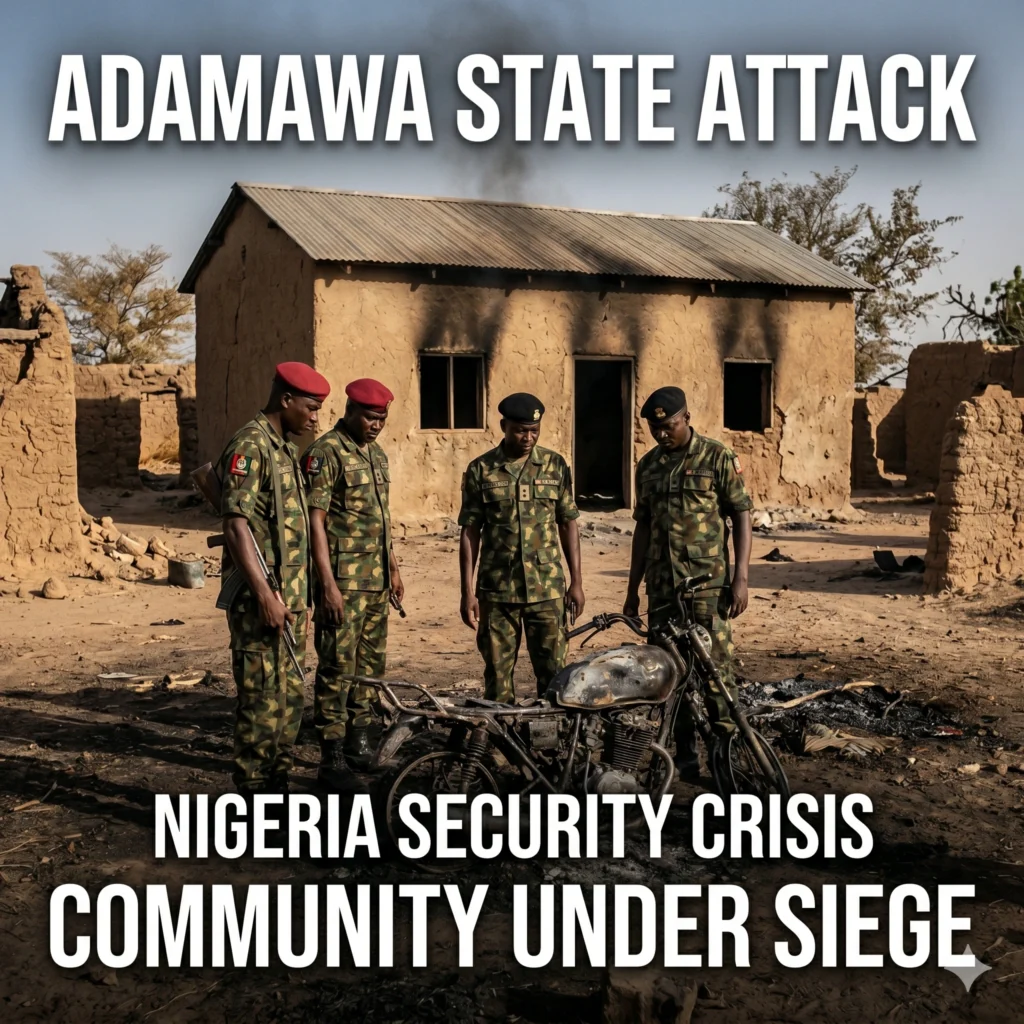
The Immediate Impact on the Guyaku Community
The loss of twenty-nine lives in a single afternoon has devastated the Guyaku community and the surrounding districts. Among the victims were twenty-eight men and one woman, many of whom were primary breadwinners for their respective families. The suddenness of the shooting at the football pitch meant that many victims had no time to seek cover or flee the immediate vicinity. Consequently, the local healthcare facilities were quickly overwhelmed by the influx of wounded individuals requiring urgent surgical intervention.
State Governor Ahmadu Umaru Fintiri, upon visiting the scene, characterized the massacre as a direct affront to humanity. He stood among the ruins of homes and businesses, promising that the perpetrators would be brought to justice through intensified security operations. However, for many residents, these promises feel distant as they pack their remaining belongings to flee the area. The fear of a potential follow-up attack is palpable, leading to a mass exodus toward more secure urban centers.
The destruction of places of worship and schools is a recurring tactic used by insurgents to project power and instill long-term fear. By targeting these institutions, the militants aim to disrupt the daily routines and cultural gatherings that bind the community together. In this latest Nigeria community attack, the physical damage to the Sangere Mapindi church serves as a haunting reminder of the vulnerability of religious sites. The regional government is now faced with the monumental task of rebuilding while simultaneously providing adequate defense for the returning population.
Nigeria Community Attack
The Nigeria community attack has highlighted the ongoing security gaps in the northeastern border regions near Cameroon. Despite numerous military offensives, extremist affiliates and criminal gangs continue to operate with a degree of impunity in remote areas. The geography of Adamawa, characterized by difficult terrain and porous borders, provides these groups with ample hiding spots and escape routes. This makes it challenging for conventional forces to respond rapidly to reports of active sieges in rural villages.
Witnesses to the Guyaku massacre described how the gunmen pursued fleeing civilians into residential areas to continue their assault. This was not a quick “hit and run” operation; rather, it was a deliberate multi-hour occupation designed to cause maximum physical and psychological damage. The arson attacks were particularly effective at rendering the village uninhabitable, forcing survivors into a state of displacement. Without homes to return to, many of these families are now facing a secondary crisis of homelessness and food insecurity.
As the Islamic State expands its influence in West Africa, the frequency of these large-scale raids appears to be increasing. The group utilizes these violent spectacles to recruit new members and demonstrate their capabilities to the international community. For the residents of Adamawa, however, these geopolitical maneuvers translate into a very real and terrifying threat to their lives. The Nigeria community attack is a stark reminder that the war against insurgency is far from over, requiring a more robust and localized security strategy.
Humanitarian Crisis and the Plight of the Displaced
The humanitarian concerns following the Nigeria community attack are reaching critical levels as thousands of people abandon their ancestral lands. The sudden displacement of an entire community creates a ripple effect throughout the state’s already strained resources. Displaced persons are currently seeking refuge in makeshift camps or with relatives in neighboring towns, leading to overcrowding and poor sanitary conditions. Relief agencies are calling for immediate shipments of food, blankets, and medical supplies to prevent a widespread health crisis.
Visible grief and fear dominate the conversations among the survivors who are now questioning their future in the region. Many have lost not only their loved ones but also their livelihoods, as vehicles and farming equipment were destroyed in the fires. The psychological trauma of witnessing a mass shooting at a community gathering place will likely persist for generations. Mental health support is virtually non-existent in these remote areas, leaving the victims to process their grief without professional assistance.
- Loss of twenty-nine lives, including twenty-eight men and one woman.
- Systematic arson of homes, churches, and primary schools in Guyaku.
- Mass displacement of residents fearing further insurgent activity.
- Severe disruption to local agricultural and economic activities.
Regional Security Challenges and Government Response
Governor Fintiri’s pledge to intensify security operations comes at a time of high public skepticism regarding the effectiveness of such measures. While the military has maintained a presence in Adamawa, the sheer number of vulnerable communities makes 24-hour protection nearly impossible. The Nigeria community attack has prompted calls for the establishment of more localized “community defense forces” to act as a first line of defense. However, arming civilians carries its own set of risks and could potentially lead to further intra-communal violence.
The proximity of the Cameroon border remains a major factor in the persistence of these militant groups. Insurgents often cross the border to evade capture, utilizing the jurisdictional boundaries to their advantage. Strengthening trans-border security cooperation is essential if the Nigerian government hopes to dismantle the networks responsible for the Guyaku massacre. Without a coordinated effort between the two nations, these groups will continue to exploit the “no-man’s land” between the two territories to launch their raids.
- Increased deployment of mobile strike teams to the Gombi local government area.
- Enhanced intelligence gathering through the use of aerial surveillance and local informants.
- Reconstruction funds promised for the damaged schools and places of worship.
- Strengthening of border patrols in collaboration with Cameroonian security forces.
The Role of Ideology and Radicalization in the Northeast
The claim of responsibility by the Islamic State underscores the ideological nature of the Nigeria community attack. The group’s presence in the northeast has evolved over the years, moving from a localized insurgency into a branch of a global terror network. This evolution has brought more sophisticated weaponry and propaganda techniques to the region, making the militants more dangerous than ever. Radicalization efforts often target disenfranchised youth in rural areas who see no future in the existing economic system.
Addressing the root causes of this radicalization is just as important as the military response. Poverty, lack of education, and a perceived lack of government representation create a fertile ground for extremist ideologies to take root. When a community like Guyaku is attacked, it further erodes the trust between the citizens and the state, making the insurgents’ message more appealing to some. Therefore, the recovery process must include socio-economic development alongside the rebuilding of physical infrastructure.
The Nigeria community attack was a calculated strike against a soft target, designed to showcase the state’s inability to protect its citizens. By choosing a football pitch—a symbol of community and leisure—the militants sent a clear message that no place is safe. Breaking this cycle of violence requires a holistic approach that combines security, justice, and economic opportunity. Until the underlying issues of regional instability are addressed, the threat of similar massacres will continue to hang over the people of Adamawa.
Documenting the Destruction: A Look at the Aftermath
The physical evidence of the Nigeria community attack is extensive, with large sections of the village reduced to ash. Journalists and security officials who visited the scene described the smell of smoke still hanging in the air days after the event. The charred remains of vehicles and the bullet-riddled walls of the primary school tell a story of a community that was given no quarter. These images have circulated widely on social media, sparking national outrage and demands for more decisive action from the federal government.
The loss of the local church and school means that the community’s social and educational life has been put on indefinite hold. Children who should be in classrooms are instead sitting in displacement camps, their educations interrupted by senseless violence. The church, which served as a central meeting point for many families, now stands as a hollow shell. The Nigeria community attack has essentially wiped out the institutional memory and infrastructure of an entire village in a matter of hours.
- Documentation of hundreds of bullet casings found at the football pitch.
- Detailed reports on the specific types of accelerants used to burn the houses.
- Personal accounts from survivors who hid in nearby bushes during the siege.
- Forensic identification of the twenty-nine victims to ensure proper burial.
Conclusion and the Road to National Healing
The Nigeria community attack in Adamawa state is a tragedy that will leave a permanent scar on the nation’s history. The twenty-nine lives lost were more than just statistics; they were members of a community that deserved safety and peace. As the country mourns, there is a growing consensus that the current security paradigms must change. The resilience of the Nigerian people is legendary, but that resilience is being tested to its absolute limit by these recurring acts of terror.
The path forward requires a renewed commitment to the protection of rural communities and the aggressive pursuit of those who fund and direct these attacks. The Islamic State and its affiliates must be shown that their actions will not lead to the collapse of the state, but rather to its further unification against them. The Nigeria community attack must be the last such incident of its kind if the country is to fulfill its potential as a stable and prosperous nation. Justice for the victims of Guyaku is the first step on that long road to recovery.
As the families of the deceased begin the painful process of burials, the eyes of the world remain on Nigeria. The international community must provide more than just words of condemnation; it must offer the technical and humanitarian support needed to end this cycle of violence. The memory of the twenty-nine people who died at the football pitch should serve as a constant motivation for all those working toward a more peaceful future. The Nigeria community attack will not be forgotten, and its legacy must be one of change and renewed determination.
For more details & sources visit: Forbes
Read more on Nigeria news: 360 News Orbit – Nigeria.