
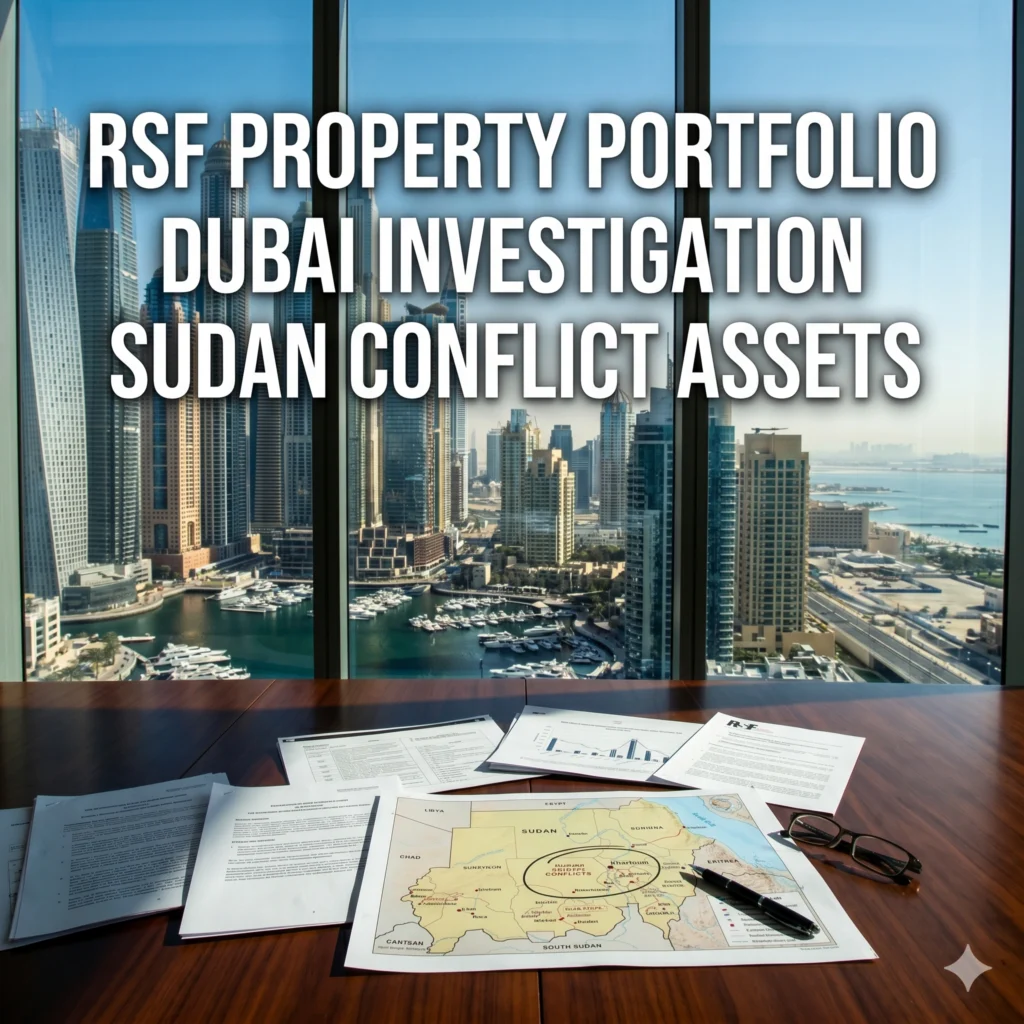
Sudan RSF leadership scandal details have emerged in a scathing investigative report that links the paramilitary group to a multi-million dollar luxury property portfolio in Dubai. According to the investigation by The Sentry, family members and sanctioned associates of Mohamed Hamdan “Hemedti” Dagalo have acquired over twenty high-end real estate assets. This sprawling paramilitary-industrial complex is reportedly funded through a sophisticated network of gold smuggling and illicit financial flows that bypass international oversight. Consequently, the findings have sparked a global outcry regarding the use of the United Arab Emirates as a financial safe haven for militia leaders.
The timing of this revelation is particularly devastating as Sudan continues to be gripped by a brutal conflict between the Rapid Support Forces and the regular army. While the leadership maintains a life of luxury abroad, the Sudanese population is enduring what observers call the largest humanitarian crisis in the modern world. Millions have been forced to flee their homes, and the country’s infrastructure is in a state of total collapse. Therefore, the contrast between the RSF’s external wealth and the internal suffering of the Sudanese people has become a focal point for international sanctions discussions.
The Paramilitary-Industrial Complex and Gold Smuggling
The Sudan RSF leadership scandal is built upon a foundation of gold, which serves as the primary currency for Hemedti’s paramilitary-industrial complex. For years, the RSF has controlled key mining regions, using the proceeds to build a private army that rivals the national military in both equipment and funding. The Sentry’s report highlights how this gold is moved through a complex web of shell companies spanning Africa and the Middle East. This allows the militia to maintain a constant stream of revenue even while under the pressure of international diplomatic condemnation.
Global financial monitors have often identified the gold trade as a high-risk sector for money laundering, yet the RSF has managed to exploit regulatory gaps. By integrating their illicit gains into the legitimate real estate market of the UAE, the militia leadership secures their personal futures while the nation burns. This financial insulation allows them to prolong the conflict without facing the direct economic consequences of their actions. The investigation provides a rare and detailed look into the specific mechanisms used to convert raw minerals into luxury apartments and villas.
Furthermore, the involvement of sanctioned individuals in these property deals raises serious questions about the effectiveness of current international banking “Know Your Customer” protocols. If individuals already on global watchlists can successfully purchase multi-million dollar assets, the entire system of targeted sanctions may be compromised. The Sudan RSF leadership scandal thus highlights a systemic failure in the global financial architecture. Addressing these loopholes is essential if the international community hopes to drain the resources fueling the Sudanese civil war.
Sudan RSF Leadership Scandal
The Sudan RSF leadership scandal involves a network of family members who act as proxies for the militia’s top brass in international transactions. By using relatives and trusted associates, Hemedti is able to maintain a layer of plausible deniability regarding his personal involvement in foreign real estate. However, the investigative trail clearly leads back to the heart of the RSF’s command structure and its illicit funding sources. This discovery has led to renewed calls for the United Arab Emirates to tighten its property registration laws to prevent further abuse by war-linked entities.
Humanitarian organizations have pointed out that the 17.7 million pounds spent on Dubai luxury could have provided life-saving aid to thousands of Sudanese families. Instead, this wealth is being used to provide a comfortable fallback for a leadership accused of genocide and systemic human rights violations. The psychological impact on the displaced population, seeing their oppressors living in opulence, cannot be overstated. It reinforces a sense of injustice that complicates any future efforts at national reconciliation or peace negotiations.
The ongoing war has resulted in a staggering 33 million people requiring urgent humanitarian assistance across the country. This means that more than half of the population is currently dependent on outside aid that is frequently blocked or diverted by the warring factions. The Sudan RSF leadership scandal proves that while the fighters on the ground may be short on food, the leadership is never short on cash. This disparity is a driving force behind the continued instability and the refusal of the RSF to engage in meaningful ceasefire talks.
Escalating Hunger and the Humanitarian Catastrophe
As the conflict disrupts food supplies and agricultural cycles, at least 19 million individuals are now facing acute hunger. This is a direct consequence of the violence perpetrated by the RSF and their rivals, who have prioritized territorial control over the survival of the citizenry. The Sudan RSF leadership scandal adds insult to injury, showing that the funds meant for national development are instead sitting in foreign bank accounts. The destruction of local markets and trade routes has created a man-made famine of unprecedented proportions in East Africa.
International observers have documented how the RSF uses its financial power to recruit fighters and purchase advanced weaponry, further escalating the violence. The ability to move money freely through regional hubs ensures that the militia remains well-supplied despite the chaos at home. Without a crackdown on these financial channels, the humanitarian crisis will only continue to worsen as the war enters its next phase. The link between illicit finance and physical violence is clearer in the Sudan RSF leadership scandal than in almost any other modern conflict.
- Displacement of over 10 million people from their ancestral homes.
- Systematic destruction of hospitals, schools, and water treatment plants.
- Targeted violence against ethnic minorities in the Darfur region.
- Widespread use of sexual violence as a weapon of war by militia members.
Geopolitical Implications and the Role of the UAE
The United Arab Emirates finds itself in a difficult position as the Sudan RSF leadership scandal brings its financial regulations into the spotlight. While the UAE has denied providing direct military support to the RSF, the presence of such a significant property portfolio suggests a high level of financial hospitality. Critics argue that the lack of transparency in the Dubai real estate market makes it an ideal destination for those seeking to hide dirty money. This situation has strained relations between the UAE and other international powers who are seeking to isolate the militia.
Regional stability is at risk as the Sudanese conflict threatens to spill over into neighboring countries like Chad and South Sudan. The RSF’s ability to fund its operations through an external network means that the war could last for years, creating a permanent zone of instability. The Sudan RSF leadership scandal is therefore not just a financial story but a critical national security issue for the entire African continent. Diplomats are now debating whether to expand sanctions to include the specific companies and individuals named in The Sentry’s investigative report.
The investigation also calls for a rethink of how the international community engages with the RSF in peace negotiations. Treating Hemedti as a legitimate political actor while his network loots the country may be counterproductive to achieving a lasting peace. Some activists argue that the first step to peace is the immediate freezing of all foreign assets linked to the militia leadership. This would provide the necessary leverage to force the RSF to the bargaining table and stop the daily atrocities being committed on the ground.
Legal Frameworks and the Prosecution of Sporting Fraud
While the term “sporting fraud” is often associated with match-fixing, in the context of international law, it can also refer to the fraudulent use of sporting entities to launder money. The RSF has been known to use various front organizations, including some with links to cultural and sporting associations, to move funds. The Sudan RSF leadership scandal might eventually involve legal experts looking into how these varied channels were used to bypass traditional banking monitors. Italian and European legal precedents regarding the seizure of criminal assets are being studied by those seeking justice for Sudan.
The prosecution of such complex financial crimes requires a high degree of international cooperation, which has so far been lacking in the Sudanese case. Many of the jurisdictions where the RSF operates have weak rule of law or are themselves involved in the illicit trade. This makes the Sudan RSF leadership scandal a perfect example of why a global, unified approach to financial transparency is required. Without it, warlords and militias will always find a “safe haven” to store their ill-gotten gains while their home countries suffer.
- Verification of the legal owners of the twenty luxury Dubai properties.
- Mapping of the shell company networks used for gold export.
- Tracking of the digital currency transactions used to move wealth across borders.
- Analysis of the satellite data showing the growth of RSF-controlled mining sites.
The Sentry’s Recommendations for Global Action
The investigative group The Sentry has provided a clear roadmap for how to address the Sudan RSF leadership scandal. Their primary recommendation is the immediate imposition of “second-order” sanctions, which would target anyone doing business with the RSF’s financial network. This would create a “chilled” environment for the militia’s business interests, making it much harder for them to operate in international markets. Such measures have been used effectively in other conflicts to reduce the capacity of armed groups to sustain long-term warfare.
In addition to sanctions, there is a call for a dedicated international task force to track and seize the assets identified in the report. The proceeds from these seizures could eventually be placed into a trust fund for the reconstruction of Sudan and the support of its displaced citizens. This would turn the Sudan RSF leadership scandal from a tale of theft into a source of hope for the victims of the conflict. However, this requires a level of political will that has yet to be fully demonstrated by the major world powers.
Educational campaigns are also needed to inform the global gold and real estate industries about the risks of dealing with RSF-linked entities. Many businesses may be unknowingly facilitating the militia’s operations through third-party vendors and opaque supply chains. By shining a light on the Sudan RSF leadership scandal, the investigative report provides the necessary data for companies to conduct proper due diligence. The goal is to make the RSF’s money “toxic” so that no reputable financial institution will touch it.
Conclusion and the Path to Accountability
The Sudan RSF leadership scandal is a stark reminder of the dark side of global interconnectedness. It shows how the resources of a struggling nation can be siphoned off to fund the luxury lifestyles of those responsible for its destruction. The 17.7 million pound property portfolio in Dubai is just the tip of the iceberg, representing a fraction of the total wealth extracted from Sudan. As the investigation continues, it is likely that even more assets will be discovered in other financial hubs around the world.
For the people of Sudan, the path to accountability begins with the exposure of these financial crimes. Knowing that the world is watching their leaders’ bank accounts provides a small measure of solace to those who have lost everything. The Sudan RSF leadership scandal must serve as a catalyst for a broader movement toward transparency and justice in international finance. Only by cutting off the money can we hope to cut off the violence and begin the long process of healing a broken nation.
Ultimately, the resolution of the Sudanese conflict will depend on whether the international community is willing to take the difficult steps outlined by investigators. Words of condemnation are no longer enough when they are ignored by those with millions in the bank. The Sudan RSF leadership scandal has provided the evidence; now it is up to the world to provide the action. The future of Sudan and the credibility of the global human rights regime depend on the response to this unprecedented crisis.
For more details & sources visit: The Guardian
Read more on Sudan news: 360 News Orbit – Sudan.