
Euclyd challenges Nvidia as the Eindhoven-based startup enters critical negotiations with global investors to secure a massive funding round. This ambitious Dutch semiconductor challenger is currently seeking at least one hundred million euros in fresh capital to scale its revolutionary energy-efficient chip architecture. Founded in 2024 by former ASML executive Bernardo Kastrup, the company represents a bold step toward European technological sovereignty in the artificial intelligence sector. With the guidance of former ASML chief executive Peter Wennink, Euclyd challenges Nvidia by focusing on the high-demand phase of practical AI inference rather than traditional model training. This strategic pivot allows the firm to address the inefficiencies inherent in existing GPU designs that currently dominate the global market landscape today.
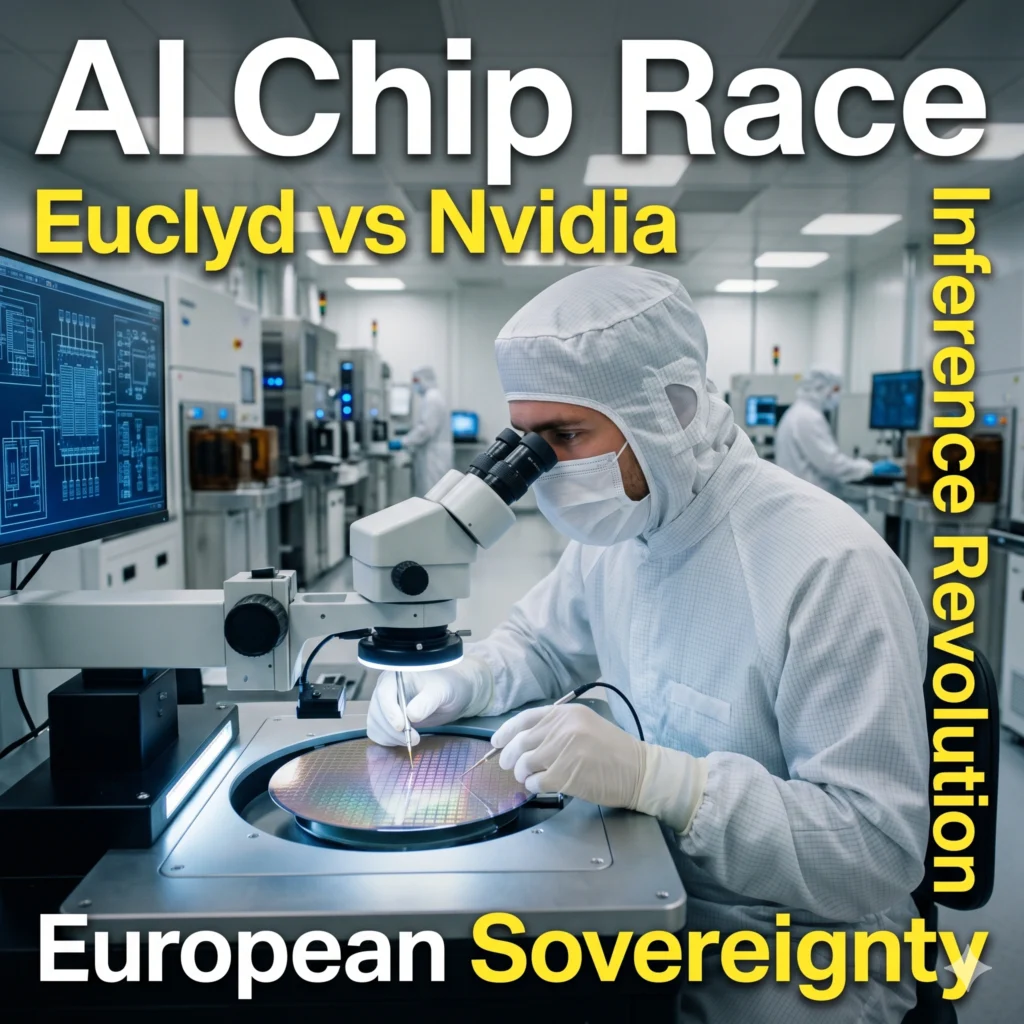
The Strategic Funding Goal for Dutch Innovation
The primary objective for the Eindhoven team involves securing the capital necessary to bring their proprietary Craftwerk architecture to a global stage. Euclyd challenges Nvidia by promising a level of energy efficiency that was previously thought impossible within the current constraints of silicon-based computing designs. By targeting a minimum of one hundred million euros, the startup intends to bridge the massive funding gap that often hampers European tech firms.
This capital injection will support the transition from initial design phases to large-scale production and commercialization of their specialized hardware solutions. Euclyd challenges Nvidia not just in raw power, but in the economic sustainability of running massive AI models across decentralized data centers. Investors are increasingly looking at how the Dutch firm handles data movement between memory and compute cores to solve modern bottlenecks.
The involvement of Peter Wennink as an advisor provides the company with unparalleled industry connections and strategic foresight within the semiconductor ecosystem. Euclyd challenges Nvidia by leveraging the deep institutional knowledge found within the Dutch “Silicon Fen” region surrounding Eindhoven and the ASML supply chain. This foundation provides a credible path toward challenging the absolute dominance of American hardware manufacturers in the burgeoning AI inference market.
Euclyd Challenges Nvidia
The fundamental architectural difference between these two companies lies in how they handle the massive data loads required for modern machine learning. Euclyd challenges Nvidia by utilizing a sophisticated multi-chiplet system designed to process information in multiple physical locations simultaneously to drastically reduce operational latency. Unlike standard GPUs, the Craftwerk system is optimized specifically for the inference phase, where speed and power consumption are the most critical factors.
Early internal tests suggest that this new architecture could be up to one hundred times more energy efficient than the latest Vera Rubin chips. Euclyd challenges Nvidia by addressing the “memory wall” problem that currently limits the performance of traditional graphics processing units in AI tasks. By minimizing the distance data must travel between components, the Dutch startup significantly reduces heat generation and electricity requirements.
The market shift toward inference represents a unique window of opportunity for smaller, more agile players to disrupt established supply chains. Euclyd challenges Nvidia as the industry moves away from the massive compute-heavy training phase toward everyday deployment of AI in consumer devices. This transition requires a different type of silicon logic that prioritizes efficiency and responsiveness over the raw brute-force capabilities of traditional GPUs.
Revolutionizing Energy Efficiency in AI Hardware
Sustainability has become a primary concern for data center operators who are struggling to manage the soaring electricity costs associated with AI. Euclyd challenges Nvidia by offering a solution that aligns with the European Union’s strict environmental regulations and carbon neutrality goals for 2030. The Craftwerk architecture is designed from the ground up to maximize the “performance per watt” metric, which is now the industry standard for value.
Traditional architectures often waste significant amounts of energy simply moving data back and forth without performing any actual mathematical computations. Euclyd challenges Nvidia by implementing a localized processing strategy that keeps data near the compute cores, thereby eliminating the most power-hungry aspects of chip operation. This innovation is expected to save large enterprise customers millions in annual cooling and power expenses once deployed.
The technical specifications of the upcoming systems are designed to push the boundaries of what is possible with current lithography techniques. Euclyd challenges Nvidia by aiming for thirty-two PFLOPS of compute power while maintaining a fraction of the thermal footprint seen in current high-end hardware. This balance of power and efficiency is the cornerstone of their value proposition to the international investment community.
Bridging the European Funding Gap in 2026
Despite the technological breakthroughs happening in Eindhoven, the company faces a significant challenge regarding the availability of venture capital in Europe. Euclyd challenges Nvidia in an environment where American firms consistently secure significantly higher valuations and larger funding rounds than their counterparts across the Atlantic. Data from early 2026 shows a stark contrast, with U.S. firms raising billions while Europeans fight for millions.
The strategic importance of this funding round cannot be overstated for the future of European digital autonomy and economic security. Euclyd challenges Nvidia as a symbol of the continent’s desire to control its own computing infrastructure and reduce dependence on foreign technology providers. If successful, this funding will serve as a blueprint for other European semiconductor startups looking to compete on the world stage.
- European AI chip firms raised only eight hundred million dollars in the first quarter of 2026.
- United States semiconductor startups secured nearly five billion dollars during the same timeframe.
- Euclyd aims to break this trend by attracting global sovereign wealth funds and private equity.
- The 100 million euro target is considered the minimum threshold for credible market entry.
The Path to Mass Production by 2028
The timeline for bringing a new chip architecture to market is notoriously long and complex, requiring precise execution at every stage. Euclyd challenges Nvidia by setting an aggressive goal to commence full-scale production of their systems by the beginning of 2028. This schedule accounts for the rigorous testing and validation required by enterprise clients in the medical, automotive, and financial sectors.
Engineering teams in Eindhoven are currently focused on refining the multi-chiplet interconnects that allow for seamless communication between various processing nodes. Euclyd challenges Nvidia by proving that a modular approach to chip design can outperform the monolithic structures that have dominated the industry for decades. This modularity also allows for easier upgrades and more flexible manufacturing options in different geographic regions.
By the time production begins, the demand for dedicated inference hardware is expected to have tripled compared to current 2026 levels. Euclyd challenges Nvidia by positioning itself as the primary alternative for organizations that require high-performance AI without the massive overhead of GPU clusters. The focus on specialized hardware ensures that the company is not spread too thin across multiple competing market segments.
Navigating Geopolitical Pressures in the Chip War
The global concentration of semiconductor production has become a major point of concern for governments and corporate leaders alike. Euclyd challenges Nvidia during a period of intense geopolitical tension where access to advanced computing power is seen as a matter of national security. Europe is currently pushing for sovereign computing capabilities to ensure that its industries remain competitive regardless of shifting trade policies.
By developing its technology entirely within the Dutch ecosystem, the startup avoids many of the export restrictions and supply chain vulnerabilities of others. Euclyd challenges Nvidia by offering a “Made in Europe” alternative that guarantees a level of transparency and security that is highly valued by government agencies. This focus on local sovereignty is a key selling point for investors who are wary of the risks associated with globalized manufacturing.
The chips produced by Euclyd are expected to play a vital role in the future of autonomous vehicles, smart cities, and secure communication networks. Euclyd challenges Nvidia by ensuring that the underlying hardware of these critical systems is not controlled by a single foreign entity. This strategic positioning aligns the company’s success with the broader political objectives of the European Commission and member states.
Technical Advantages of the Craftwerk Architecture
At the heart of the Dutch startup’s offering is a fundamental rethink of how silicon should be organized for neural network processing. Euclyd challenges Nvidia by discarding many of the legacy components found in general-purpose GPUs that are unnecessary for AI inference tasks. This streamlined approach allows more of the chip’s surface area to be dedicated to actual mathematical operations and local memory storage.
The multi-chiplet system is particularly effective at handling the parallel nature of modern AI models, which often require thousands of simultaneous calculations. Euclyd challenges Nvidia by providing a hardware layer that is natively optimized for the specific data flows used by Transformers and Large Language Models. This deep integration between software requirements and hardware capabilities results in significantly lower latency for end-users.
- Craftwerk uses a decentralized memory model to prevent data congestion during peak workloads.
- The architecture supports native 8-bit and 4-bit quantization to further enhance processing speeds.
- Hardware-level encryption is integrated into the chiplet fabric for secure AI applications.
Impact on the Global Artificial Intelligence Market
The entry of a well-funded European competitor could lead to a more diversified and resilient market for AI hardware worldwide. Euclyd challenges Nvidia by forcing a conversation about the long-term sustainability and cost-effectiveness of current industry standards and practices. Competition in the inference space is likely to drive down costs for developers and accelerate the deployment of AI across various industries.
As more companies realize that they do not need massive, power-hungry GPUs for every task, the demand for specialized inference chips will grow. Euclyd challenges Nvidia by capturing this emerging segment of the market that prioritizes efficiency and total cost of ownership over peak theoretical performance. This shift could eventually lead to a more balanced ecosystem where different types of chips are used for different parts of the AI lifecycle.
The success of the Eindhoven startup would also validate the European approach to innovation, which often focuses on deep engineering and long-term stability. Euclyd challenges Nvidia by proving that a small, highly specialized team can disrupt a trillion-dollar industry through superior architectural design. This narrative is powerful for attracting top-tier engineering talent from around the world to the Netherlands.
Overcoming Technical Bottlenecks in Modern Computing
One of the greatest hurdles in modern chip design is the efficient movement of data between the processor and the system memory. Euclyd challenges Nvidia by implementing a proprietary “Compute-in-Memory” strategy that significantly reduces the need for external data transfers. This technical breakthrough is one of the reasons the company claims such high levels of energy efficiency compared to its competitors.
By integrating the memory directly into the compute fabric, the startup eliminates the traditional von Neumann bottleneck that slows down most modern computers. Euclyd challenges Nvidia by demonstrating that a non-traditional approach to architecture can yield exponential improvements in performance for specific AI workloads. This innovation is protected by a robust portfolio of international patents developed by the Eindhoven engineering team.
- Reduced data movement leads to a significant decrease in the overall thermal signature of the chip.
- Localized processing allows for higher clock speeds without the risk of overheating.
- The architecture is scalable from small edge devices to massive data center racks.
Future Outlook for European Sovereign Computing
As we look toward the end of the decade, the role of companies like Euclyd will become increasingly central to the global tech narrative. Euclyd challenges Nvidia not just for market share, but for the right to define the next generation of computing standards for the AI era. The successful scaling of these technologies is critical for the future autonomy of European digital infrastructure and economic health.
With the support of industry veterans and a clear technical vision, the startup is well-positioned to navigate the challenges of the semiconductor world. Euclyd challenges Nvidia by remaining focused on its core mission of providing the most efficient inference hardware on the planet. If the current funding round meets its targets, the company will have the resources to turn this vision into a commercial reality.
The global tech community is watching closely to see if this Dutch challenger can truly shift the balance of power in the AI market. Euclyd challenges Nvidia by offering a glimpse into a future where high-performance computing is both sustainable and accessible to a wider range of organizations. The journey of the Craftwerk architecture from the drawing board to the data center is a testament to the enduring power of innovation.
Collaboration within the Eindhoven Tech Ecosystem
The success of a semiconductor startup depends heavily on the surrounding ecosystem of suppliers, researchers, and manufacturing partners. Euclyd challenges Nvidia by drawing on the dense network of high-tech companies located in the Brainport Eindhoven region of the Netherlands. This area is home to world-class talent and facilities that are essential for developing cutting-edge silicon hardware.
By collaborating with local universities and research institutes, the company ensures a steady pipeline of new ideas and skilled engineers. Euclyd challenges Nvidia by fostering a culture of innovation that is deeply rooted in the long history of Dutch excellence in physics and engineering. This local focus provides a competitive advantage that is difficult for foreign firms to replicate in a short amount of time.
- Partnerships with local photonics firms are exploring the use of light-based data transfers.
- Collaboration with Dutch software companies ensures that the hardware is easy for developers to use.
- Access to advanced cleanroom facilities allows for rapid prototyping of new chip designs.
- The presence of ASML nearby provides invaluable insights into the future of lithography.
Final Thoughts on the Dutch AI Revolution
The move by Euclyd to raise one hundred million euros marks a pivotal moment for the European semiconductor industry as it seeks to regain its footing. Euclyd challenges Nvidia with a combination of veteran leadership, architectural innovation, and a clear understanding of the market’s future needs. While the path ahead is filled with challenges, the potential rewards for the startup and the region are immense.
As AI becomes more integrated into every aspect of our lives, the hardware that powers it will become the most important commodity in the world. Euclyd challenges Nvidia by ensuring that Europe has a seat at the table during this transformative period in human history. The “Craftwerk” era is just beginning, and its impact will be felt far beyond the borders of the Netherlands.
Investors and industry analysts alike will continue to monitor the progress of the Eindhoven team as they move toward their 2028 production goal. Euclyd challenges Nvidia by proving that with the right combination of capital and creativity, even the most dominant giants can be successfully challenged. The story of this Dutch startup is a reminder that in the world of technology, change is the only constant.
For more details & sources visit: Innovation Origins
Read more on Netherland news: 360 News Orbit – Netherland.