
Emperor Penguin Extinction Risk has become a defining crisis for global biodiversity as the International Union for Conservation of Nature officially reclassifies the species as Endangered. This April 2026 announcement follows years of catastrophic ice melt and record-low sea ice levels across the Antarctic continent. Scientists and marine ecologists warn that without immediate intervention, the world’s largest penguin species faces functional extinction by the year 2100.
The primary driver of this ecological disaster is the rapid loss of vital breeding grounds, which has led to mass juvenile deaths and disrupted molting cycles. As a sentinel species, the emperor penguin signals the extreme severity of human-induced climate change in real time. Recent data indicates that Antarctica is losing more than 100 billion metric tons of ice annually, a figure that continues to climb.
This loss of stable sea ice shelves has directly resulted in the mass drowning of penguin chicks across several vulnerable Antarctic colonies. Young penguins lack the waterproof plumage necessary to survive in frigid polar waters when ice floes break apart prematurely before they are ready to swim. Consequently, the reclassification serves as a dire warning about the global failure to control greenhouse gas emissions.
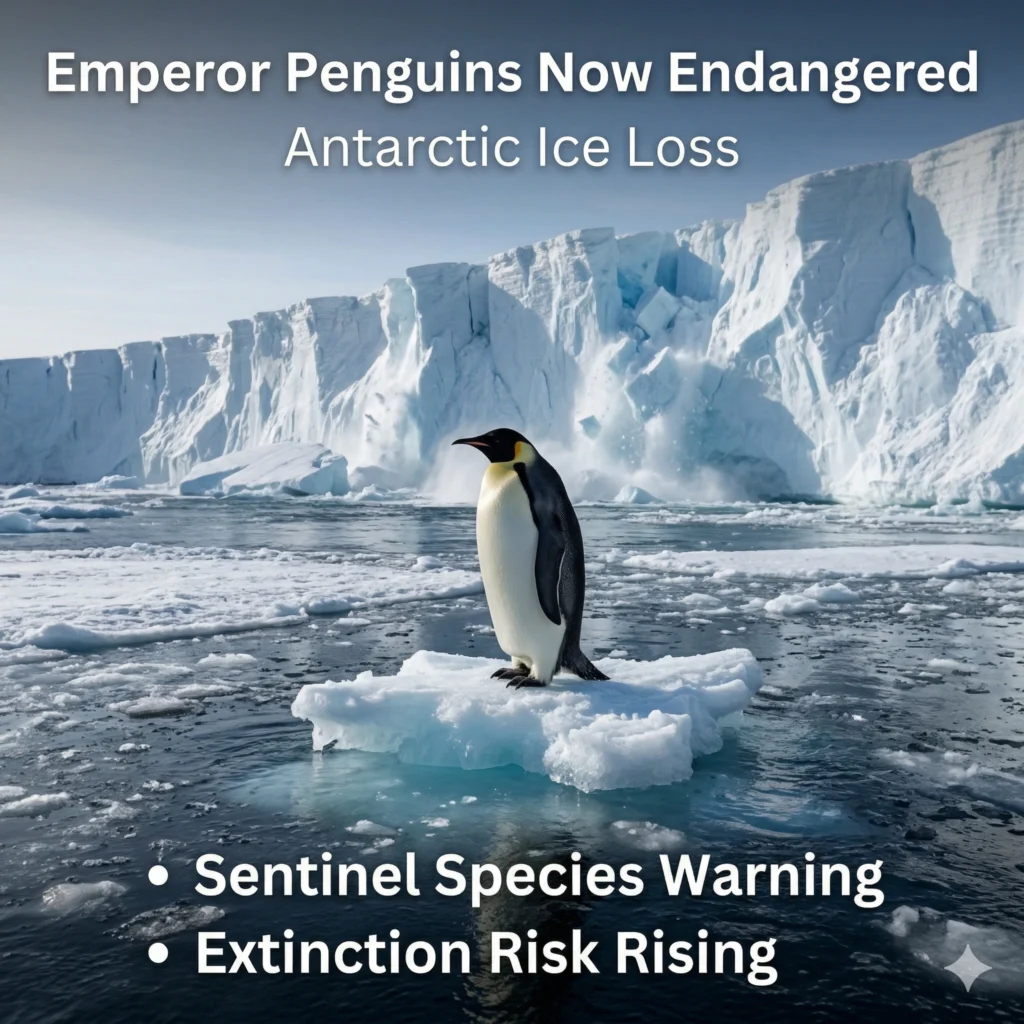
Emperor Penguin Extinction Risk
The mounting Emperor Penguin Extinction Risk is rooted in the precarious nature of their reproductive cycle, which depends entirely on land-fast sea ice. Adult penguins require a stable platform to raise their young for at least nine months of the year. When this ice platform dissolves early in the season, the results are nearly always catastrophic for the entire colony’s breeding success.
Marine ecologists have identified several specific threats that contribute to the current population decline. The warming of the Southern Ocean not only melts the ice from above via air temperature but also erodes the ice shelves from below through rising water temperatures. This dual-threat environment creates a situation where the birds have nowhere to go to escape the encroaching sea.
Research indicates that the global emperor penguin population declined by approximately 10% between the years 2009 and 2018. Current estimates place the remaining adult population of the species at approximately 595,000 individuals worldwide. While this number may seem high, the rate of decline and the frequency of total breeding failures suggest that the numbers could plummet further within the next decade.
Impact of Record Low Sea Ice Levels
The relationship between the Emperor Penguin Extinction Risk and sea ice stability cannot be overstated. Sea ice serves as the foundation for the entire Antarctic food web, supporting the krill populations that penguins rely on for food. As the ice disappears, the availability of prey decreases, forcing adults to travel further and spend more energy to feed their growing chicks.
Adult penguins are also at significant risk of hypothermia if sea ice disappears before their annual feather molt is complete. During the molting process, penguins lose their old feathers and grow new, waterproof ones, a period during which they cannot enter the water. If the ice breaks up during this phase, they are left stranded and exposed to the elements without their natural insulation.
Scientific models predict that up to 98% of emperor penguin colonies could vanish if current warming trends continue unabated. Dr. Philip Trathan has noted that early sea ice breakup is already negatively impacting breeding and feeding habitats across the continent. The frequency of these “early breakups” has shifted from once-in-a-decade events to almost annual occurrences in certain regions.
Mass Juvenile Mortality Events
A heartbreaking component of the Emperor Penguin Extinction Risk is the high rate of chick mortality observed in the Halley Bay and Bellingshausen Sea regions. In these areas, thousands of chicks have perished in a single season when the ice they were standing on disintegrated. These mass mortality events prevent an entire generation of birds from reaching maturity, leading to a demographic collapse.
The biological vulnerability of the young is the most critical factor here. Chicks are born with a soft down that provides warmth but zero protection against water. If they fall into the ocean before their adult feathers grow in, they succumb to the cold in a matter of minutes. This tragic reality has become the face of the climate crisis in the polar regions.
- Young penguins require approximately 150 days to grow waterproof feathers.
- Early ice breakup in December often occurs before the fledging process is complete.
- Mass drowning events have wiped out entire colonies in the Weddell Sea.
- Surviving chicks often suffer from stunted growth due to nutritional stress.
These factors combined create a feedback loop that accelerates the Emperor Penguin Extinction Risk. As fewer chicks survive to adulthood, the aging population of the colony cannot sustain itself. This has led to the abandonment of several historical breeding sites that have been used for centuries, as the birds search in vain for stable ground.
Scientific Reclassification and Its Meaning
The move by the IUCN to list the species as Endangered is a formal recognition of the Emperor Penguin Extinction Risk. This status provides more than just a label; it triggers international conservation protocols and encourages governments to implement stricter environmental protections. It also prioritizes the species for research funding and habitat monitoring projects.
However, many scientists argue that local conservation efforts are insufficient without global atmospheric changes. Unlike other endangered species that may suffer from overhunting or local pollution, the emperor penguin’s threat is atmospheric. The warming of the planet is a global issue that requires a global solution, making the penguin a symbol of international shared responsibility.
The reclassification also highlights the inadequacy of current global greenhouse gas emission controls. Despite numerous international agreements, the rate of Antarctic warming remains twice the global average. This “polar amplification” means that the Emperor Penguin Extinction Risk is manifesting much faster than models predicted only twenty years ago.
The Role of Antarctica as a Sentinel
Monitoring the Emperor Penguin Extinction Risk provides vital data on the overall health of the Antarctic ecosystem. Because these penguins are at the top of the food chain, their struggles reflect issues deeper in the ocean. Changes in their population often precede wider shifts in the populations of seals, whales, and fish that share their habitat.
International scientific teams use satellite imagery to count penguin colonies from space. This remote sensing technology has revealed that even remote colonies, once thought to be safe from climate impacts, are now showing signs of instability. The data gathered from these observations is crucial for building more accurate climate models for the entire planet.
- Satellite tracking shows penguins migrating to higher, more stable ice shelves.
- Changes in guano stains on the ice help researchers estimate colony sizes.
- Automated cameras provide year-round monitoring of chick development.
- Thermal imaging tracks the energy expenditure of huddling adults during winter.
The information gained through these methods confirms that the Emperor Penguin Extinction Risk is a continent-wide phenomenon. There are no longer any “safe havens” in Antarctica where the ice is guaranteed to remain stable for the duration of the breeding season. This universality of the threat is what prompted the urgent update to their conservation status.
Urgent International Action Required
To mitigate the Emperor Penguin Extinction Risk, the international community must commit to more aggressive carbon reduction targets. The survival of the species is linked directly to the targets set in the Paris Agreement and subsequent climate summits. Keeping global warming below 1.5°C is considered the only way to save the majority of the penguin colonies.
Furthermore, the creation of massive Marine Protected Areas (MPAs) around Antarctica is a key strategy recommended by conservationists. These zones would limit commercial krill fishing, ensuring that penguins have an abundant food source as they deal with the stress of a changing environment. Reducing competition for food gives the birds a better chance of survival.
The reclassification of the emperor penguin is a call to action for every nation. While the birds reside in a land that belongs to no one, their fate is determined by everyone’s carbon footprint. Addressing the Emperor Penguin Extinction Risk is not just about saving a single species; it is about preserving the integrity of one of the world’s last great wildernesses.
Future Projections for 2100
If the current trajectory of ice loss remains unchanged, the Emperor Penguin Extinction Risk will culminate in the loss of nearly all colonies by 2100. This projection is based on the most recent climate data and the accelerating rate of ice shelf collapse. The disappearance of these birds would represent a significant loss to the world’s natural heritage and a failure of global environmental stewardship.
Some scientists are exploring the possibility of “assisted colonization,” moving birds to the few areas of the continent where ice might remain stable. However, this is a logistically difficult and controversial approach that does not solve the root cause of the problem. The consensus remains that the only true solution is the stabilization of the Earth’s climate.
The next few decades will be the most critical for the survival of the species. If emissions can be curtailed, there is a chance that the penguins can adapt to a slightly warmer world. If not, the Emperor Penguin Extinction Risk will transition from a warning into a permanent reality. The 2026 reclassification stands as a historical marker of the moment the world was forced to acknowledge this truth.
Biological Adaptations and Their Limits
Emperor penguins have evolved incredible biological adaptations to survive the coldest environment on Earth, but these traits are no defense against the Emperor Penguin Extinction Risk. Their ability to huddle for warmth and dive to depths of 500 meters is useless if the ice they need to stand on simply vanishes. Evolution occurs over millennia, but climate change is happening over decades.
The birds’ high site fidelity, meaning their tendency to return to the same breeding spot year after year, is now a liability. When a traditional breeding site becomes unstable, the penguins often struggle to find a suitable alternative nearby. This behavioral rigidity makes them even more vulnerable to the sudden shifts in ice distribution caused by warming oceans.
- The penguin’s thick layer of blubber provides insulation but requires high food intake.
- Their social huddling behavior depends on large, stable groups of adults.
- Slow reproductive rates mean populations take decades to recover from losses.
- High energy costs for travel limit how far they can move from nesting sites.
Understanding these biological limits helps researchers predict which colonies are at the highest Emperor Penguin Extinction Risk. It also underscores why human intervention is so necessary. We are asking an animal specialized for an ice-bound world to survive in a world where the ice is rapidly disappearing.
Conclusion: A Call for Global Stewardship
In conclusion, the Emperor Penguin Extinction Risk is a stark reminder of the interconnectedness of our global environment. The reclassification of these iconic birds as Endangered is not just a scientific update; it is a moral plea for change. The loss of the emperor penguin would be a permanent scar on the history of human civilization and a sign of a planet in deep distress.
The data is clear, and the warnings from the scientific community have never been louder. We have the technology and the knowledge to slow the warming that threatens these birds, but we lack the collective political will to act decisively. As we move forward into 2026 and beyond, the fate of the emperor penguin remains in our hands.
By protecting the Antarctic and its residents, we are ultimately protecting ourselves. The same processes that lead to the Emperor Penguin Extinction Risk also drive sea-level rise and extreme weather patterns globally. Saving the penguins is an integral part of saving the habitable world as we know it. Let this Endangered status be the catalyst for the radical change the planet so desperately needs.
For more details & sources visit: A-Z Animals
Read more on Antarctica news: 360 News Orbit – Antarctica.