
Global Tech Sector Outlook 2026 is currently characterized by a complex mix of record-breaking financial projections and significant structural challenges. While global semiconductor revenues are on a trajectory to reach nearly $1 trillion by the end of the year, the industry is navigating a landscape of shifting priorities and emerging constraints. The explosive growth of Artificial Intelligence (AI) and 5G infrastructure continues to drive demand for high-performance computing, yet this very demand is creating bottlenecks in other market segments.
Analysts remain divided on the long-term sustainability of this growth, as supply-chain fragility and geopolitical instability introduce a high degree of unpredictability. Consequently, the Global Tech Sector Outlook 2026 serves as a critical barometer for the health of the broader world economy, highlighting both the immense potential of new technologies and the fragile nature of the global production networks that sustain them.
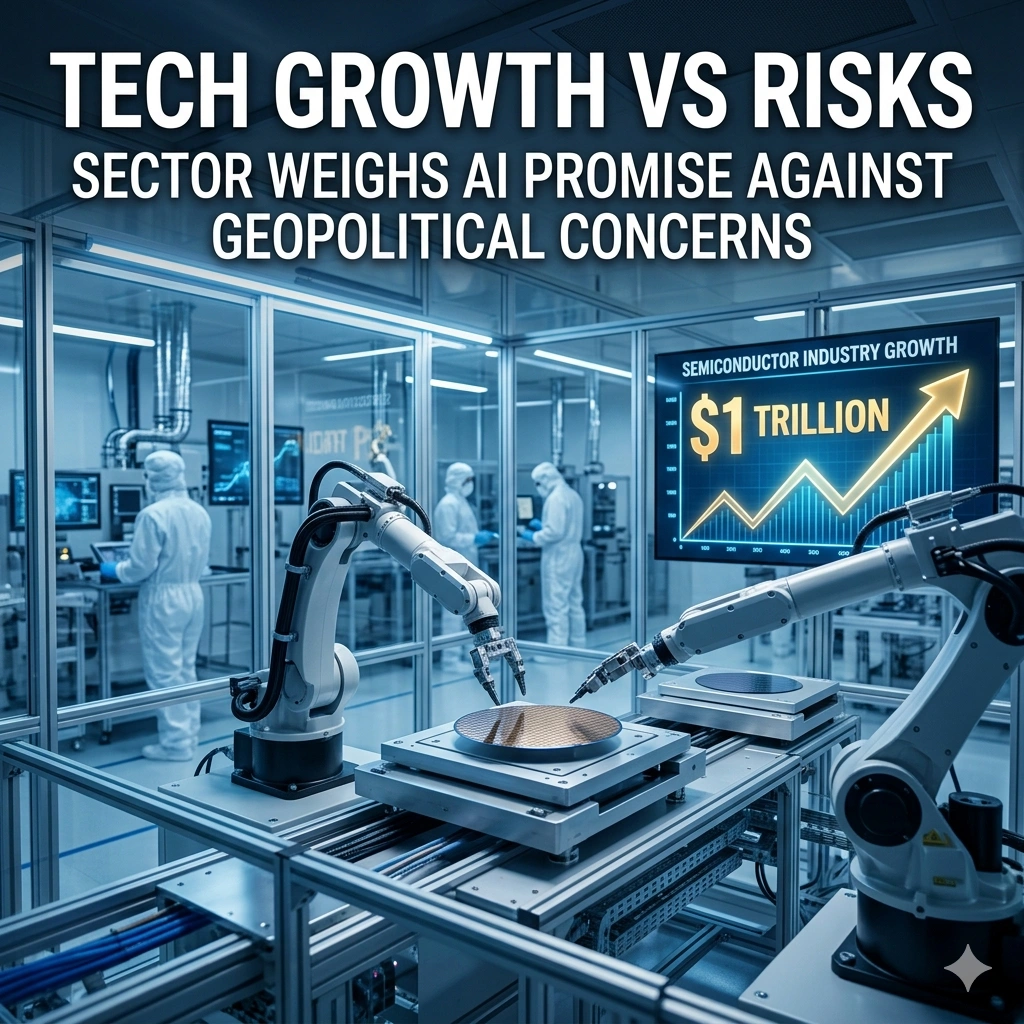
The Massive Scale of Semiconductor Growth in 2026
The most striking element of the Global Tech Sector Outlook 2026 is the sheer volume of capital flowing into the semiconductor industry. With revenues approaching the $1 trillion mark, the sector has evolved from a cyclical market into a foundational pillar of global infrastructure. This growth is primarily fueled by the relentless expansion of data centers and the integration of AI into every facet of consumer electronics. Manufacturing plants are operating at near-full capacity to keep pace with the demand for advanced nodes and specialized chips.
However, this rapid expansion is not without its hurdles. The cost of building and maintaining state-of-the-art fabrication facilities has skyrocketed, leading to higher prices for end-users. Analysts suggest that while the revenue numbers are impressive, the actual volume of units shipped may be stabilizing. This indicates that price increases, rather than pure demand growth, are contributing significantly to the $1 trillion milestone. The Global Tech Sector Outlook 2026 must therefore be viewed through a lens of inflation and rising production costs.
AI Dominance and the Concentration of Market Power
A central theme in the Global Tech Sector Outlook 2026 is the increasing concentration of wealth and resources within AI-focused companies. As generative AI becomes a standard requirement for businesses, the demand for high-bandwidth memory (HBM) and specialized GPUs has reached unprecedented levels. This has created a “favored segment” within the tech world, where infrastructure providers are seeing record margins while other sectors, such as traditional consumer PCs and smartphones, face stagnant growth.
This concentration of market power poses a risk to the overall stability of the industry. If the AI bubble were to cool, the reliance on a single growth driver could lead to a sharp correction. Furthermore, the tightening supply of memory chips for AI is making it harder for manufacturers of non-AI devices to secure the components they need at affordable prices. The Global Tech Sector Outlook 2026 warns that this imbalance could lead to a two-tier tech economy where only the most well-funded companies can stay competitive.
Global Tech Sector Outlook 2026
The Global Tech Sector Outlook 2026 remains a topic of intense debate among major research firms like Apex Securities and Kenanga Research. Apex reports that order pipelines are healthier than ever, with capacity expansions finally catching up to the initial AI surge. On the other hand, Kenanga points out that the market is becoming dangerously narrow. This divergence in opinion highlights the “crossroads” nature of the current year, where structural growth meets economic reality.
Maintaining a positive Global Tech Sector Outlook 2026 requires a delicate balance between innovation and cost management. As customer qualifications translate into steady revenue, the industry must ensure that it does not outpace the ability of consumers to pay for these advanced technologies. Profit margins are already thinning in the mid-stream of the supply chain, where companies are caught between rising material costs and the inability to pass those costs onto the final buyer. The Global Tech Sector Outlook 2026 hinges on whether the industry can find a sustainable middle ground.
Supply Chain Fragility and Geopolitical Risk Factors
No discussion of the Global Tech Sector Outlook 2026 is complete without addressing the looming shadow of geopolitical instability. Research from MBSB specifically cites tensions in the Middle East and ongoing trade disputes as potential dampeners for global demand. Semiconductors are a global product with components crossing multiple borders before final assembly. Any disruption in major shipping lanes or a change in export regulations can have an immediate and devastating effect on the entire ecosystem.
Furthermore, the fragility of the supply chain has been exposed by the concentration of advanced manufacturing in specific geographic locations. While there are efforts to diversify “fab” locations, these projects take years to become operational. In the short term, the Global Tech Sector Outlook 2026 is vulnerable to any local event that might impact these production hubs. This inherent risk is why many investors are moving toward a more cautious stance despite the high revenue projections for the year.
Rising Costs and the Affordability Crisis in Tech
The Global Tech Sector Outlook 2026 is increasingly influenced by the “affordability gap” in high-end electronics. As the cost of R&D and manufacturing increases, the price of flagship devices continues to climb. This has led to longer replacement cycles for consumers, which in turn slows down the revenue growth for manufacturers of consumer-facing hardware. The industry is currently struggling to justify these higher price points in an environment of global economic uncertainty.
Thinning profit margins are particularly visible among smaller players in the tech supply chain. While the giants at the top are thriving, the companies providing raw materials and basic components are facing intense pressure to lower their prices. This squeeze could lead to a wave of consolidations within the industry. The Global Tech Sector Outlook 2026 suggests that the sector may see fewer, but larger, companies dominating the landscape by the end of the decade, potentially reducing competition and slowing innovation in the long run.
The Role of 5G and High-Performance Computing
Despite the risks, the Global Tech Sector Outlook 2026 is bolstered by the continued rollout of 5G networks and the rise of high-performance computing (HPC). These technologies are no longer just concepts; they are the engines driving the modernization of industries like automotive, healthcare, and logistics. 5G is enabling a new generation of Internet of Things (IoT) devices, which require a steady supply of mid-range semiconductors, providing some balance to the AI-heavy market.
HPC is also finding new applications in scientific research and climate modeling, ensuring a diverse range of customers for advanced silicon. These sectors are less sensitive to consumer economic shifts, providing a “floor” for the Global Tech Sector Outlook 2026. As long as enterprises continue to prioritize digital transformation, the demand for high-end processing power will remain robust. This structural shift toward a “digitized everything” world is the primary reason many analysts remain optimistic despite the clear and present risks.
Future Projections and the Path Toward 2027
Looking beyond the current year, the Global Tech Sector Outlook 2026 serves as a bridge to a more mature AI economy. By 2027, many of the capacity expansions currently under construction will be fully operational, potentially easing the supply constraints that are currently driving up prices. The industry is also expected to transition to even smaller transistor nodes, promising more efficiency and power. However, the path to these milestones is fraught with the potential for economic volatility.
The Global Tech Sector Outlook 2026 will likely be remembered as the year the industry had to grow up and face the realities of its own success. The move toward $1 trillion in revenue is a sign of dominance, but the internal stresses of the market suggest that a new strategy is needed. Companies that can manage their supply chain risks while maintaining a focus on affordability will be the ones that thrive in the coming years. The Global Tech Sector Outlook 2026 remains positive, but it is a “guarded” positivity that respects the complexity of the global landscape.
Conclusion: Balancing Innovation and Stability
The Global Tech Sector Outlook 2026 ultimately reflects a world in transition. We are seeing the birth of a trillion-dollar industry that powers every aspect of human life, yet that same industry is vulnerable to the smallest geopolitical tremor. The focus on AI and 5G has created incredible opportunities, but it has also created imbalances that must be corrected. The $1 trillion revenue milestone is a cause for celebration, but it is also a reminder of the high stakes involved in modern tech.
In conclusion, the Global Tech Sector Outlook 2026 is a story of incredible potential tempered by significant risks. Success in this environment requires more than just technical innovation; it requires strategic foresight and a resilient supply chain. As the year progresses, the tech sector will continue to be the primary engine of global growth, provided it can navigate the mounting pressures of costs and geopolitics. The Global Tech Sector Outlook 2026 is a testament to human ingenuity and a warning that even the most advanced industries are not immune to the realities of our interconnected world.
For more details & sources visit: News.Az
Read more about Malaysia news on 360 News Orbit – Malaysia.