
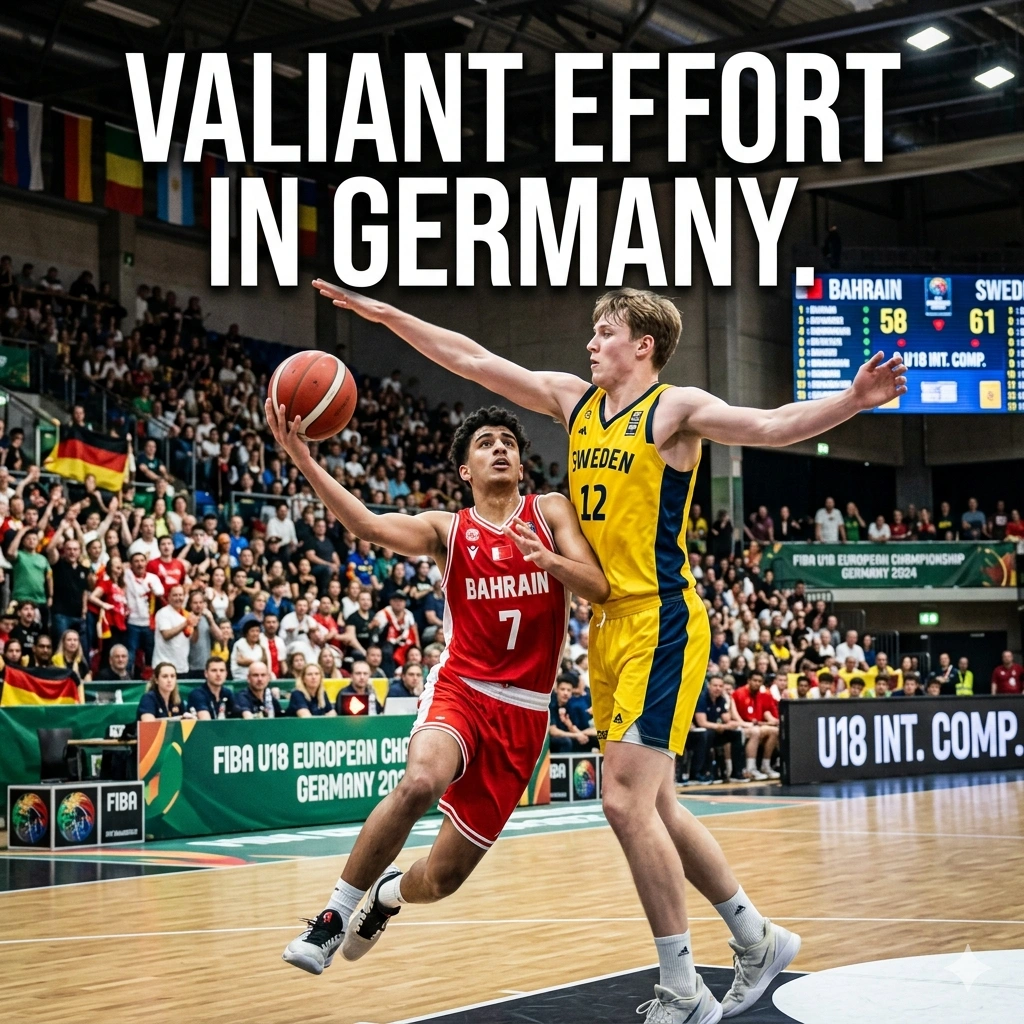
The Youth Basketball Team representing the Kingdom of Bahrain demonstrated remarkable courage and tactical growth during their recent encounter at the Albert Schweitzer Tournament. Facing off against a physically imposing Swedish side in Germany, the young Bahraini athletes showcased the high level of talent currently emerging from the Gulf region. Although the final scoreboard reflected a significant gap, the initial phases of the game proved that Bahrain can compete with European powerhouses when executing their defensive schemes. This tournament serves as a critical developmental milestone, providing the squad with the international exposure necessary to refine their skills before major continental qualifiers. As the team continues its journey in Mannheim, the focus remains on long-term progression rather than short-term results.
A Historic Deadlock in the Opening Quarter
The match began with an unexpected display of parity as the Youth Basketball Team matched Sweden point-for-point in a high-octane first period. Both sides utilized aggressive transition play, resulting in a 21-21 tie that silenced many skeptics in the arena. Bahrain’s ability to navigate Sweden’s full-court press was a testament to their improved ball-handling and court vision under pressure. This opening performance set a positive tone, proving that the Gulf champions possess the raw scoring power to challenge established basketball nations. However, maintaining that intensity over four quarters remains the primary challenge for the developing roster as they face elite competition.
Analyzing the Decisive Second Quarter Surge
The momentum shifted dramatically in the second period when the Swedish team capitalized on a series of defensive lapses and turnovers. While the Youth Basketball Team struggled to find their rhythm in the half-court set, Sweden’s depth began to wear down the Bahraini starters. Being held to just eight points in ten minutes proved to be the turning point that defined the eventual outcome of the game. This scoring drought highlighted the need for more consistent offensive options beyond their primary scorers when the opposition adjustments take effect. Learning to manage these mid-game fluctuations is a key part of the international learning curve for these young athletes.
Youth Basketball Team
The Youth Basketball Team relies heavily on the leadership and physical presence of their star center during these high-stakes international fixtures. Throughout the game in Germany, the team’s tactical approach revolved around high-post screens and quick perimeter rotations to create space for their shooters. Despite the 101-70 final score, the fundamental execution in the half-court offense showed significant improvement compared to their opening match against Germany. The coaching staff is focusing on defensive transition, ensuring that the Youth Basketball Team can recover quickly after missed shots to prevent easy fast-break opportunities. These technical refinements are essential for the team’s success in upcoming regional tournaments.
Individual Brilliance: Somto Patrick Onoduenyi’s Performance
The standout performer for the Bahraini side was undoubtedly the Arab youth MVP, Somto Patrick Onoduenyi, who delivered a world-class double-double. Recording 26 points and 14 rebounds against a taller European frontcourt, Onoduenyi proved why he is considered one of the brightest prospects in Asian basketball. His ability to finish through contact and command the defensive glass kept the Youth Basketball Team competitive during several stretches of the game. Beyond the statistics, his vocal leadership on the floor helped settle his teammates during Sweden’s most aggressive runs. Such individual excellence provides a solid foundation for the national program to build upon in the coming years.
Sweden’s Tactical Depth and Scoring Balance
While Bahrain relied on individual star power, the Swedish victory was characterized by balanced scoring and superior bench depth. With five players reaching double figures, the Europeans forced the Youth Basketball Team to defend multiple threats simultaneously, eventually stretching the Bahraini defense to its breaking point. Malcolm Berglund Price led the charge for Sweden, matching Onoduenyi’s scoring output and facilitating ball movement that led to open three-point looks. This “strength in numbers” approach is a hallmark of European basketball that the Bahraini program aims to emulate as its talent pool expands. Facing such diversity in scoring threats provides the Bahraini defenders with invaluable experience in high-level tactical awareness.
Albert Schweitzer Tournament as a Global Stage
Participating in the 31st Albert Schweitzer Tournament is a prestigious honor that places the Youth Basketball Team among the world’s elite. Known as an unofficial world championship for under-18 teams, the event held in Mannheim and Viernheim is a scouting hotbed for professional leagues and American colleges. For the Bahraini players, this is an opportunity to prove they belong on the same court as future NBA and EuroLeague stars. The pressure of playing in front of international scouts and a passionate German crowd is a unique psychological test. This experience builds a level of mental toughness that cannot be replicated in domestic league play.
Strategic Goals for the FIBA U18 Asia Cup
The primary objective of this European tour is to prepare for the FIBA U18 Asia Cup 2026 qualifiers scheduled for later this year. By facing the Youth Basketball Team against stronger, faster opponents now, the coaching staff hopes to make the regional qualifiers feel less daunting. The physical brand of basketball played in Germany is preparing the Bahraini athletes for the rigorous demands of the Asian circuit. Adjustments made during these losses are being documented and analyzed to create a more resilient defensive system. The ultimate goal is to secure a spot in the continental finals and continue Bahrain’s upward trajectory in the FIBA world rankings.
- Focus on improving defensive communication during opponent fast breaks.
- Enhancement of bench scoring contributions to support the starting five.
- Increased emphasis on physical conditioning to match European intensity.
- Refining late-game execution in close-scoring scenarios.
Resilience and the Bahraini Fighting Spirit
Despite the 31-point deficit at the final buzzer, the Youth Basketball Team never stopped competing, scoring 41 points in the second half. This refusal to surrender is a core value of the national team program and has earned them respect from international observers. The players demonstrated great character by adjusting their offensive strategy mid-game to regain some of the lost momentum. This resilience is particularly important for a youth squad that is still finding its identity on the global stage. Head coach and the technical staff have praised the players for their work ethic and commitment to the national jersey.
The Role of Physicality in Modern Basketball
One of the most apparent differences during the Sweden game was the gap in physical strength and interior presence. The Youth Basketball Team faced challenges in the paint, where Sweden utilized their height advantage to secure second-chance points. Moving forward, the Bahraini athletic program is looking to integrate more specialized strength and conditioning protocols for its youth divisions. Ensuring that the Youth Basketball Team can hold their ground against larger opponents is vital for their defensive interior. This physical development will be a major focus as the players return to their home training facilities after the tournament concludes.
Technical Analysis: Transition Defense Challenges
A detailed look at the game footage reveals that transition defense was the area where the Youth Basketball Team struggled the most. When offensive plays broke down, the recovery speed to the defensive end was often slightly behind the Swedish counter-attack. This allowed the Europeans to go on the decisive second-quarter run that essentially sealed the game’s outcome. Correcting these errors requires both better conditioning and a higher level of tactical discipline during live play. The coaches are working on “safety” roles where specific players are tasked with immediately retreating to the defensive half upon a shot attempt.
Improving Bench Production and Rotation
To compete at the highest international levels, the Youth Basketball Team needs a more consistent contribution from its secondary units. In the match against Sweden, the starters played heavy minutes, which led to visible fatigue during the final stages of the game. Developing a deeper rotation allows the team to maintain a high-intensity defensive pressure without exhausting their star players like Onoduenyi. The Albert Schweitzer Tournament provides a safe environment to test younger bench players against elite competition. Expanding the active roster’s capability is a strategic priority for the national federation moving into the 2026 season.
Fan Support and National Pride
The journey of the Youth Basketball Team has been followed closely by fans back in Manama and across the Kingdom. Social media has been flooded with messages of support, acknowledging the difficulty of the competition and the pride felt in seeing the national flag in Germany. This connection between the fans and the youth team creates a positive ecosystem for the growth of the sport. Every time the Youth Basketball Team steps on the court, they are representing a nation with a rich sporting heritage and a bright future. The experience gained in Mannheim is seen as a collective victory for the entire Bahraini basketball community.
- Strengthening the grassroots scouting network to find more interior talent.
- Establishing international partnerships for coaching exchange programs.
- Investing in high-tech video analysis tools for youth development.
- Increasing the number of international friendly matches for the U18 category.
Lessons Learned from the Host Nation Defeat
The previous loss to Germany provided the Youth Basketball Team with a clear blueprint of what is required to compete at the world level. The German squad utilized a highly structured offensive system that forced Bahrain into difficult defensive rotations throughout the game. While the result was another setback, the tactical lessons learned were immediately applied in the first quarter against Sweden. This rapid adaptation shows that the Bahraini players are quick learners and are capable of implementing complex game plans under pressure. Every loss in Germany is being treated as a masterclass in modern basketball strategy.
The Importance of Regional Qualifiers
While the tournament in Germany is a highlight, the real “pressure cooker” will be the FIBA U18 Asia Cup qualifiers. The Youth Basketball Team must finish at the top of their regional group to ensure their progression in the Asian hierarchy. These qualifiers will feature traditional rivals and will be played in high-stakes environments where every possession matters. The confidence gained from scoring 70 points against a team like Sweden will serve as a psychological boost when facing regional opponents. The national federation has already begun logistical planning to ensure the team has the best possible preparation for these matches.
Coaching Philosophy and Development
The head coach of the Youth Basketball Team has emphasized a philosophy of “process over outcome” during this developmental phase. By focusing on the correct execution of plays and defensive principles, the wins will eventually follow as the players mature. This patient approach is essential for preventing burnout among young athletes and fostering a genuine love for the game. The coaching staff is also focusing on the mental aspect of the sport, helping the players stay composed during hostile environments. This holistic development strategy is aimed at producing well-rounded professionals who can eventually graduate to the senior national team.
Future Stars of Bahraini Basketball
Beyond Onoduenyi, several other members of the Youth Basketball Team have shown flashes of high-level potential during their time in Germany. Sharp-shooters and agile guards have demonstrated that the Bahraini backcourt is as talented as any in the region. These players represent the future of the sport in the Kingdom and are being groomed for long-term success. The international experience they are gaining now will be the cornerstone of their professional careers. As they continue to develop, the expectation is that they will lead Bahrain to new heights in the FIBA rankings.
International Media Coverage and Recognition
The performance of the Youth Basketball Team has not gone unnoticed by the international media covering the event in Mannheim. Analysts have praised the team’s fighting spirit and the individual brilliance of their star players. This positive coverage helps elevate the profile of Bahraini basketball and may lead to more invitations to prestigious global tournaments. Being recognized on a world stage is a significant achievement for a program that is still in its growth phase. The Youth Basketball Team is effectively acting as ambassadors for the Kingdom, showcasing its sporting ambitions to a global audience.
Assessing the Strength of Group A
Group A at the Albert Schweitzer Tournament is widely considered one of the most difficult in the competition’s history. With hosts Germany and European giants like Sweden, the Youth Basketball Team was always going to face an uphill battle. However, playing against the best is the only way to truly measure progress and identify areas for improvement. The difficulty of the group has accelerated the learning process for the Bahraini squad, forcing them to adapt to elite speed and physicality. This “baptism by fire” will undoubtedly pay dividends when they return to regional competition.
- Regular participation in European-based training camps during summer.
- Increased focus on 3×3 basketball to improve individual ball-handling.
- Enhanced nutritional and recovery support for youth athletes.
- Implementing a standardized playing style across all youth age groups.
Final Thoughts on the Journey Ahead
The 101-70 scoreline against Sweden is a single chapter in the much larger story of the Youth Basketball Team. The resilience shown in the face of adversity and the flashes of brilliance in the first quarter are the true takeaways from the game. As the team prepares for their next fixture, they carry with them the lessons of Germany and the hopes of a nation. The path to the top is never easy, but the Bahraini youth are proving they have the heart and the talent to make the journey. With continued support and investment, the future of Bahraini basketball looks exceptionally bright.
Conclusion of the Germany Campaign
As the team concludes its current run in Germany, the focus immediately shifts to the next phase of their 2026 campaign. The Youth Basketball Team has proven that they belong on the international stage and that they are capable of competing with the best. The hard work put in during the Albert Schweitzer Tournament will serve as the foundation for their future successes. The nation looks forward to welcoming their young heroes back and supporting them in their quest for continental glory. Bahrain’s basketball revolution is well underway, led by a group of resilient and talented young men.
For more details & sources visit: Gulf Daily News (GDN Online)
Read more about Behrain news on 360 News Orbit-Behrain.