
South Pole Logistics are the cornerstone of modern scientific endeavor and the blueprint for our upcoming journey to the stars. The frozen expanse of Antarctica serves as a rigorous testing ground for the future of human survival beyond Earth. As we look toward long-duration missions to Mars and the Moon, the methods used to sustain life in the most inhospitable place on our planet offer invaluable data.
Managing a base at the bottom of the world is a task of monumental proportions that requires precision and resilience. The Amundsen-Scott South Pole Station is more than just a research hub; it is a living laboratory where every gallon of fuel and every pound of food represents a triumph of planning. This isolation mirrors the lonely vacuum of space, making the station the ultimate terrestrial analog for agencies like NASA and private firms.
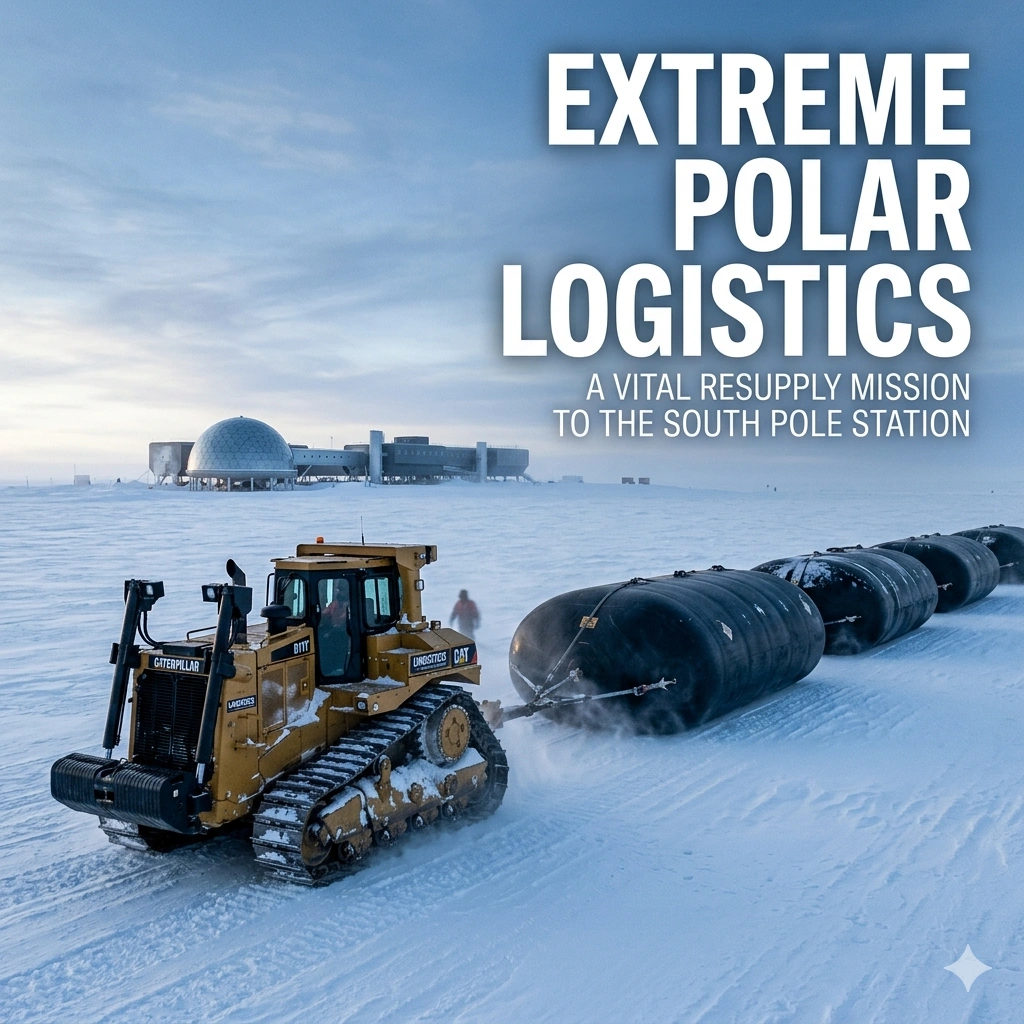
The Foundation of South Pole Logistics
The framework of South Pole Logistics begins with a massive maritime operation known as Operation Deep Freeze. Every year, a fleet of icebreakers and heavy cargo ships must navigate the treacherous Southern Ocean to reach McMurdo Station. This coastal hub serves as the primary gateway for all supplies intended for the interior, acting much like a lunar gateway would for deep space travel.
Once the supplies arrive at the coast, the secondary phase of the supply chain initiates under extreme pressure. Workers must move thousands of tons of equipment and food before the brief summer window closes and the continent becomes inaccessible. This frantic pace of work requires a level of coordination that is rarely seen in standard commercial shipping or military operations.
The logistics chain is further complicated by the unpredictable nature of Antarctic weather, which can halt operations for weeks. Engineers and logisticians must account for these delays by building significant redundancy into every part of the plan. This mindset of preparing for the worst-case scenario is exactly what will be required for the first human colonies on the Martian surface.
Essential Technologies for Extreme Environments
Innovation is the primary driver of South Pole Logistics, as standard machinery often fails in the face of such intense cold. Specialized vehicles, such as ski-equipped LC-130 Hercules aircraft, are the only way to ferry heavy loads directly to the geographic pole. These planes are the workhorses of the continent, though they are limited by the thin air and high altitude of the polar plateau.
Ground transport has also seen a revolution with the development of the McMurdo-South Pole Highway. This is not a road in the traditional sense but a 1,000-mile groomed snow track that allows tractor-trains to haul massive fuel bladders. These traverses are far more cost-effective than flying and allow for the transport of items too heavy for the aging fleet of cargo planes.
- Robotic sensors are now used to detect hidden crevasses along the traverse route to ensure safety.
- Advanced insulation materials developed for space are being tested on Antarctic habitats to save energy.
- Satellite communication arrays provide the only link to the outside world for the isolated winter crews.
South Pole Logistics
The core of the mission is the execution of South Pole Logistics during the brutal eight-month winter period. During this time, no aircraft can land or take off because the temperatures are so low that hydraulic fluids freeze and fuel turns to gel. The station must be entirely self-sufficient, relying on what was stockpiled during the hectic summer months to survive the dark.
This period of total isolation is the closest a human can get to being on another planet without leaving Earth. The psychological and physical demands on the crew are immense, requiring a logistics system that prioritizes mental health as much as physical calories. Food is not just fuel; it is a vital component of morale that requires careful selection and storage.
Every system within the station must be monitored with extreme care by the logistics team. From the power generators to the water recycling systems, there is no room for error when help is thousands of miles away. The lessons learned during these winter-overs are directly informing the design of life-support systems for the Artemis program and beyond.
Powering Life in the Deep Freeze
Energy is the most critical resource within the sphere of South Pole Logistics, as heat is a matter of life or death. The station consumes vast quantities of AN-8 polar equipment fuel, which must be transported across the ice at great expense. Finding ways to reduce this dependency is a top priority for researchers looking at renewable energy sources.
Solar power is an excellent supplement during the months of constant daylight, but it is useless during the long polar night. Wind turbines have been tested with varying degrees of success, though the extreme cold makes moving parts brittle and prone to shattering. This energy struggle is a direct preview of the challenges lunar settlers will face during the fourteen-day-long moon nights.
To maximize efficiency, the station uses waste heat from the generators to warm the living quarters and melt ice for water. This circular economy of energy is a hallmark of sophisticated logistics in extreme environments. It ensures that every joule of energy is utilized to its fullest extent before being lost to the freezing atmosphere.
Water Harvesting and the Rodwell System
Securing a steady water supply is a unique challenge that falls under the umbrella of South Pole Logistics. Since the station sits on nearly two miles of solid ice, there is no liquid water to be found naturally. To solve this, engineers utilize “Rodwells,” which are essentially giant underground cups of melted ice created by circulating hot water.
A Rodwell can provide fresh water for several years before the cavern becomes too large or moves too far from the station. Once a well is exhausted, a new one must be drilled, requiring precise logistical planning and heavy machinery. This method of extracting water from ice is a likely candidate for future missions to the lunar poles where water ice is trapped in shadows.
- Water conservation is strictly enforced, with residents limited to very short showers twice a week.
- Gray water is treated and repurposed where possible to reduce the strain on the heating systems.
- The purity of the glacial ice makes the water some of the cleanest on the planet once it is melted.
Psychological Impacts of Long-Term Isolation
While most focus on the physical side of South Pole Logistics, the “logistics of the mind” is equally important. Maintaining a healthy community in a confined space for months on end requires a deliberate approach to recreation and social structure. The station includes a gym, a library, and even a small greenhouse to provide a sense of normalcy and fresh growth.
Fresh vegetables, known as “freshies,” are a rare luxury that must be managed as a high-priority logistical item. When the first planes arrive after the winter, the delivery of fresh fruit and mail is often more celebrated than the arrival of scientific equipment. These small touches are what prevent “cabin fever” from compromising the safety and productivity of the mission.
The interpersonal dynamics of a small, isolated group are studied extensively by sociologists and space agencies. Conflict resolution and leadership structures are tested in real-time, providing a roadmap for how to manage a crew on a three-year journey to Mars. The social logistics of the South Pole are just as vital as the delivery of fuel.
Geopolitical Pressures on Antarctic Research
The stability of South Pole Logistics is currently being tested by shifting global politics and resource competition. While the 1959 Antarctic Treaty designates the continent for peaceful scientific use, several nations are testing these boundaries. Increased activity by Russia and China in the surrounding waters has led to concerns about the long-term security of the region.
These tensions can complicate the international cooperation that is necessary for successful polar operations. Shared search and rescue protocols, fuel depots, and weather data are all part of a fragile network that relies on mutual trust. If this trust erodes, the cost and risk of maintaining a presence at the South Pole will skyrocket for all nations involved.
Proposed funding cuts in various Western nations also threaten the continuity of long-term logistical projects. Maintaining a presence in such a difficult environment requires a consistent and heavy financial commitment that is often hard to justify to taxpayers. However, the cost of losing our foothold in this strategic scientific arena could be far higher in the long run.
Mapping the Future of Space Exploration
The ultimate goal of refining South Pole Logistics is to pave the way for humanity to become a multi-planetary species. By solving the problems of extreme cold, isolation, and resource management on Earth, we are building the foundation for our future. The South Pole is not just a destination; it is a gateway to the solar system that teaches us how to survive.
The challenges of the South Pole remind us that exploration is never easy, but it is always necessary for the growth of our civilization. By continuing to invest in the complex systems required to live at the edge of the world, we ensure that the light of human knowledge continues to shine in the darkest places. The future is cold, distant, and difficult, but thanks to the lessons learned at the pole, we are ready to face it.
South Pole Logistics will remain the gold standard for high-stakes management in the years to come. Whether we are drilling for ice cores or preparing for a lunar landing, the principles remain the same: preparation, redundancy, and courage. As we move forward, the white desert of the south will continue to guide our way into the black void of space.
The evolution of these systems is a testament to human ingenuity and our refusal to stay within the boundaries of the comfortable. From the first explorers who trekked on foot to the modern engineers who manage a high-tech base, the spirit of the pole remains unchanged. We are a species of explorers, and the South Pole is our most important training ground for the greatest adventure in human history.
For more details & sources visit: Andreessen Horowitz (a16z)
Read more on Antarctica news: 360 News Orbit – Antarctica.