
UN Resolution on Hormuz tensions reached a fever pitch today at the United Nations Security Council as Russia and China officially exercised their veto power to block a Bahrain-proposed measure. The failed resolution was intended to coordinate international defensive efforts to secure the vital waterway, which remains paralyzed by a maritime blockade.
The diplomatic stalemate comes at a time when global energy markets are experiencing unprecedented volatility, leading to fuel rationing in several major economies. The UN Resolution on Hormuz was seen by many as a final attempt at a peaceful maritime solution before a looming deadline for potential military intervention.
While 11 of the 15 council members voted in favor of the security measure, the dual veto from Moscow and Beijing has effectively halted the legal framework for a multinational naval escort. This development leaves the international community in a state of extreme anxiety as the risk of a wider regional conflict continues to escalate.
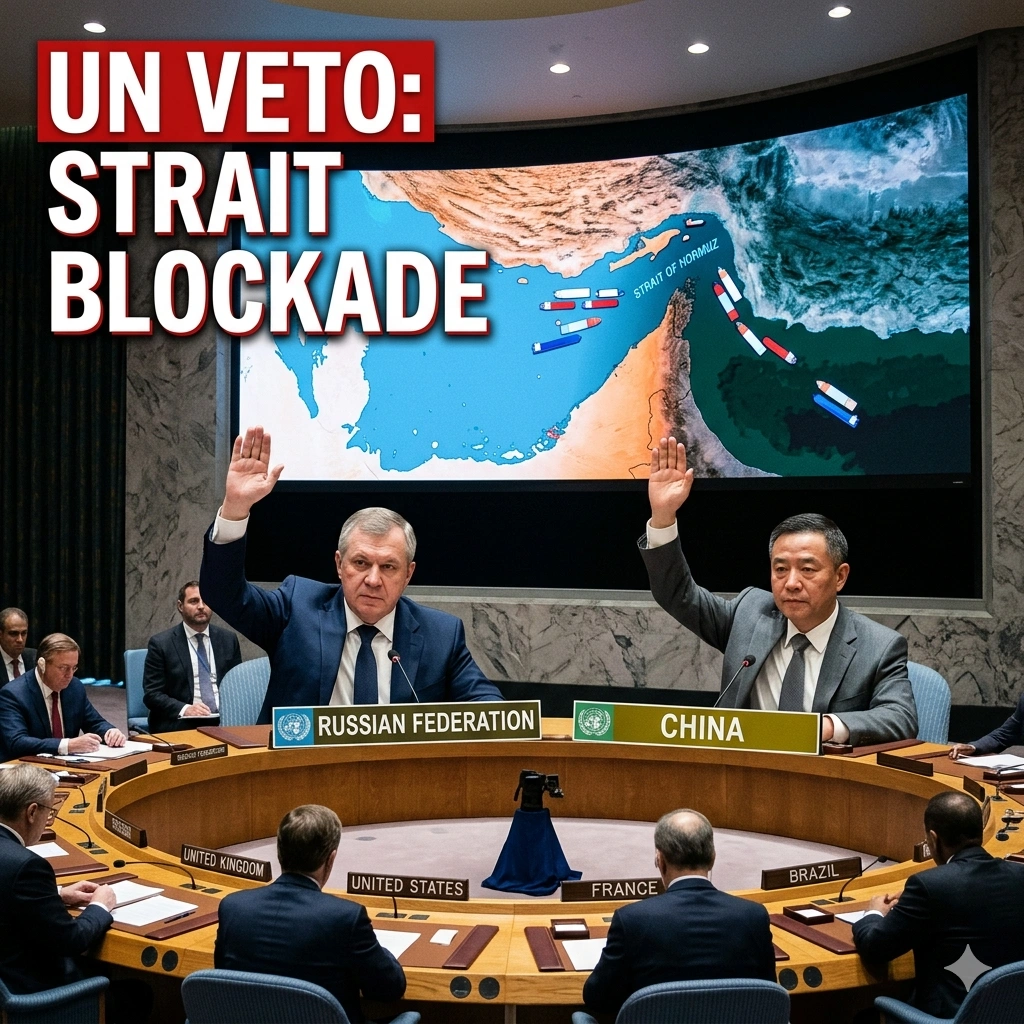
UN Resolution on Hormuz
The primary objective of the UN Resolution on Hormuz was to create a safe corridor for commercial shipping and humanitarian aid through the Persian Gulf. By establishing a UN-backed naval presence, proponents hoped to deter further aggression and stabilize the rapidly rising cost of crude oil and liquefied natural gas.
Opponents of the UN Resolution on Hormuz argued that the text of the proposal was fundamentally biased against Tehran and failed to account for the root causes of the regional instability. Russia and China claimed that the resolution was a thinly veiled attempt to legitimize Western military expansion in a highly sensitive geopolitical zone.
The failure of the UN Resolution on Hormuz has profound implications for global trade, as the Strait of Hormuz handles nearly one-fifth of the world’s daily petroleum consumption. Without a diplomatic breakthrough, the “maximum pressure” tactics currently being employed are likely to continue, further straining the delicate balance of power.
Global Fuel Price Surge and Rationing
The immediate consequence of the failed UN Resolution on Hormuz has been a sharp spike in global fuel prices, hitting record highs in European and Asian markets. Consumer anxiety is growing as gas stations in several countries report shortages and have begun implementing strict rationing protocols to preserve domestic stocks.
Economists warn that the continued blockade, coupled with the lack of a UN Resolution on Hormuz, could lead to a sustained period of global inflation. High energy costs are trickling down into the price of food and manufactured goods, creating a cost-of-living crisis that is affecting millions of households worldwide.
Many nations are now looking for alternative energy sources or rerouting supplies around the Cape of Good Hope, though these measures are significantly more expensive. The absence of a UN Resolution on Hormuz means that shipping insurance premiums remain at prohibitive levels, further driving up the final cost for the end consumer.
The Role of Russia and China in the Veto
The decision by Moscow and Beijing to block the UN Resolution on Hormuz underscores the deepening divide within the Security Council regarding Middle Eastern policy. Both nations emphasized that any lasting solution must involve direct dialogue with Iran rather than the imposition of external military frameworks.
By vetoing the UN Resolution on Hormuz, Russia and China are signaling their commitment to an alternative diplomatic path that challenges the traditional influence of Western powers in the region. This move has been met with sharp criticism from Washington and London, who view the veto as an obstruction of international maritime law.
Strategic analysts suggest that the veto of the UN Resolution on Hormuz may also be linked to broader geopolitical alliances and trade agreements. Both Russia and China have maintained significant energy and security ties with Tehran, making them reluctant to support any measure that could be perceived as a direct threat to Iranian interests.
Impact on Humanitarian Aid Deliveries
One of the most tragic aspects of the deadlock over the UN Resolution on Hormuz is the disruption of vital humanitarian aid to conflict-torn regions like Gaza and Sudan. The blockade has prevented cargo ships carrying medicine and food supplies from reaching those in desperate need, exacerbating already dire situations.
Humanitarian organizations had urged the passage of the UN Resolution on Hormuz as a way to ensure that aid could bypass the military tensions. With the resolution now dead, these organizations are forced to find much slower and more dangerous land routes to deliver life-saving resources.
The international community is calling for the creation of “blue corridors” specifically for aid, but such an agreement seems unlikely without the overarching framework of a UN Resolution on Hormuz. The human cost of the diplomatic stalemate is becoming more apparent every day as storage facilities for essential goods begin to run dry.
Deadlines and Military Escalation Risks
The veto of the UN Resolution on Hormuz occurs just as a critical deadline set by U.S. President Donald Trump for the reopening of the strait is set to expire. The White House has previously hinted at “massive” military strikes if commercial shipping remains blocked beyond the current week.
Without the legal cover of a UN Resolution on Hormuz, any unilateral military action by the U.S. or its allies would face significant international scrutiny and potential condemnation. However, the administration has argued that protecting global commerce is a matter of national security that transcends the need for UN approval.
The failure of the UN Resolution on Hormuz has essentially left the situation in a vacuum, where military posturing is the only remaining form of communication between the opposing sides. Naval assets from multiple nations are currently stationed just outside the Persian Gulf, waiting for the next move from their respective commanders.
Bahrain’s Strategic Proposal at the UN
As the primary sponsor of the UN Resolution on Hormuz, Bahrain had attempted to present a balanced middle ground that could satisfy the security concerns of all regional actors. Their proposal focused on the technical aspects of maritime safety rather than the political disputes driving the conflict.
The rejection of the UN Resolution on Hormuz is a significant blow to small Gulf nations that rely heavily on the stability of the waterway for their economic survival. Bahrain has expressed deep disappointment that the Security Council could not set aside geopolitical rivalries to protect a common global interest.
Diplomats from Manama are reportedly working on a modified version of the UN Resolution on Hormuz in hopes of finding a compromise that Russia and China might accept. However, given the current climate of high-stakes brinkmanship, the prospects for a near-term consensus remain extremely low.
Stock Market Volatility and Investor Fear
Global stock exchanges have entered a period of extreme volatility following the news that the UN Resolution on Hormuz had been blocked. Major indices in New York, London, and Tokyo saw sharp declines as investors moved their capital into “safe-haven” assets like gold and government bonds.
The uncertainty surrounding the UN Resolution on Hormuz has made it difficult for analysts to predict the future of the global economy in the coming quarter. Corporate earnings in the transportation and manufacturing sectors are expected to take a major hit if the blockade persists into the summer months.
Financial experts recommend that investors brace for a prolonged period of market instability until a definitive resolution—diplomatic or otherwise—is reached. The failure of the UN Resolution on Hormuz has effectively removed the “peace premium” that many had hoped would stabilize the markets this April.
Environmental Risks of a Maritime Standoff
The continued tension in the region, exacerbated by the failed UN Resolution on Hormuz, also poses a significant risk to the marine environment. The presence of a large number of warships and the threat of active combat in a confined waterway could lead to catastrophic oil spills.
Environmental groups have pointed out that a UN Resolution on Hormuz would have included protocols for rapid response to maritime disasters. Without these protections, the fragile ecosystems of the Persian Gulf are at the mercy of military events that could cause irreparable damage.
The potential for a “shadow war” at sea—involving mines and drone attacks—is a major concern for those who track environmental safety in international waters. The lack of a UN Resolution on Hormuz means there is no central authority to manage the fallout of a potential ecological disaster in the strait.
The “Bias” Argument: Moscow and Beijing Speak
Russia and China’s primary justification for blocking the UN Resolution on Hormuz was that the document was “one-sided.” They argued that by focusing solely on Iranian actions, the resolution ignored the provocations from Western-aligned forces in the region.
The representatives from Moscow stated that a UN Resolution on Hormuz should have included a call for the withdrawal of foreign naval assets to de-escalate the situation naturally. They believe that an increased military presence, even under a UN banner, only serves to increase the likelihood of a miscalculation.
China’s delegation echoed these sentiments, suggesting that the UN Resolution on Hormuz was a product of “Cold War thinking.” They advocated for a regional security conference that would include all littoral states as equals, rather than a top-down mandate from the Security Council.
Impacts on Global Supply Chains
Global logistics firms are reporting massive delays in the delivery of electronics, machinery, and consumer goods due to the fallout of the failed UN Resolution on Hormuz. The “just-in-time” manufacturing model is being tested to its breaking point as parts remain stuck on ships avoiding the region.
The absence of a UN Resolution on Hormuz has forced companies to seek more expensive air freight options to keep production lines running. This added cost is eventually passed on to the consumer, contributing to the inflationary spiral mentioned previously.
Supply chain managers are now re-evaluating their reliance on routes that pass through geopolitical chokepoints. The failure of the UN Resolution on Hormuz may lead to a permanent shift in global trade patterns, with a greater emphasis on regionalized manufacturing and shorter supply routes.
Public Opinion and International Protests
In many world capitals, public protests have erupted calling for a diplomatic solution to the crisis after the failure of the UN Resolution on Hormuz. Citizens are increasingly frustrated by the rising cost of living and the perceived inability of the UN to prevent a global energy crisis.
Social media campaigns have used the hashtag #HormuzPeace to push for a new UN Resolution on Hormuz that addresses the concerns of all council members. This grassroots pressure is a reflection of the widespread fear that the world is sleepwalking into a massive energy-driven depression.
Despite the public outcry, the political deadlock at the UN remains firm. The veto has become a symbol of the broader paralysis of international institutions in the face of 21st-century geopolitical conflicts, leaving many to wonder if a UN Resolution on Hormuz will ever be possible.
Technical Details of the Blocked Resolution
The technical annex of the UN Resolution on Hormuz contained detailed plans for satellite monitoring and drone patrols of the strait. These systems were intended to provide real-time data on ship movements to prevent accidental collisions or boardings.
Additionally, the UN Resolution on Hormuz would have established a direct communication link between the Iranian Navy and the multinational escort force. This “hotline” was seen by security experts as the most important tool for preventing a localized incident from turning into a full-scale war.
By blocking the UN Resolution on Hormuz, the Security Council has effectively rejected these safety mechanisms. The lack of a formalized communication channel is perhaps the most dangerous aspect of the current situation, as commanders on the ground are forced to make split-second decisions with limited information.
Strategic Importance of the Strait
The Strait of Hormuz is the world’s most important oil transit chokepoint, a fact that makes the failed UN Resolution on Hormuz a matter of global survival. More than 20 million barrels of oil flow through the narrow passage every day, representing a massive portion of the energy used by modern civilization.
Without a UN Resolution on Hormuz to guarantee safe passage, the global economy is essentially functioning with a gun to its head. The ability of a single nation to hold the world’s energy supply hostage is a scenario that international law was supposed to prevent.
The long-term strategic goal of many Western nations remains the diversification of energy routes to reduce the importance of the strait. However, until such infrastructure is built, a UN Resolution on Hormuz remains the only short-term hope for maintaining global economic stability.
Looking Forward: Will a New Deal Emerge?
As the sun sets on another day of diplomatic failure, the question remains: what comes next after the vetoed UN Resolution on Hormuz? Some diplomats suggest that an informal “coalition of the willing” may form to protect shipping without a UN mandate.
Others hope that a secret back-channel negotiation might lead to a revised UN Resolution on Hormuz that both Russia and China can support. Such a deal would likely require significant concessions from the U.S. regarding its “maximum pressure” campaign and regional military presence.
The clock is ticking, and the pressure of soaring fuel prices is forcing every government to reconsider its position. The failure of the UN Resolution on Hormuz today does not mean that the door to diplomacy is closed forever, but it has certainly made the path to peace much narrower.
Conclusion of the UN Stalemate
The veto of the UN Resolution on Hormuz by Russia and China marks a significant turning point in the 2026 Middle East crisis. It highlights the limits of international diplomacy and the intense rivalry that now defines the highest levels of global governance.
The world now waits to see how the U.S. and its allies will respond to the collapse of the UN Resolution on Hormuz. With the President’s deadline approaching, the choice between further diplomacy and direct military action has never been more stark.
The UN Resolution on Hormuz was meant to be a bridge to peace, but it has instead become a wall of disagreement. The coming days will determine whether the international community can find another way forward or if the crisis in the strait will lead to a global catastrophe.
Ultimately, the failure of the UN Resolution on Hormuz is a reminder that in a multipolar world, consensus is the rarest and most valuable commodity of all. Without it, the security of the global commons remains at risk.
For more details & sources visit: Al Jazeera
Read more about China news on 360 News Orbit – China.