
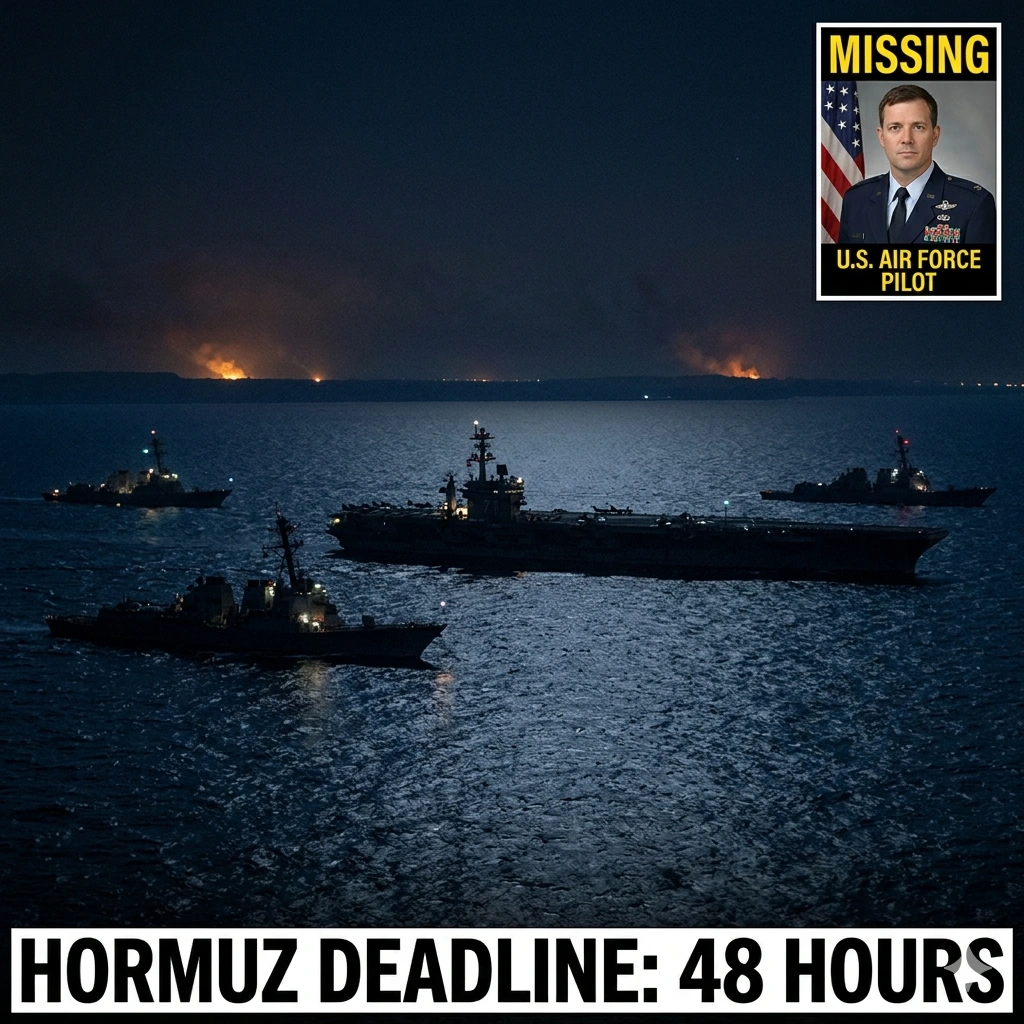
The Trump Iran Deadline has sent shockwaves through global markets as the 48-hour window for Tehran to reopen the Strait of Hormuz fast approaches. This ultimatum, issued on Saturday, April 4, 2026, marks the most dangerous point in a six-week conflict that has already decimated regional stability. With a missing U.S. pilot still lost in Iranian territory, the White House has signaled that its patience for diplomatic stalling has finally reached its end.
The international community is now bracing for a massive military escalation if the Monday deadline is not met by the Iranian leadership. This standoff represents a critical test of resolve for both Washington and Tehran in a war that began in late February. As the clock ticks down, the risk of a total regional conflagration grows more likely with every passing hour of silence from the Iranian Joint Military Command.
The Strategic Gravity of the Trump Iran Deadline
The Trump Iran Deadline is not merely a political statement but a direct military directive aimed at restoring global shipping lanes. By giving Tehran 48 hours to act, the U.S. administration is forcing a choice between economic capitulation and potential infrastructural ruin. The Strait of Hormuz remains the world’s most vital energy artery, and its continued closure has paralyzed international trade.
President Trump has characterized the Iranian military as significantly weakened, suggesting that further resistance would be futile for the Islamic Republic. However, the rhetoric coming out of Tehran suggests a willingness to engage in a “war of all against all” to protect its sovereignty. This clash of wills has pushed oil prices to record highs, impacting every major economy on the planet.
Experts believe that the Trump Iran Deadline was timed to coincide with the intensified search for the downed American aviator. The administration is likely using the threat of expanded strikes to ensure the safe return of the pilot or to gain intelligence on his location. Failure to comply by Monday morning could trigger a new phase of the aerial campaign.
Search Operations for the Missing U.S. Pilot
While the Trump Iran Deadline looms, the primary focus of U.S. Central Command remains the recovery of a pilot downed during Friday’s heavy combat. The aviator is believed to be in a remote, mountainous region of Iran, making a rescue mission exceptionally high-risk. Special operations units are reportedly on standby, awaiting a window of opportunity to move into enemy territory.
The downing of two U.S. warplanes on April 3 was a rare blow to American air superiority in the region. It demonstrated that despite significant losses, Iranian air defenses still possess the capability to strike high-value targets. This technical resilience has complicated the Pentagon’s strategy for achieving total dominance over Iranian airspace.
The search is currently a race against time, as both U.S. intelligence and Iranian ground forces are scouring the crash site area. The capture of an American pilot would provide Tehran with a significant bargaining chip in any future negotiations. Consequently, the pressure to find the pilot before the 48-hour deadline expires is immense for U.S. planners.
Trump Iran Deadline
The Trump Iran Deadline serves as the final warning before a potential shift toward targeting Iran’s most sensitive industrial and energy assets. Following the strike on the Mahshahr petrochemical complex, the U.S. has shown a willingness to dismantle the economic backbone of the regime. The Monday deadline is the last chance for Tehran to avoid a total collapse of its domestic infrastructure.
Iranian officials have responded by threatening to open the “doors of hell” against U.S. bases in Qatar, Bahrain, and the UAE. This escalatory language indicates that Iran may choose to widen the conflict rather than back down under pressure. The next 48 hours will determine if the region moves toward a ceasefire or a devastating regional war.
The involvement of Israeli strikes on petrochemical targets adds another layer of complexity to the Trump Iran Deadline. Prime Minister Netanyahu’s confirmation of these attacks suggests a coordinated front aimed at maximum pressure on the Iranian government. This trilateral tension between the U.S., Israel, and Iran is currently the greatest threat to world peace in 2026.
Evacuations at the Bushehr Nuclear Facility
As the Trump Iran Deadline approaches, the safety of nuclear infrastructure has become a major international concern for the United Nations. Reports of an airstrike hitting near the Bushehr nuclear facility prompted an immediate response from Russian authorities. Rosatom has already evacuated nearly 200 of its specialist workers from the site to avoid potential casualties.
The proximity of combat to nuclear sites has raised the specter of an environmental catastrophe in the Persian Gulf. Russia has called for restraint, warning that any damage to the reactor’s core could have “irreversible consequences” for the entire region. Despite these warnings, the military campaign continues to edge closer to these sensitive zones.
The evacuation of Russian personnel is a clear indicator that Moscow views the Trump Iran Deadline as a credible and imminent threat. It also suggests that the Kremlin may no longer be able to guarantee the safety of its citizens within Iran. This shift in the security landscape marks a significant turning point in the six-week-old conflict.
Global Economic Impact of the Strait Closure
The failure to resolve the standoff before the Trump Iran Deadline has sent the global shipping industry into a state of total chaos. With the Strait of Hormuz effectively a war zone, insurance premiums for tankers have skyrocketed to unsustainable levels. This has led to a massive backlog of vessels waiting in the Gulf of Oman and the Arabian Sea.
- Global oil prices have surged past $150 per barrel as supply chains remain severed.
- Manufacturing hubs in Asia and Europe are reporting significant delays in raw material deliveries.
- Consumer prices for fuel and electricity are spiking in the United States and Canada.
- International airlines have rerouted thousands of flights to avoid the growing combat zone.
The Trump Iran Deadline is seen by many economists as the final opportunity to prevent a global recession. If the Monday deadline passes without a resolution, the economic damage could take years to repair. The pressure from international allies on both sides to find a diplomatic exit is reaching its peak.
Rhetoric of the Iranian Military Command
General Ali Abdollahi Aliabadi has emerged as the voice of Iranian defiance in the face of the Trump Iran Deadline. His statements suggest that the Iranian military is prepared for a protracted conflict, regardless of the cost to its infrastructure. He has explicitly stated that any attack on Iranian soil will be met with a “symmetrical response” against U.S. interests.
The “decimated” label used by the White House has been met with fierce propaganda from Tehran, showcasing remaining missile capabilities. Iran has released footage of underground missile silos, warning that they are ready to launch if the Strait is forcefully reopened. This psychological warfare is designed to deter the U.S. from following through on its Monday threat.
Internal pressure within Iran is also mounting as the civilian population bears the brunt of the airstrikes and economic sanctions. However, the military leadership remains firmly in control, utilizing the external threat to consolidate domestic power. The Trump Iran Deadline has, for now, forced the regime into a corner with few options for a graceful retreat.
Israeli Involvement and the Mahshahr Strike
The confirmation of the Mahshahr strike by Benjamin Netanyahu has further solidified the link between U.S. and Israeli military objectives. This strike targeted a critical node in Iran’s oil export capacity, dealing a severe blow to the regime’s remaining revenue streams. It serves as a practical demonstration of what the Trump Iran Deadline looks like in action.
Reports from the ground indicate that the strike killed at least five people and caused extensive damage to the facility’s refining units. This escalation into targeting high-value economic assets signals a departure from purely military engagement. The U.S. and its allies are now clearly engaged in a strategy of total economic warfare.
- The Mahshahr complex was responsible for a significant portion of Iran’s domestic fuel production.
- Israeli intelligence reportedly provided the precise coordinates to avoid hitting nearby residential areas.
- The strike has led to widespread fuel shortages within Iran, further straining the civilian infrastructure.
- Pro-Iranian militias in Iraq and Yemen have vowed to retaliate against Israeli interests in response.
The timing of this strike, just days before the Trump Iran Deadline, was intended to weaken Iran’s resolve. Instead, it seems to have stiffened the resistance of the hardliners in the Iranian Revolutionary Guard. The cycle of strike and counter-strike shows no signs of slowing as the Monday deadline nears.
U.S. Domestic Support for the Military Campaign
Within the United States, the Trump Iran Deadline has received a mixed response from the public and political leaders. Supporters of the President argue that a firm deadline is the only way to break the deadlock and protect American interests. They point to the missing pilot as a moral justification for a more aggressive military posture.
Critics, however, warn that the 48-hour ultimatum could trap the U.S. into an unnecessary and costly ground war. They argue that a Monday deadline leaves little room for the very diplomacy that could save the pilot’s life. The political divide over the conflict is becoming increasingly sharp as the costs of the war continue to mount.
The White House remains undeterred, citing the need for “peace through strength” as the guiding principle of its Middle East policy. For the Trump administration, the Trump Iran Deadline is a test of American credibility on the global stage. A retreat from the deadline without concessions from Tehran would be seen as a major political defeat.
The Role of Rosatom and International Evacuations
The decision by Rosatom to pull its workers out of Bushehr is perhaps the most telling sign of the imminent danger. As the Trump Iran Deadline approaches, foreign nationals are fleeing the country in anticipation of a massive air campaign. This “brain drain” of international experts will have long-term consequences for Iran’s technical capabilities.
Other international organizations, including several UN agencies, have also begun reducing their staff footprints in Tehran. The atmosphere in the Iranian capital is described as tense, with residents bracing for a significant increase in aerial activity. The Trump Iran Deadline has effectively turned the country into a waiting room for a larger conflict.
Russia’s role in the crisis is particularly delicate, as it seeks to protect its investments while avoiding a direct confrontation with the U.S. The evacuation of 200 workers is a pragmatic move to minimize Russian casualties in a war they cannot control. It also serves as a silent acknowledgment that the Trump Iran Deadline is likely to be enforced.
Military Preparedness of U.S. Forces in the Region
In preparation for the expiration of the Trump Iran Deadline, U.S. forces have moved into high-alert status across the Middle East. Additional carrier strike groups and land-based fighter squadrons have been deployed to reinforce existing positions. The Pentagon is ensuring that every possible contingency is covered before the Monday morning deadline arrives.
The logistics of reopening the Strait of Hormuz by force would involve a massive minesweeping operation and constant air cover. Navy planners are reportedly finalizing the details of “Operation Sentinel’s Gate,” which would be triggered if the deadline passes. This operation would be the largest naval engagement for the U.S. in decades.
- F-35 and F-22 squadrons have been conducting around-the-clock patrols near the Iranian border.
- Patriot missile batteries in Saudi Arabia and the UAE are on maximum readiness for inbound threats.
- Cyber Command has reportedly intensified its efforts to disrupt Iranian command and control networks.
- Medical units in the region have been bolstered to handle potential casualties from a wider conflict.
The sheer scale of the U.S. buildup is a physical manifestation of the Trump Iran Deadline. It leaves no doubt that the administration is prepared to use every tool at its disposal to achieve its stated goals. The coming days will test the structural integrity of the U.S. military’s regional presence.
Diplomatic Last-Ditch Efforts at the UN
As the Trump Iran Deadline nears its conclusion, a flurry of diplomatic activity is taking place behind the scenes at the United Nations. Several European and Arab nations are attempting to broker a middle-ground solution that would see the Strait reopened without further strikes. However, both Washington and Tehran seem entrenched in their respective positions.
The UN Secretary-General has called for an immediate humanitarian pause to allow for the recovery of the missing pilot and the delivery of aid. So far, these pleas have been ignored by the combatants, who view the conflict in zero-sum terms. The Trump Iran Deadline has essentially sidelined traditional diplomatic channels in favor of raw power politics.
If a breakthrough does not occur by Sunday night, the international community will be forced to watch as the conflict enters a new and potentially final stage. The failure of diplomacy in this instance would be a significant blow to the relevance of international institutions in 2026. All eyes remain on the clock as the 48-hour window closes.
Future Implications for the Strait of Hormuz
The outcome of the Trump Iran Deadline will forever change the way the Strait of Hormuz is governed and secured. A successful reopening by force would lead to a permanent U.S.-led naval presence to prevent future closures. This would fundamentally alter the balance of power in the Persian Gulf for the foreseeable future.
Conversely, if Iran successfully resists the deadline, it would demonstrate the limits of American military pressure in the modern era. This could encourage other regional actors to challenge the status quo, leading to further instability. The stakes of the Trump Iran Deadline are therefore global and historical in nature.
Regardless of the immediate military outcome, the trust between the major powers in the region has been completely shattered. Rebuilding any form of regional security architecture will take decades of careful diplomacy. The events of April 2026 will be remembered as the moment the Middle East was pushed to the very edge of the abyss.
Conclusion: The Final 48 Hours
The Trump Iran Deadline has created a moment of profound uncertainty for the entire world. With the life of a missing pilot hanging in the balance and the global economy on the brink, the Monday deadline is a turning point. President Trump’s ultimatum has left no room for error or miscalculation on either side.
As Tehran weighs its options, the cost of defiance has never been higher. The destruction of its petrochemical and nuclear infrastructure is a real and present danger. At the same time, the U.S. faces the risk of a long and bloody conflict that could drain its resources and distract from other global priorities.
The world now waits for Monday. Whether the Trump Iran Deadline leads to a peaceful reopening of the Strait or a devastating escalation, the landscape of the Middle East has been changed forever. The next 48 hours will be among the most consequential in modern history.
For more details & sources visit: Orange County Register
Read more about USA news on 360 News Orbit – United States of America.