
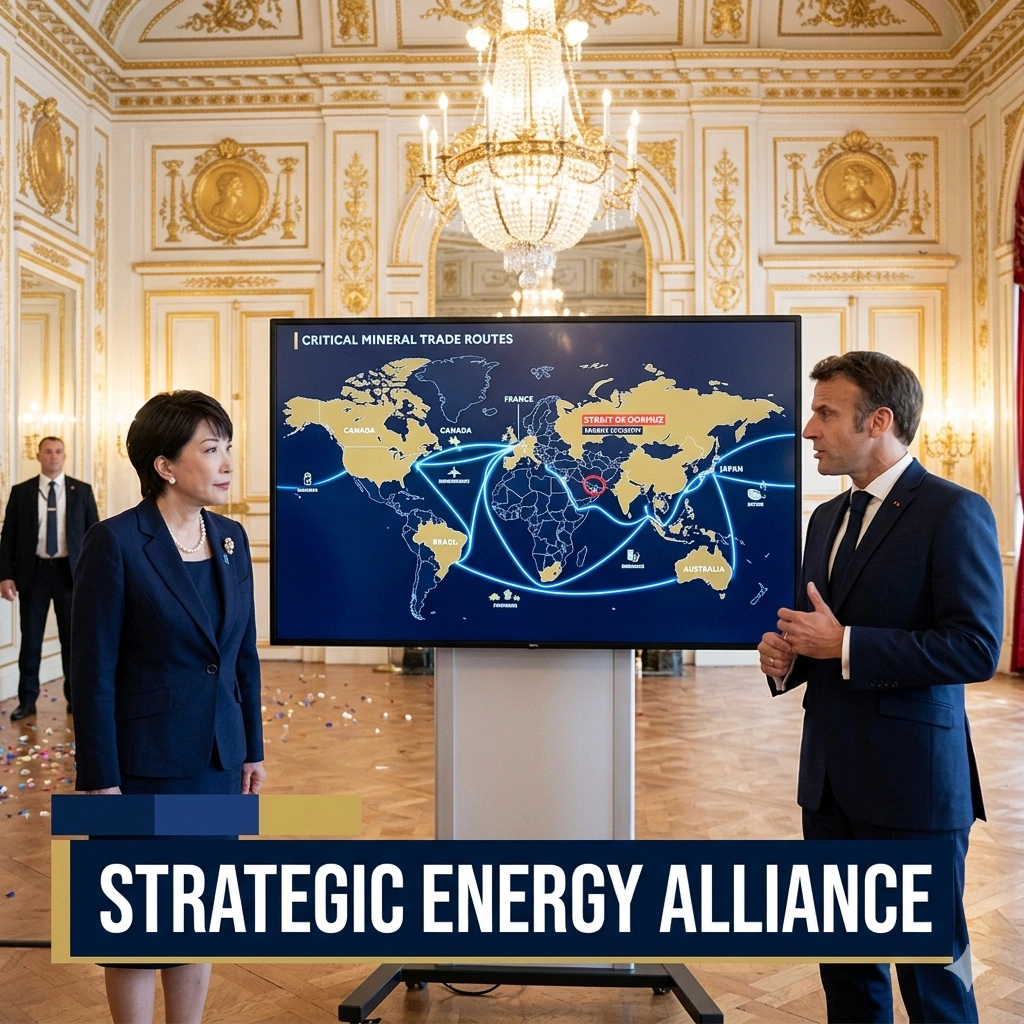
Global Energy Security is undergoing a radical transformation as Japan and France solidify a strategic alliance to combat the ongoing Middle East crisis. Japanese Prime Minister Takaichi Sanae and French President Emmanuel Macron met at the Akasaka State Guest House to sign a historic partnership agreement. This high-level summit was triggered by the effective closure of the Strait of Hormuz, which has sent shockwaves through the international community. The two nations are now prioritizing supply chain resilience and technological innovation to mitigate the risks of a volatile global market.
The cornerstone of this new agreement is the “Critical Minerals Roadmap,” a comprehensive plan designed to reduce overreliance on dominant global suppliers like China. By diversifying their energy sources and securing rare earth elements, both nations aim to protect their industrial bases from external political pressure. This proactive approach to Global Energy Security highlights the growing importance of bilateral cooperation in a fragmented geopolitical landscape. As traditional energy routes face unprecedented blockades, the Japan-France alliance offers a blueprint for national survival and long-term economic autonomy.
Global Energy Security
The recent summit marks a pivotal moment for Global Energy Security as nations seek alternatives to fossil fuels and vulnerable shipping lanes. Prime Minister Takaichi and President Macron emphasized that the current blockade in the Middle East is a structural vulnerability that requires immediate action. By focusing on nuclear innovation and critical mineral refining, the two countries are building a defensive shield against energy weaponization. This strategy is essential for maintaining industrial productivity during a period of intense regional conflict and trade disruptions.
Strategic investments in new technologies are at the heart of these Global Energy Security efforts to ensure a stable future. The leaders discussed the importance of fusion energy and advanced nuclear fuel cycles as permanent solutions to the current energy shock. By combining Japanese engineering prowess with French nuclear expertise, the alliance aims to set a new standard for international energy cooperation. These Global Energy Security initiatives are not merely reactionary but are designed to provide a sustainable foundation for the next several decades.
The Critical Minerals Roadmap for 2026
A major highlight of the bilateral talks was the formal launch of the Japan-France Roadmap on Critical Minerals to secure vital resources. This plan specifically targets the concentration of rare earth refining, which has historically been dominated by a single global power. The roadmap outlines a clear path for developing independent processing facilities that can support the production of electric vehicles and defense systems. Ensuring a steady supply of these materials is a fundamental component of Global Energy Security in the modern age.
The roadmap includes specific timelines for the extraction and refining of heavy rare-earth oxides required for high-tech manufacturing. Both nations have agreed to share technical data and investment risks to accelerate the development of these essential supply chains. By decoupling from unreliable suppliers, Japan and France are taking a bold step toward true economic sovereignty and resource independence. This level of coordination is a significant milestone in the ongoing quest for Global Energy Security and industrial resilience.
The Caremag Project and JOGMEC Collaboration
Central to the new mineral strategy is the Caremag project located in France, which receives significant backing from Japanese entities. The Japan Organization for Metals and Energy Security, known as JOGMEC, is playing a lead role in financing and technical support. This project is expected to supply approximately 20% of Japan’s heavy rare-earth oxides by late 2026, providing a critical buffer. Such projects are vital for Global Energy Security as they create localized hubs for the production of materials used in wind turbines.
The collaboration between JOGMEC and French industrial partners serves as a model for future international resource development projects globally. By leveraging French geography and Japanese capital, the two nations are effectively bypassing traditional bottlenecks in the global supply chain. This synergy ensures that both countries can continue their transition to green energy without being held hostage by geopolitical shifts. The Caremag project is a tangible manifestation of the Global Energy Security goals outlined during the Akasaka summit.
Nuclear Innovation and Fusion Energy Goals
Beyond minerals, Japan and France are deepening their cooperation on advanced nuclear technologies to achieve long-term energy autonomy. The leaders reaffirmed their commitment to the ITER and JT-60SA projects, which focus on the groundbreaking potential of fusion energy. Unlike traditional fission, fusion offers the promise of nearly limitless clean energy without the associated risks of long-lived radioactive waste. Advancing these technologies is a top priority for Global Energy Security in an increasingly carbon-constrained world.
The partnership also covers the development of closed nuclear fuel cycles, which maximize the efficiency of existing nuclear resources. By recycling spent fuel, both nations can reduce their dependence on imported uranium and improve the sustainability of their power grids. These technical advancements are crucial for maintaining Global Energy Security while meeting ambitious climate targets set for the coming decade. The joint research initiatives between French and Japanese scientists are expected to yield significant breakthroughs in reactor design and safety.
Addressing the Strait of Hormuz Blockade
The effective closure of the Strait of Hormuz has forced a rapid reassessment of Global Energy Security strategies for all major economies. With commercial traffic at a standstill, the risk of a prolonged energy shortage has become a reality that cannot be ignored. Japan and France are leading the call for international cooperation to protect maritime routes while simultaneously developing land-based alternatives. This dual-track approach is necessary to navigate the complexities of the current Middle East conflict.
The blockade has highlighted the dangers of relying on a few geographical chokepoints for the world’s most essential energy resources. Global Energy Security now requires a more distributed and diversified network of energy production and transportation to be truly effective. The Japan-France alliance is a direct response to this need, focusing on localized production and regional energy hubs. By reducing the strategic importance of any single waterway, the two nations are making the global economy more resilient to localized shocks.
Strategic Benefits of the Japan-France Alliance
- Enhances the stability of high-tech manufacturing sectors by securing a steady supply of rare earth elements and heavy oxides.
- Accelerates the transition to carbon-neutral energy sources through joint research and development in fusion and advanced nuclear technology.
- Strengthens the diplomatic influence of both nations by creating a powerful alternative to traditional energy and mineral supply chains.
- Provides a framework for rapid response during energy crises, allowing for the sharing of resources and technical expertise when needed.
The Impact on Electric Vehicle Production
The transition to electric vehicles is heavily dependent on the availability of magnets and batteries made from critical minerals. Global Energy Security is therefore intrinsically linked to the success of the automotive industry’s move away from internal combustion engines. The Japan-France roadmap ensures that manufacturers in both countries will have the materials they need to remain competitive in a crowded market. Without these secured minerals, the green transition would likely face significant delays and increased costs for consumers.
By securing 20% of its rare-earth needs through the Caremag project, Japan is protecting its iconic automotive brands from supply shocks. France, in turn, benefits from Japanese investment and technology, positioning itself as a leader in European mineral processing and refining. This symbiotic relationship is a key driver of Global Energy Security for the 21st-century economy, where technology and energy are inseparable. The alliance ensures that the EV revolution can continue despite the ongoing instability in traditional energy-producing regions.
Defense Systems and National Security Links
Modern defense systems rely heavily on the same rare earth elements used in green energy technologies and consumer electronics. Therefore, Global Energy Security is a matter of national defense as much as it is an economic or environmental issue. The Japan-France partnership includes provisions for the secure supply of materials used in radar, guidance systems, and advanced military hardware. Protecting these supply chains is essential for maintaining the technological edge of both nations’ armed forces.
The leaders noted that economic security and traditional military security are now two sides of the same coin in a globalized world. By collaborating on mineral security, Japan and France are strengthening their collective defense posture against potential adversaries who might use resource denial as a weapon. These Global Energy Security measures send a clear message that the alliance is prepared to defend its industrial and military interests. The integration of economic and security policy is a defining characteristic of the Takaichi and Macron administrations.
Future Projections for Global Energy Markets
Looking toward 2030, the landscape of the world’s energy markets will likely be defined by these types of strategic bilateral alliances. Global Energy Security will shift away from a reliance on globalized commodity markets toward more secure, regionalized supply networks. Japan and France are at the forefront of this trend, showing that cooperation between like-minded nations can overcome the challenges of a volatile world. We can expect more countries to follow this lead, creating a web of interlocking security agreements.
The success of fusion energy and advanced nuclear projects will play a decisive role in determining which nations thrive in the new era. Global Energy Security will increasingly depend on technological leadership rather than just geographical luck or resource abundance. Those who invest in innovation today will be the ones who enjoy the greatest levels of stability and prosperity tomorrow. The Japan-France roadmap is a significant first step toward this more secure and technologically advanced future for the global community.
Navigating Geopolitical Rivalries and Trade
The push for Global Energy Security often requires navigating a complex web of geopolitical rivalries and conflicting national interests. Japan and France must balance their need for resource independence with the reality of integrated global trade and existing diplomatic commitments. Their partnership is designed to be inclusive, offering a path for other nations to join in building a more resilient energy framework. This approach avoids the pitfalls of isolationism while still prioritizing national and economic security.
Trade policies are being rewritten to reflect the new priorities of Global Energy Security and supply chain resilience for the modern age. Tariffs and incentives are increasingly being used to encourage domestic or allied production of critical materials and energy technologies. The Japan-France alliance is a central part of this broader shift in global trade dynamics, favoring security and stability over the lowest possible cost. This transition is not without its challenges, but it is a necessary adjustment to the realities of a more fragmented world.
Key Projects in the Japan-France Partnership
- The ITER Project: A massive international effort to harness nuclear fusion, with Japan and France playing leading roles in research and engineering.
- The JT-60SA Project: An advanced tokamak located in Japan that serves as a critical testing ground for the larger ITER fusion experiment.
- The Caremag Refining Hub: A state-of-the-art facility in France designed to process rare earth elements for the global tech and energy sectors.
- Joint Nuclear Fuel Recycling: A collaborative effort to develop technologies that allow for the reuse of spent nuclear fuel in next-generation reactors.
Promoting Stability in a Volatile Energy Market
The ultimate goal of these Global Energy Security measures is to create a more stable and predictable environment for businesses and consumers. By reducing the frequency and severity of energy shocks, governments can foster long-term investment and sustainable economic growth for all. The Japan-France alliance provides a stabilizing force in a market that has been characterized by extreme volatility and political manipulation. Their commitment to transparency and cooperation is a vital antidote to the uncertainty that currently plagues the world’s energy sector.
Stable energy prices are essential for maintaining social cohesion and public trust in government institutions during difficult times. Global Energy Security policies that prioritize affordability and reliability are therefore crucial for the health of democratic societies. The leaders of Japan and France are acutely aware of this responsibility as they work to build a more secure energy future. Their efforts demonstrate that even in a time of crisis, it is possible to find constructive and innovative solutions to the world’s most pressing problems.
Conclusion on the Akasaka State Guest House Summit
The summit at the Akasaka State Guest House has set a new course for the relationship between Japan and France for years to come. By prioritizing Global Energy Security and critical mineral resilience, the two nations are taking control of their own economic destinies. The roadmap signed by Prime Minister Takaichi and President Macron is a powerful statement of intent that will resonate across the global stage. It shows that through cooperation and innovation, it is possible to overcome the structural vulnerabilities that threaten our collective prosperity.
As the world continues to grapple with the energy crisis of 2026, the Japan-France alliance will serve as a beacon of stability. The focus on Global Energy Security is not just a policy choice but a necessary response to a world in flux. By building a future based on nuclear innovation and secure supply chains, Japan and France are ensuring that they will remain leaders in the global economy. Their partnership is a testament to the enduring power of diplomacy and the shared values that bind these two great nations together in a common cause.
For more details & sources visit: The Diplomat
Read more about France news on 360 News Orbit – France.