
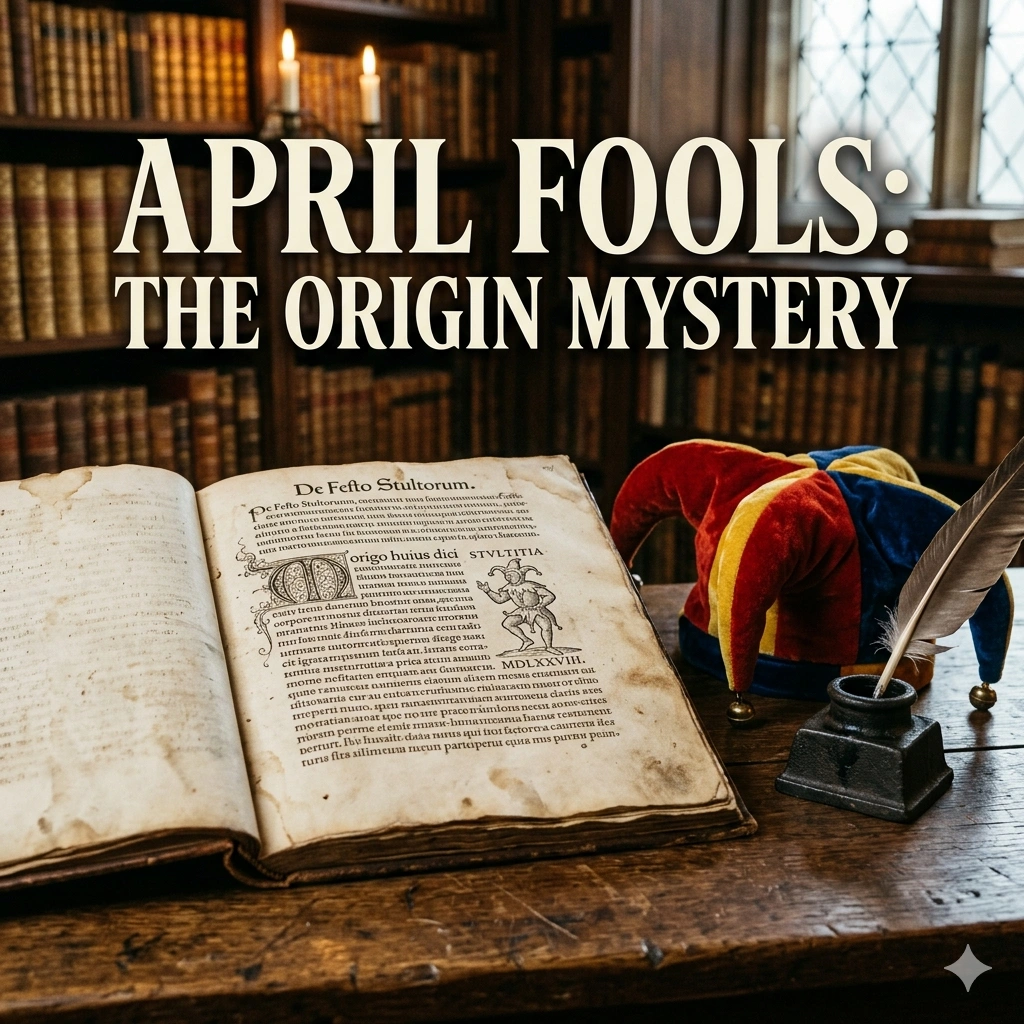
The April Fools’ Day mystery continues to baffle historians and cultural experts as millions of people across the globe engage in elaborate hoaxes. Despite its status as a nearly universal tradition, no one can pinpoint exactly when or why we started tricking each other on this specific date. Some argue it is a remnant of ancient Roman festivals, while others believe it stems from medieval calendar shifts in Western Europe. The April Fools’ Day mystery is further complicated by the fact that many “official” origin stories are themselves elaborate pranks designed to fool the curious. As we navigate a digital age where misinformation spreads rapidly, understanding the roots of this day has never been more relevant for modern society.
The Roman Hilaria and Ancient Foundations
One of the most persistent theories in the April Fools’ Day mystery involves the Roman festival of Hilaria, celebrated at the end of March. During this ancient festival, Romans would dress in disguises and imitate high-ranking officials to celebrate the resurrection of the god Attis. This spirit of masquerade and reversal of social roles shares a striking resemblance to the modern pranks we see today. Historians investigating the April Fools’ Day mystery often cite Hilaria as the earliest psychological precursor to our April 1 antics. However, the multi-century gap between the fall of Rome and the first recorded mentions of April Fools makes a direct link difficult to prove.
The festival of Hilaria was a time of joy and “hilarity,” providing a much-needed break from the rigid structures of Roman life. In many ways, the April Fools’ Day mystery is a reflection of the human need for a temporary release from social norms and expectations. Similar festivals existed in other cultures, such as the Holi festival in India, which also involves playfulness and the breaking of traditional boundaries. While the Roman connection is academically appealing, it remains just one piece of a much larger and more fragmented historical puzzle. The April Fools’ Day mystery suggests that the urge to prank is an inherent part of the human experience across all eras.
The French Connection and the Poisson d’Avril
In the 16th century, France shifted its New Year’s Day from April 1 to January 1 following the adoption of the Gregorian calendar. According to one popular theory in the April Fools’ Day mystery, those who continued to celebrate the New Year in April were mocked as “fools” and had paper fish stuck to their backs. This gave rise to the term “poisson d’avril” or “April fish,” a tradition that remains incredibly popular in France and Italy to this day. This calendar shift theory is often cited as the definitive answer to the April Fools’ Day mystery, but some scholars remain skeptical of its late appearance in written records.
The “April fish” symbol is thought to represent a young, easily caught fish—much like an innocent person who falls for a simple prank. In the context of the April Fools’ Day mystery, this transition period in France provides a logical, if not entirely verified, explanation for the holiday’s timing. It highlights how changes in administrative law can inadvertently create long-lasting cultural traditions that outlive the laws themselves. Even today, French schoolchildren delight in pinning paper fish on unsuspecting teachers, keeping the spirit of the April Fools’ Day mystery alive for a new generation. This specific cultural quirk remains one of the most charming aspects of the holiday’s disputed history.
The Great Kugel Hoax of 1983
Perhaps the funniest part of the April Fools’ Day mystery is how many people were tricked by a Boston University professor in 1983. Professor Joseph Boskin told an Associated Press reporter that the holiday began during the reign of Emperor Constantine, when a jester named Kugel was allowed to be “king for a day.” This story was printed in newspapers across America as a factual solution to the April Fools’ Day mystery, only for Boskin to later reveal he had made the entire thing up. This incident serves as a meta-commentary on the holiday itself, proving that even “experts” are not immune to being fooled on April 1.
The Kugel story was so well-constructed that it still appears in some textbooks and online articles as a legitimate historical theory. This layers of deception make the April Fools’ Day mystery even more difficult to untangle for modern researchers. It reminds us that historical “facts” can sometimes be nothing more than a well-placed joke that stood the test of time. Boskin’s prank has now become a permanent part of the April Fools’ Day mystery, illustrating the very behavior the holiday seeks to celebrate. It teaches a valuable lesson about skepticism and the importance of verifying sources, even when they come from prestigious academic institutions.
April Fools’ Day mystery
The April Fools’ Day mystery is a testament to the endurance of oral tradition over written documentation. For centuries, the practice of playing “fruitless errands” was passed down through families and communities without any formal record. The first undeniable evidence appeared in a 1561 Flemish poem, which described a servant being sent on useless tasks on the first of April. This suggests that the April Fools’ Day mystery had already been a well-established custom in the Low Countries long before it reached the English-speaking world. The poem is a “smoking gun” for historians, providing a firm date in a sea of historical ambiguity.
By the time the tradition reached England, it was described by antiquarians as “Fooles Holy Day,” a time of year when even the most serious citizens could indulge in a bit of madness. The April Fools’ Day mystery is deeply rooted in the concept of the “fool’s errand,” where a victim is sent to find a non-existent object like “pigeon’s milk” or a “left-handed wrench.” These tasks were designed to waste time and highlight the gullibility of the target, much to the amusement of the onlookers. This specific form of pranking has remained a staple of the holiday for nearly five hundred years, showing remarkably little change since the Renaissance.
Chaucer and the Nun’s Priest’s Tale
Geoffrey Chaucer’s “The Canterbury Tales” is often brought up in discussions regarding the April Fools’ Day mystery. In the “Nun’s Priest’s Tale,” a line mentions “Syn March was gon,” which some interpret as a reference to April 1 being a day of trickery. However, many scholars believe this was actually a scribal error and that Chaucer was referring to May 3rd. This linguistic confusion adds another layer to the April Fools’ Day mystery, as modern readers try to project the holiday back onto 14th-century literature. Whether intentional or accidental, the connection has become a favorite piece of trivia for literary enthusiasts worldwide.
The tale itself involves a fox tricking a rooster, which fits the general theme of the April Fools’ Day mystery perfectly. If Chaucer was indeed referencing the holiday, it would push the “Patient Zero” date back by nearly two hundred years. This potential link continues to spark debates in English departments and historical societies alike. The April Fools’ Day mystery thrives on these kinds of “near-miss” historical references that suggest the holiday was lurking in the shadows of European culture for much longer than we can prove. It shows how literature can both preserve and obscure the true origins of our most beloved social customs.
The Rise of the Media Hoax
In the 20th and 21st centuries, the April Fools’ Day mystery has evolved from personal pranks to massive media hoaxes. One of the most famous examples was the 1957 BBC broadcast about the “Swiss Spaghetti Harvest,” which showed farmers pulling noodles from trees. Thousands of people called the BBC asking how they could grow their own spaghetti, falling victim to the modern version of the April Fools’ Day mystery. This shift to institutionalized pranking has made April 1 a day where people are more critical of the news they consume. It has turned the entire world into a giant laboratory for psychological experiments on gullibility.
- The BBC spaghetti harvest remains the “gold standard” for televised April Fools pranks.
- In 1996, Taco Bell claimed to have bought the Liberty Bell and renamed it the “Taco Liberty Bell.”
- Google famously “launched” a beverage called Google Gulp that supposedly optimized brain function.
- The “Guardian” once published a multi-page supplement about a non-existent island nation called San Serriffe.
These corporate and media pranks have expanded the scope of the April Fools’ Day mystery to include millions of people at once. They often rely on high production values and authoritative voices to bypass our natural skepticism. In a world of “fake news,” these annual jokes serve as a healthy reminder to question what we see and hear. The April Fools’ Day mystery has successfully transitioned from a folk tradition to a sophisticated marketing tool. Despite the commercialization, the core element remains the same: the thrill of the successful “gotcha” moment.
The Psychology Behind the Prank
Psychologists interested in the April Fools’ Day mystery often look at why we find joy in deceiving others once a year. They suggest that pranking is a form of social bonding that allows us to test the boundaries of trust in a safe and controlled environment. The April Fools’ Day mystery provides a socially sanctioned outlet for aggression and creativity that would otherwise be frowned upon. When a prank is revealed, the shared laughter acts as a “re-set” button for social tension, strengthening the relationship between the prankster and the victim. It is a ritual that reinforces our collective understanding of reality by temporarily distorting it.
Understanding the “fool” is just as important as understanding the “prankster” in the April Fools’ Day mystery. Being fooled requires a certain level of innocence and openness, qualities that are often undervalued in our cynical modern world. The April Fools’ Day mystery celebrates this vulnerability, turning it into a source of entertainment rather than shame. Of course, the best pranks are those that are harmless and end with everyone laughing together. When a joke goes too far, it loses the spirit of the holiday and becomes a source of conflict rather than connection. This psychological balance is what has kept the tradition alive for centuries.
H2 EXACT MATCH FOCUSED KEYWORD: April Fools’ Day mystery
The April Fools’ Day mystery continues to inspire amateur sleuths and professional historians alike to dig deeper into our archives. Every year, new theories emerge, from the behavior of birds during the spring equinox to the influence of the “Lord of Misrule” in medieval courts. The April Fools’ Day mystery is a puzzle that refuses to be solved, and perhaps that is exactly how it should be. A holiday based on deception should naturally have a deceptive history that keeps us guessing forever. This lack of a clear answer is part of what makes the tradition so resilient and fascinating to study.
As we look toward the future, the April Fools’ Day mystery will likely incorporate new technologies like AI and deepfakes. These tools will make the hoaxes even more convincing and the April Fools’ Day mystery even more difficult to navigate for the average person. However, the fundamental human reaction to being “fooled” remains unchanged since the days of Ancient Rome. We are a species that loves to play, and the April Fools’ Day mystery is the ultimate playground for our collective imagination. As long as there are people willing to believe a tall tale, there will be someone ready to tell one on April 1.
Global Variations of the Holiday
While we focus on the April Fools’ Day mystery in the West, similar traditions exist across the globe under different names. In Spanish-speaking countries, “Día de los Santos Inocentes” on December 28th serves a similar purpose, featuring pranks and “innocents” who fall for them. In the context of the April Fools’ Day mystery, these variations suggest a cross-cultural desire for a day of foolishness. The Iranian holiday of Sizdah Bedar, which involves outdoor pranks and is celebrated on the 13th day of the Persian New Year, also aligns closely with the April 1 timeline. These global parallels make the April Fools’ Day mystery a truly international phenomenon.
- Scotland calls it “Huntigowk Day,” focusing on sending people on “gowk” (cuckoo) errands.
- In Brazil, April 1 is known as “Dia da Mentira” (Day of the Lie).
- Portugal celebrates by throwing flour at friends and family.
- Nordic countries often participate in “April-snar,” involving paper-based trickery.
Each culture adds its own unique flavor to the April Fools’ Day mystery, reflecting local humor and history. The diversity of these celebrations proves that while the date might vary, the spirit of the prank is universal. The April Fools’ Day mystery is a bridge between cultures, showing that we all share a common capacity for silliness and deception. Whether it involves paper fish, flour, or fake news, the goal is always to bring a little bit of chaos into the routine of daily life. This global perspective is essential for anyone trying to understand the holiday’s true impact.
The Survival of the Tradition in 2026
In 2026, the April Fools’ Day mystery remains as relevant as ever, providing a much-needed break from the serious news of the day. As we deal with global conflicts and economic shifts, the ability to laugh at ourselves is a vital survival mechanism. The April Fools’ Day mystery reminds us not to take life—or the internet—too seriously for at least twenty-four hours. It is a day that rewards the clever and humbles the proud, maintaining a healthy social equilibrium. Even in a high-tech world, the simple “fool’s errand” remains a powerful tool for connection.
Historians may never find the “Patient Zero” of the April Fools’ Day mystery, but the search itself is part of the fun. Every dead end and fake theory adds to the legend of the day, making the April Fools’ Day mystery even more complex for future generations. Perhaps the real answer is that the holiday has no single origin, but instead grew out of a thousand different local traditions that merged over time. This organic evolution makes the April Fools’ Day mystery a beautiful example of cultural history in action. So, as you head out today, keep an eye out for “pigeon’s milk” and remember the long history of the fools who came before you.
Conclusion: Embracing the Unknown
Ultimately, the April Fools’ Day mystery is a celebration of the unknown and the unexpected. It teaches us that uncertainty can be a source of joy rather than fear, provided we have the right attitude. The April Fools’ Day mystery encourages us to be more observant, more skeptical, and more playful in our daily lives. As we close this chapter on the holiday’s history, let us remember that the best joke is the one that brings us together in shared laughter. The April Fools’ Day mystery is a gift from the past that continues to give every single year.
Whether you are pinning a fish on a friend’s back or falling for a sophisticated AI hoax, you are participating in a tradition that spans centuries. The April Fools’ Day mystery is your invitation to join the long line of pranksters and poets who have kept this day alive. So, go ahead and play that prank, but be prepared for the “gotcha” that might be coming your way too. After all, in the world of the April Fools’ Day mystery, we are all fools for at least one day of the year. Happy April 1, and may your errands be fruitful, even if they are entirely imaginary.
For more details & sources visit: Library of Congress
Read more on global developments: 360 News Orbit – Extended Orbit