
The France’s brown motorway signs have transformed the nation’s high-speed road network into the world’s longest and most accessible art gallery. First introduced in 1972, these distinctive “muted brown” panels were designed to break the monotony of long-distance driving while simultaneously educating travelers about the rich heritage passing by their windows. Today, thousands of these illustrations line the autoroutes, serving as a high-speed curriculum in French geography, gastronomy, and soul. For anyone traveling at 130 km/h, these signs offer a fleeting yet profound connection to the landscapes and stories that define the French identity.
Recent cultural studies highlight that France’s brown motorway signs are more than mere decorations; they are a sophisticated state-commissioned project intended to boost regional tourism. By highlighting hidden gems like the Royal Abbey of Fontevraud or the engineering marvel of the Millau Viaduct, the signs encourage spontaneous detours that pump millions into local economies. This “open-air gallery” effectively markets the beauty of the French countryside to both domestic commuters and international tourists. The project has evolved over fifty years to cover the entire national network, ensuring that no region’s story goes untold.
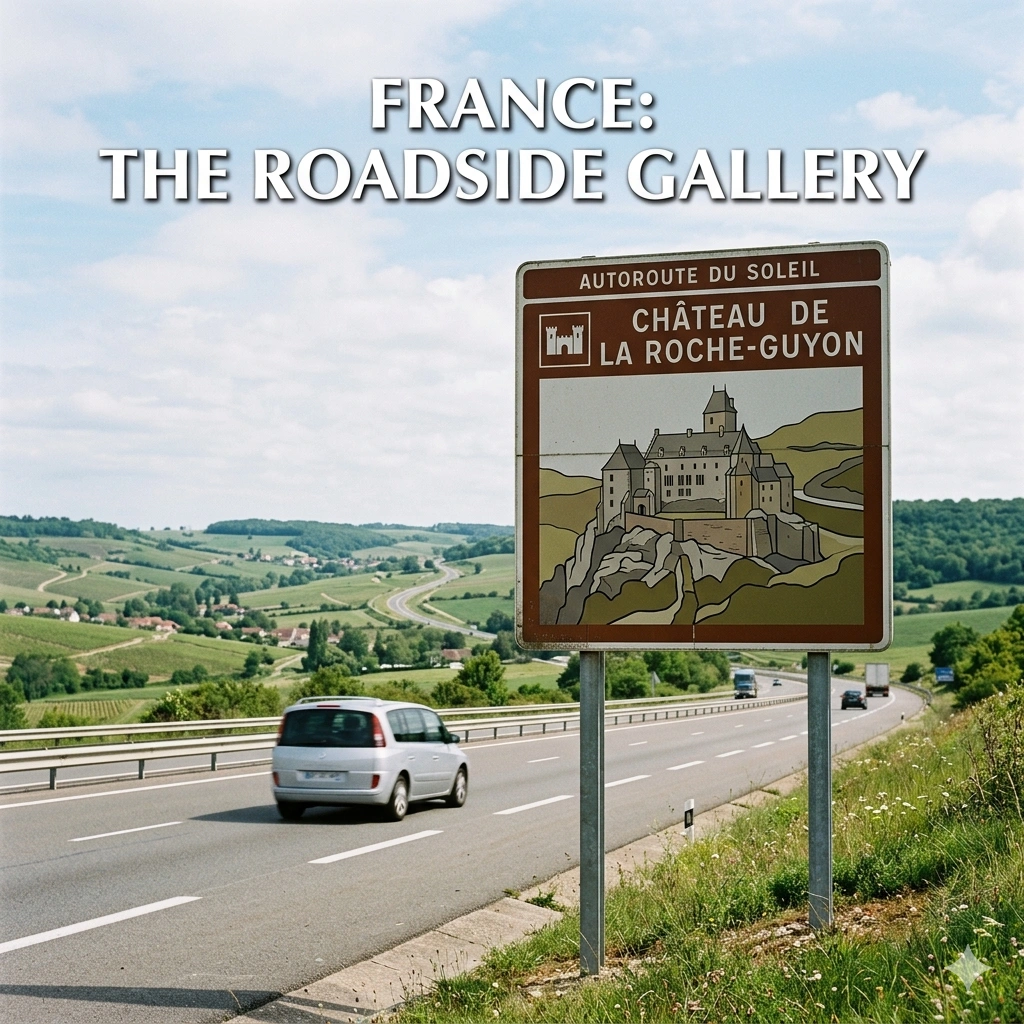
Frances brown motorway signs
The France’s brown motorway signs are officially known as “signalisation d’animation culturelle et touristique,” and they follow strict graphic standards to maintain national consistency. Each sign is designed to be evocative rather than literal, using a specific shade of brown that stands out against the natural green and grey of the roadside without being a distraction. The choice of brown was a deliberate psychological move to associate the signs with earth, history, and reliability. This branding has been so successful that the “brown sign” has become a universal symbol for a point of interest across Europe, though the French versions remain the most artistic.
The process for selecting which sites get featured on France’s brown motorway signs is rigorous and involves local municipalities, historians, and motorway operators. A site must possess significant historical, architectural, or natural value to earn a spot on the 130 km/h gallery. This competitive selection process ensures that only the most representative “soul” of a region is showcased to the public. Consequently, being featured on a motorway sign is seen as a badge of honor for small villages and local heritage sites, often leading to a measurable increase in visitor numbers.
- Historical Depth: Signs range from prehistoric cave paintings to 20th-century modernist bridges.
- Geographic Coverage: Every major motorway in France, from the A1 to the A89, features these panels.
- Artistic Style: The use of negative space and simple lines allows the driver’s brain to process the image instantly.
For many locals, France’s brown motorway signs are a source of regional pride, acting as a visual shorthand for their home territory’s unique character. Whether it’s the silhouette of a specific cheese in Normandy or a medieval fortress in the Occitanie region, these signs help maintain a sense of place in an increasingly globalized world. They turn a sterile transit environment into a narrative journey, where the road itself becomes a storyteller. This unique approach to road signage has turned the French autoroute into a cultural experience that is unrivaled anywhere else in the world.
The Origins of the 1972 Art Project
The inception of France’s brown motorway signs in 1972 was a response to the rapid expansion of the French motorway network, which threatened to bypass traditional villages. Planners feared that travelers would lose their connection to the “real France” as they bypassed the old national roads for the efficiency of the toll-roads. The solution was to bring the culture to the road, creating a series of panels that would act as windows into the surrounding territory. This innovative idea was one of the first of its kind globally, setting a standard for tourist signage that many other nations would eventually emulate.
The first France’s brown motorway signs were experimental, testing different colors and illustrative styles to see what resonated most with drivers. The goal was to create a “cultural pulse” for the road, ensuring that the driver remained engaged with the environment. Over the decades, the project has expanded from a few dozen signs to several thousand, reflecting the growing importance of domestic tourism in the French economy. Today, the 1972 project is viewed as a masterclass in public art and infrastructure integration, proving that even a motorway can have a soul.
Commemorating Dark History on the Road
A unique aspect of France’s brown motorway signs is their role in acknowledging the nation’s difficult historical periods. Unlike many countries that use tourist signs only for upbeat attractions, France uses its motorway network to ensure that history—even the painful parts—is never forgotten. The sign for the Izieu Memorial is perhaps the most famous example, marking the tragic arrest of Jewish children on the orders of Klaus Barbie. By placing such a somber reminder on a high-speed road, the state ensures that the collective memory of the Holocaust remains present in the minds of the public.
- The Izieu Memorial Sign: A stark reminder of the 1944 arrests located near the A43 motorway.
- Oradour-sur-Glane: Signs directing travelers to the martyred village destroyed by the SS.
- WWI Battlefields: Numerous signs across Northern France commemorate the trenches and memorials of the Great War.
This use of France’s brown motorway signs for historical education is a vital part of the nation’s “duty of memory” (devoir de mémoire). It transforms the act of driving into an act of remembrance, forcing a moment of reflection amidst the rush of modern life. These signs are often designed with even more minimalist restraint than the tourist versions, using silhouettes that evoke a sense of gravity and respect. For many travelers, these are the most impactful signs on the entire network, grounding the beauty of the landscape in the reality of its history.
Promoting Regional Gastronomy and Wine
France’s brown motorway signs are perhaps most famous for their celebration of the country’s world-renowned food and wine culture. As you drive through the Burgundy or Champagne regions, the signs change to reflect the local “terroir,” showcasing the specific grapes or culinary specialties of the area. These illustrations act as a high-speed menu, tempting drivers to exit the motorway in search of a local bistro or a vineyard cellar. It is a highly effective form of regional marketing that celebrates the diversity of the French palate.
- Wine Routes: Signs highlighting the “Route des Vins” in regions like Alsace and Bordeaux.
- Local Specialties: Illustrations of everything from Bresse poultry to Roquefort cheese.
- Gastronomic Capitals: Signs marking cities like Lyon as centers of culinary excellence.
The inclusion of food on France’s brown motorway signs reinforces the idea that French identity is inextricably linked to the land and its produce. For a traveler, these signs provide a geographic map of flavor, showing how the ingredients change as one moves from the butter-heavy north to the olive-oil-drenched south. This “gastronomic mapping” is a key part of the project’s success, as it appeals to one of the primary reasons people travel through France in the first place: the food.
Architectural Marvels and Hidden Abbeys
The architectural diversity of the nation is proudly displayed through France’s brown motorway signs, featuring everything from Roman aqueducts to cutting-edge modern bridges. The Royal Abbey of Fontevraud and the Brou Monastery are just two examples of the medieval and Renaissance treasures highlighted to the passing driver. These signs often trigger spontaneous visits to sites that might otherwise be overlooked in favor of more famous landmarks like the Eiffel Tower. By giving equal billing to a 12th-century abbey and a 21st-century viaduct, the signs create a timeline of French engineering and devotion.
The Millau Viaduct itself has one of the most recognizable of all France’s brown motorway signs, celebrating it as a modern wonder of the world. These architectural signs are designed to capture the unique silhouette of a building, allowing the driver to identify it from a distance. For history enthusiasts, the signs act as a treasure map, pointing the way to fortified cities (bastides) and chateaux that are often just a ten-minute drive from the toll booth. This accessibility is what makes the “open-air gallery” such a powerful tool for heritage preservation and public education.
The Impact on Local Tourism and Economy
The presence of France’s brown motorway signs has a direct and measurable impact on the economic health of rural communities. Small towns that might otherwise be bypassed by the high-speed autoroutes find a second life as tourist destinations thanks to a single well-placed sign. Local business owners report significant spikes in “walk-in” traffic from travelers who saw a sign for a local castle or craft museum and decided to investigate. This “signpost effect” is a vital part of the French government’s strategy to decentralize tourism away from the major cities.
- Increased Footfall: Local sites often report a 20% increase in visitors after a new sign is installed.
- Job Creation: Tourism supported by motorway visibility helps sustain jobs in hospitality and heritage management.
- Regional Branding: The signs help small regions build a recognizable “brand” that can be used in wider marketing.
For many struggling rural areas, the France’s brown motorway signs are a lifeline that keeps their local heritage alive and funded. The small fee that motorway operators pay to maintain these signs is a fraction of the economic benefit they bring to the surrounding countryside. This symbiotic relationship between the modern infrastructure of the autoroute and the ancient history of the villages is a defining feature of the French economic landscape. It proves that progress and preservation can work hand-in-hand to create a sustainable future for local culture.
Design Philosophy: Less is More at 130 km/h
The design philosophy behind France’s brown motorway signs is rooted in the psychology of perception at high speeds. Designers must account for the fact that a driver has only about two to three seconds to see, interpret, and understand the message of the sign. To achieve this, the illustrations avoid fine details, instead focusing on bold shapes and high-contrast silhouettes. This “speed-optimized” art ensures that the message is delivered without compromising the safety of the driver or the flow of traffic.
- Contrast: The white-on-brown color scheme provides maximum legibility in all weather conditions.
- Simplicity: Backgrounds are omitted to keep the focus entirely on the primary subject.
- Symbolism: Using a single iconic image—like a specific cathedral spire—to represent an entire city.
This minimalist approach has led to France’s brown motorway signs being studied by graphic designers worldwide as a peak example of functional art. The challenge of distilling an entire region’s soul into a single brown rectangle is a task that requires both artistic talent and a deep understanding of human cognitive limits. The result is a visual language that is uniquely French—elegant, efficient, and deeply rooted in history. It is a testament to the idea that even the most functional objects in our environment can be elevated to the level of art.
The Future of the Open-Air Gallery
As we move toward 2026 and beyond, the France’s brown motorway signs are being updated to reflect modern sensibilities and new discoveries. Newer signs are incorporating themes of environmental conservation, highlighting “Grand Sites de France” and protected natural parks. There is also a push to include more diverse historical narratives, ensuring that the motorway gallery reflects the multicultural reality of modern France. While the core “muted brown” aesthetic remains, the content of the gallery continues to grow and evolve alongside the nation.
Digital integration is also on the horizon, with some motorway operators exploring how France’s brown motorway signs can interact with in-car navigation systems. Imagine a car’s audio system providing a brief 30-second history of the monument depicted on the sign as you drive past it. This “augmented reality” approach could take the high-speed education of the 1972 project to a whole new level. Regardless of the technology, the goal remains the same: to ensure that the soul of France is never lost in the blur of the journey.
For more details & sources visit: BBC Travel
Read more about France news on 360 News Orbit – France.