
The Antarctic gravity hole represents one of the most enduring geophysical mysteries of the modern era, baffling scientists for decades. This phenomenon, technically known as a geoid low, is a region where the Earth’s gravitational pull is significantly weaker than the global average. New research published in March 2026 has finally traced the origins of this anomaly to deep-seated movements within the Earth’s mantle. By studying these subterranean shifts, geologists are beginning to understand how the internal dynamics of our planet have shaped the frozen continent over millions of years.
Recent seismic tomography data indicates that the Antarctic gravity hole has existed for approximately 70 million years, predating the continent’s famous ice sheets. This advanced imaging technique allows researchers to peer into the Earth’s interior, revealing an uneven distribution of mass far below the crust. The study shows that buoyant material rising through the mantle has caused the anomaly to fluctuate in size and intensity over geological timescales. These findings provide a crucial link between deep-earth processes and the surface features we observe today in the polar regions.
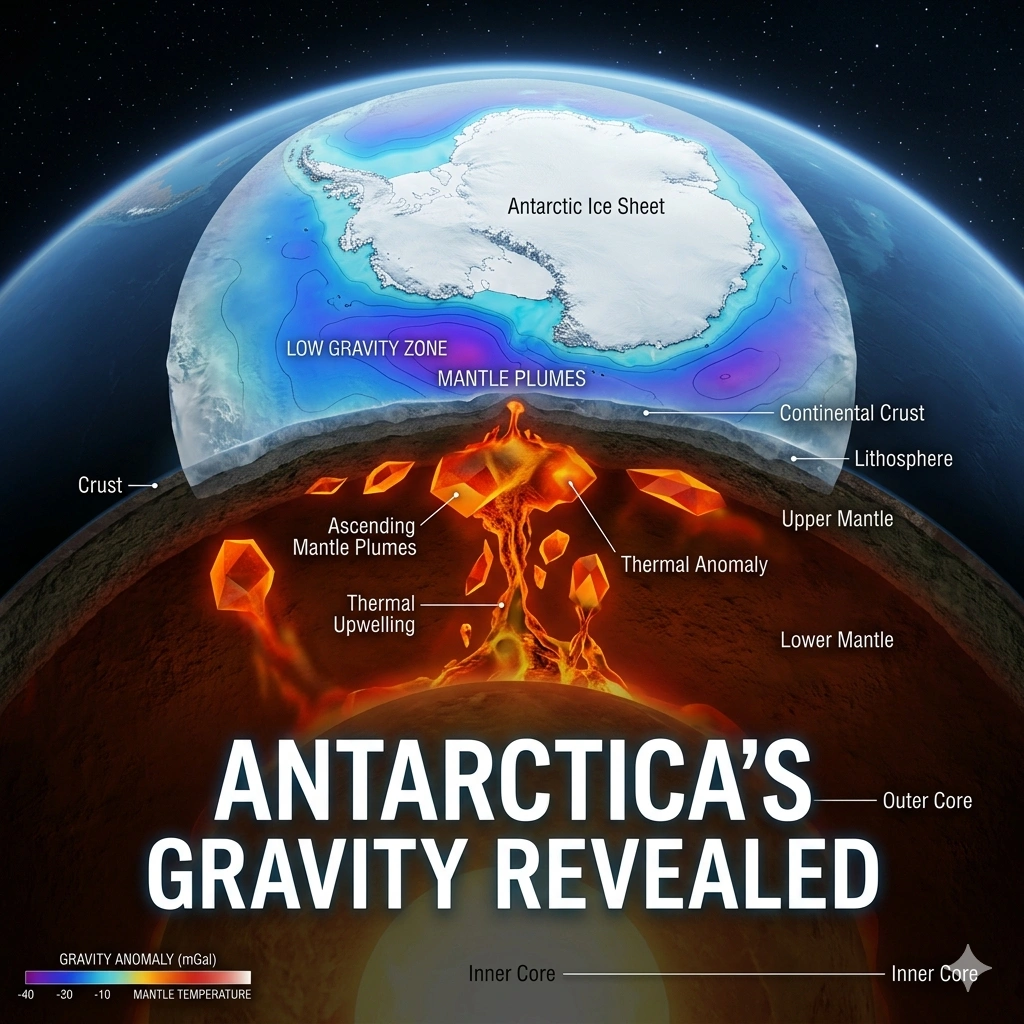
Antarctic gravity hole
The Antarctic gravity hole is not a literal “hole” in the ground but rather a dip in the Earth’s geoid where mass is less concentrated. Because Earth is not a perfect sphere and has a varying internal composition, gravity is not uniform across its entire surface. In this specific region of the Southern Ocean and Antarctica, the gravitational pull is lower because there is less “stuff” underneath to exert a pull. This lack of mass is now attributed to slow, churning rock movements within the mantle that have displaced heavier materials over tens of millions of years.
Scientists have used seismic tomography to map the Antarctic gravity hole with unprecedented detail, revealing the complex structure of the mantle below. These maps show that the anomaly is tied to “mantle plumes” or upwellings of hotter, less dense rock that rise toward the crust. As this lighter material displaces the cooler, denser mantle, the local gravitational field weakens, creating the observable “hole” in the geoid. This process is incredibly slow, occurring over millions of years, but its impact on the planet’s overall shape and gravitational balance is profound and measurable.
The Antarctic gravity hole has grown significantly over the last 35 million years, a timeline that mirrors major shifts in global tectonics. During this period, the movement of tectonic plates and the subduction of old oceanic crust influenced the flow of the mantle beneath the South Pole. The researchers found that these deep-earth currents are more dynamic than previously thought, acting as a conveyor belt for mass distribution. This discovery challenges older models that viewed the Earth’s interior as relatively static, suggesting instead a highly interconnected system between the deep core and the surface.
Role of Seismic Tomography in Discovery
The breakthrough in understanding the Antarctic gravity hole was made possible by seismic tomography, which functions like a CT scan for the entire planet. By measuring the speed of seismic waves generated by earthquakes as they travel through different layers of the Earth, scientists can identify variations in density. Areas where waves slow down typically indicate hotter, less dense material, while faster waves suggest cooler, denser rock. This technology allowed the team to visualize the buoyant material rising beneath Antarctica that is responsible for the gravity anomaly.
- Seismic tomography uses data from thousands of sensors placed around the globe to build a 3D model of the interior.
- The technique identified a massive “upwelling” of mantle material directly beneath the Antarctic geoid low.
- These findings were published in Scientific Reports, highlighting the 70-million-year history of the Antarctic gravity hole.
This mapping has revealed that the Antarctic gravity hole is not an isolated feature but part of a global network of mantle flow. Similar anomalies exist in other parts of the world, such as the Indian Ocean Geoid Low, but the Antarctic version is unique due to its proximity to a massive ice-covered landmass. The ability to “see” through thousands of miles of rock has transformed geophysics, allowing scientists to reconstruct the movements of the Earth’s interior with high precision. This tech continues to be the primary tool for solving the planet’s oldest geological mysteries.
Connection to Ancient Ice Sheet Formation
One of the most provocative findings is the link between the Antarctic gravity hole and the onset of widespread glaciation 34 million years ago. As the gravity anomaly grew, it likely caused the landmass of Antarctica to shift slightly in elevation relative to the surrounding ocean. These changes in topography and sea level could have provided the “tipping point” needed for snow to accumulate and turn into permanent ice. This suggests that the deep earth and the atmosphere worked in tandem to turn Antarctica into a frozen wilderness.
The Antarctic gravity hole acted as a silent architect, subtly modifying the continent’s physical landscape over millions of years. Before the ice sheets formed, Antarctica was a much warmer place with vast forests and diverse wildlife. However, the cooling of the Earth combined with these gravitational shifts created a perfect storm for glaciation. The researchers believe that the 30% growth in the anomaly provided the necessary structural changes to support the weight of the growing ice. This interdisciplinary approach combines geology and climatology to explain one of Earth’s biggest transitions.
- The growth of the gravity anomaly aligns perfectly with the Eocene-Oligocene transition, a major cooling period.
- Mantle movements can raise or lower the seafloor, affecting how ocean currents circulate around the continent.
- Understanding these ancient shifts helps scientists predict how modern gravity changes might influence current ice melt.
70 Million Years of Geological Evolution
The history of the Antarctic gravity hole stretches back to the Cretaceous period, a time when dinosaurs still roamed the Earth. Over these 70 million years, the anomaly has survived the breakup of supercontinents and the shifting of the planet’s magnetic poles. Its persistence suggests that the mantle structures driving it are incredibly stable and deeply rooted in the Earth’s lower layers. This longevity makes the Antarctic gravity hole a valuable “fossil” of deep-earth activity, providing clues about the planet’s internal heat engine.
Throughout this long history, the Antarctic gravity hole has served as a marker for the movement of tectonic plates across the Southern Hemisphere. As the Antarctic plate moved over different parts of the mantle, the gravity anomaly evolved in shape and intensity. The recent study utilized computer simulations to “rewind” these movements, allowing scientists to see how the hole looked millions of years ago. This long-term perspective is vital for understanding the slow-motion forces that define the geography of our world and the stability of its polar regions.
Mantle Plumes and Buoyant Material
The primary culprit behind the Antarctic gravity hole is the presence of buoyant material rising from the deep mantle toward the surface. Unlike the dense, heavy rock that usually makes up the mantle, this buoyant material is less compact, exerting less gravitational pull on the objects above it. This upwelling is thought to be a remnant of ancient subduction events, where pieces of the Earth’s crust were pushed deep into the interior and later reheated. This recycled material then rises back up, creating the gravity “voids” we detect today.
These mantle plumes are like giant, slow-moving lava lamps inside the Earth, carrying heat and lighter minerals toward the crust. In the case of the Antarctic gravity hole, this upwelling has been persistent enough to maintain the anomaly for tens of millions of years. The research team noted that the specific chemistry of this buoyant material suggests it originated from the mantle-core boundary. This deep connection highlights how events occurring thousands of miles beneath our feet can have a direct impact on the gravitational field at the surface.
- Mantle upwellings can reach temperatures hundreds of degrees hotter than the surrounding rock.
- The buoyant material causes the Earth’s crust to bulge or sag, influencing local sea levels.
- Identifying the composition of these plumes helps scientists understand the Earth’s internal cooling process.
Impact on Sea Level and Topography
The Antarctic gravity hole has a direct influence on the sea level in the Southern Ocean, a factor often overlooked in traditional climate models. Because the gravitational pull is weaker, water is less “attracted” to the region, causing the local sea level to be lower than it would be otherwise. If the gravity anomaly were to disappear, the water would rush back in, potentially raising sea levels around the Antarctic coast by several meters. This relationship between gravity and water distribution is a critical component of the planet’s physical oceanography.
- Areas of low gravity generally have lower “equilibrium” sea levels because the water is not pulled as strongly toward the center of the earth.
- Changes in the Antarctic gravity hole over millions of years have caused the shoreline of Antarctica to advance and retreat.
- Modern satellite missions, like GRACE, are now tracking how these gravity shifts interact with melting ice.
The topography of the Antarctic continent itself is also affected by the mantle movements associated with the gravity hole. As buoyant material pushes up from below, it can cause the land to rise, a process known as dynamic topography. This uplifting of the land can offset some of the sea-level changes caused by the gravity anomaly. For the Antarctic gravity hole, the net effect has been a complex dance of rising land and shifting water, all of which influenced where and how the ice sheets initially formed and grew.
Future Research and Climate Implications
The study of the Antarctic gravity hole is far from over, as scientists now look to integrate these findings into future climate projections. As the Earth continues to warm, the interaction between deep-earth gravity and surface ice will become increasingly important. If the mantle continues to shift, it could subtly change the “slope” on which the Antarctic ice sheets sit, potentially accelerating their slide into the sea. Understanding these deep-earth “wildcards” is essential for accurate long-term sea-level rise predictions.
Researchers are now planning new seismic missions to deploy even more sensitive instruments across the Antarctic interior. These tools will provide a higher-resolution view of the Antarctic gravity hole, allowing scientists to see smaller-scale variations in mantle density. The goal is to create a real-time map of mantle flow, helping us understand how the planet’s internal heat is being redistributed. This ongoing research ensures that the Antarctic gravity hole will remain a focal point of geophysical study for years to come.
- Future studies will look at the link between the gravity hole and the “West Antarctic Rift System.”
- Improved computer models will simulate how gravity shifts might affect the stability of the Thwaites Glacier.
- International collaboration is key to gathering data from the most remote parts of the frozen continent.
The discovery of the 70-million-year-old origins of the Antarctic gravity hole is a testament to the power of modern science to solve ancient mysteries. It reminds us that our planet is a dynamic, living system where the deepest parts of the interior are intimately connected to the surface. As we face a changing climate, these geological insights provide a necessary perspective on the natural cycles that have shaped our world long before humans arrived. The “gravity hole” is no longer a void in our knowledge, but a window into the soul of the Earth.
The Antarctic gravity hole serves as a reminder that the forces of nature operate on timescales far beyond human comprehension. While we focus on the changes happening over decades, the mantle is working on a scale of millions of years. This 2026 breakthrough has finally given us the tools to bridge that gap, connecting the deep past with our uncertain future. The frozen landscape of Antarctica holds many more secrets, but we are now one step closer to understanding the invisible forces that keep it in place.
For more details & sources visit: Ecoticias
Read more on Antarctica news: 360 News Orbit – Antarctica.