
The Australian inflation 5 percent surge is a looming threat that economists are monitoring with increasing concern as global conflicts escalate. According to the latest modeling from the Global Trade Analysis Project, a prolonged Middle East war could drive domestic consumer prices up significantly by September 2026. This potential shock represents a departure from previous stability, placing immense pressure on both the Reserve Bank of Australia and everyday households. If these projections hold true, the nation could face a volatile economic period characterized by rapid price increases across essential goods.
Recent analysis suggests that the Australian inflation 5 percent mark is not just a theoretical number but a highly likely outcome if the conflict persists for six months. This scenario would see Brent crude oil prices soaring toward $150 per barrel, creating a massive ripple effect throughout the entire domestic supply chain. Unlike previous energy shocks, this current crisis is compounded by a lack of local refining capacity, making the continent uniquely vulnerable to international shipping disruptions. Policymakers are now scrambling to identify sectors that can provide a buffer against these rising international costs.
The possibility of an Australian inflation 5 percent spike has also revived fears of “stagflation,” a rare and painful economic condition where prices rise while growth stalls. For a country that has largely avoided technical recessions for decades, the prospect of shrinking GDP combined with high costs is particularly alarming for the business community. Industry leaders in the manufacturing and transport sectors are already reporting a slowdown in investment as they wait for more certainty. Navigating this transmission chain of economic pain will require a delicate balance of fiscal and monetary intervention.
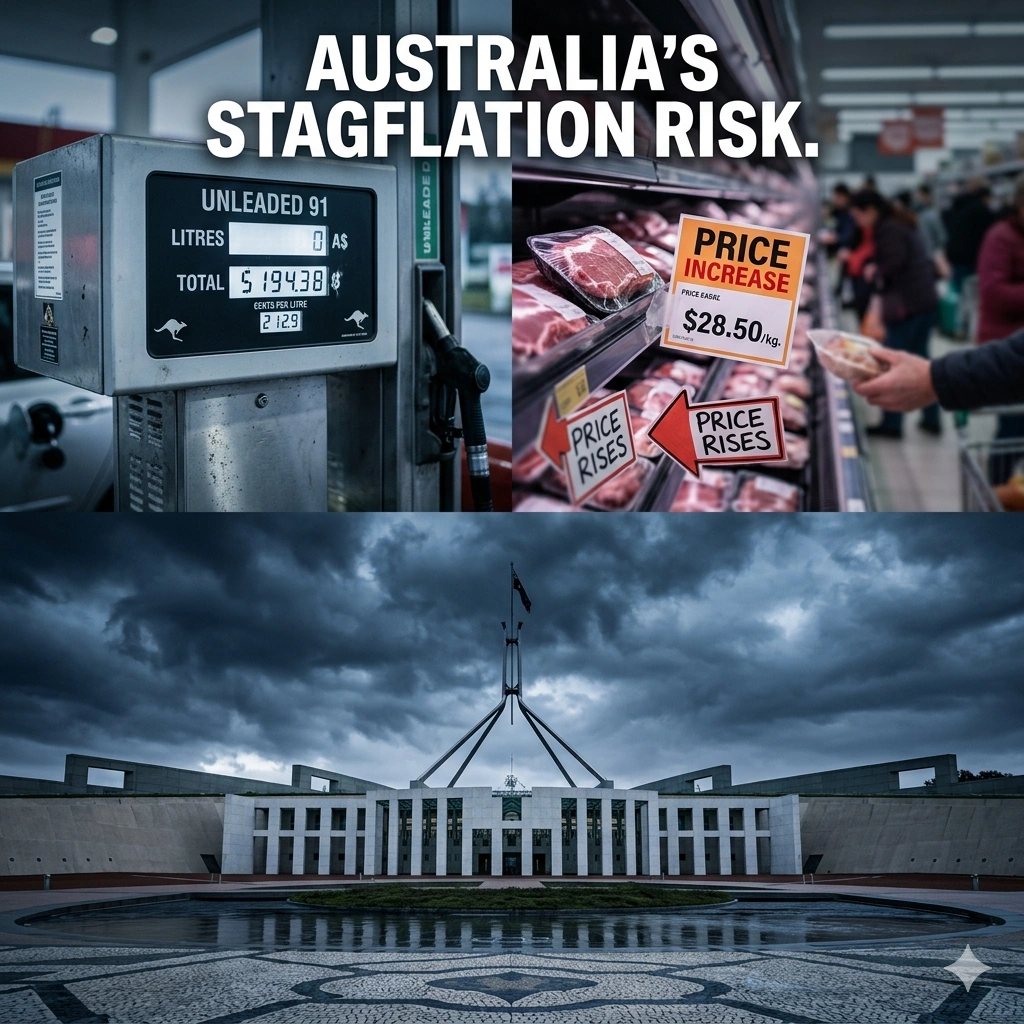
Australian inflation 5 percent
The Australian inflation 5 percent projection is rooted in the “severe” six-month conflict scenario modeled by international trade experts this March. In this specific outlook, the cost of imported refined fuels becomes the primary driver of domestic price instability, affecting everything from commuting to construction. Because Australia relies so heavily on imported petrol and diesel, any disruption in the Middle East translates almost instantly into higher costs at local service stations. This immediate hit to the hip pocket is what makes the five percent figure so plausible for the average consumer.
When the Australian inflation 5 percent threshold is crossed, the primary concern shifts to the “transmission chain” that moves through energy-intensive industries first. Sectors such as steel and chemical manufacturing are expected to see production drops of up to 15% as their operational costs become unmanageable. As these foundational industries slow down, the scarcity of materials further drives up prices for downstream products and services. This internal feedback loop is what makes the current inflationary pressure so difficult for traditional economic tools to control or mitigate.
The agricultural sector is also highly sensitive to the Australian inflation 5 percent threat due to its reliance on fuel for machinery and transport. Modeling indicates that meat and livestock production could fall by over 7%, leading to a direct increase in grocery bills for the average family. If these essential items become too expensive, discretionary spending across the rest of the economy will likely collapse, furthering the risk of a recession. Consequently, the five percent inflation figure serves as a critical warning sign for a potential nationwide cooling of consumer demand.
Risks of Stagflation in 2026
The combination of the Australian inflation 5 percent spike and a projected contraction in GDP has many analysts warning of a return to 1970s-style stagflation. This economic phenomenon occurs when the “cost-push” factors of energy prices force businesses to raise prices even as consumer demand begins to wane. In this environment, the standard remedy of raising interest rates to fight inflation can actually make the situation worse by further suppressing economic growth. It is a “lose-lose” scenario that Australian treasury officials are desperately trying to avoid through proactive planning.
Modeling shows that a severe conflict could lead to a 0.16% contraction in Australia’s total economic output, which, while seemingly small, represents billions in lost productivity. When paired with the Australian inflation 5 percent surge, the real purchasing power of the average citizen drops significantly, leading to a lower standard of living. Businesses are already expressing concern that they cannot pass on all their rising costs to consumers without losing their entire customer base. This squeeze on profit margins is a classic precursor to the stagflationary cycle that currently threatens the region.
- Real wages are projected to decline as price increases outpace traditional annual salary adjustments.
- Business investment in new equipment is expected to fall by 12% as borrowing costs and energy prices remain high.
- The unemployment rate could see an uptick as energy-intensive manufacturers are forced to downsize their operations.
Impact on Transport and Freight Costs
A major component of the Australian inflation 5 percent rise is the anticipated 7.7% jump in transport and freight expenses across the country. Australia’s vast geography means that almost every product must travel long distances by truck or rail, making the price of diesel a critical economic variable. When fuel prices spike globally, the cost of moving goods from ports to regional centers increases exponentially, a cost that is inevitably passed on to the end-user. This “freight tax” is one of the most invisible yet potent drivers of the current inflationary trend.
For the Australian inflation 5 percent scenario to be avoided, the transport industry would need significant technological or logistical breakthroughs that are currently unavailable. Many freight companies operate on razor-thin margins and do not have the capital to transition to electric heavy vehicles overnight. This means they are essentially tethered to the global oil price, making them a direct conduit for international volatility into the domestic market. The vulnerability of the transport sector highlights the urgent need for a more resilient national fuel security strategy.
Agricultural Sector and Grocery Prices
The Australian inflation 5 percent threat is particularly evident when looking at the potential 7.6% drop in meat and livestock production. High energy costs affect everything from the production of fertilizers to the operation of cold storage facilities and processing plants. When these costs rise, farmers are forced to reduce their herd sizes or cut back on production to stay solvent, leading to supply shortages. These shortages then manifest as “sticker shock” for consumers at the supermarket, who are already struggling with general cost-of-living increases.
- Fertilizer prices, which are often tied to natural gas costs, are expected to rise by 20% in the severe war scenario.
- Refrigerated transport, essential for the dairy and meat industries, will face the highest fuel surcharges.
- Grain exports may see a temporary boost in value, but the cost of production will eat into the profits for local farmers.
The link between energy and food is the most sensitive part of the Australian inflation 5 percent equation for most voters. While a rise in the price of luxury goods can be ignored, a significant jump in the price of beef, milk, and bread directly impacts social stability. This is why many economists are urging the government to prioritize food security and agricultural support in their upcoming budget. Protecting the food supply chain is seen as a vital step in mitigating the worst effects of the projected inflationary spike.
Energy Export Shield vs Domestic Pain
Australia’s status as a top-tier exporter of Liquified Natural Gas (LNG) and coal acts as a partial shield against the Australian inflation 5 percent crisis. When global energy prices rise, the nation’s terms of trade improve, bringing in massive amounts of tax revenue and export income. This wealth helps bolster the Australian Dollar and provides the government with the fiscal firepower to fund relief programs. However, this macro-level benefit often fails to trickle down to the individual consumer who is paying record prices for petrol.
The paradox of the Australian inflation 5 percent situation is that a country so rich in energy can still be so vulnerable to energy-driven inflation. This is primarily due to the decision decades ago to close most domestic oil refineries in favor of cheaper imports from Singapore and South Korea. Now, during a global conflict, that lack of “sovereign refining” capability is proving to be a strategic and economic liability. While the export shield protects the government’s balance sheet, it does little to lower the daily expenses for a family living in the suburbs.
Targeted Relief and Renewable Transition
To combat the Australian inflation 5 percent surge, many experts are advocating for targeted relief rather than broad-based fuel excise cuts. Universal subsidies can often be “inflationary” themselves by encouraging continued high consumption and adding to the government’s debt. Instead, focusing on low-income households and critical transport providers could provide the most effective cushion against the price shock. This approach aims to protect those most at risk without overheating the broader economy or distorting market signals.
- Direct energy rebates for households in the bottom 20% of income earners.
- Grants for freight companies to upgrade to more fuel-efficient or alternative-energy vehicles.
- Increased funding for regional public transport to reduce the reliance on private car travel.
Furthermore, the Australian inflation 5 percent warning is being used as a catalyst to accelerate the transition to renewable energy. By reducing the economy’s exposure to global oil markets, the nation can permanently lower its vulnerability to future geopolitical shocks. Wind, solar, and green hydrogen offer a path toward energy independence that traditional fossil fuels can no longer provide in a fractured world. Advocates argue that every dollar spent on renewable infrastructure today is a hedge against the inflation spikes of tomorrow.
GTAP Modeling and Economic Projections
The use of the Global Trade Analysis Project (GTAP) modeling provides a data-driven foundation for the Australian inflation 5 percent forecast. This sophisticated tool allows economists to simulate complex interactions between different sectors and international trading partners. By inputting variables related to the Middle East conflict and the closure of key shipping routes, the model can trace how a shock in one part of the world travels to the Australian coast. The results are a sobering reminder of how interconnected the global economy has become in 2026.
According to the GTAP data, the Australian inflation 5 percent outcome is the result of multiple compounding factors rather than a single event. It accounts for higher insurance premiums, longer shipping routes around the Cape of Good Hope, and the increased cost of synthetic inputs for manufacturing. The model suggests that even if the war ends relatively quickly, the “echoes” of these price increases will be felt for several quarters. This long-tail effect is why the September 2026 window is cited as the peak period for inflationary pressure in the region.
Manufacturing and Chemical Sector Slump
The Australian inflation 5 percent spike is expected to hit the manufacturing and chemical sectors particularly hard, with output falls of 15% and 14% respectively. These industries are “heavy users” of energy, meaning that electricity and gas prices represent a large portion of their total production costs. When these inputs become too expensive, Australian firms lose their competitive edge against overseas rivals who may have access to cheaper or subsidized energy. This leads to a reduction in domestic production and a greater reliance on expensive imports.
For the Australian inflation 5 percent scenario to be mitigated, these industrial players would need immediate support to maintain their operations. A collapse in local chemical production, for example, would have a knock-on effect on the agricultural sector, which relies on these chemicals for crop protection. The interconnectedness of these industries means that a failure in one can quickly lead to a systemic economic crisis. Maintaining a base level of industrial capacity is therefore seen as a key component of national economic security during this period of global war.
Future Outlook for Interest Rates
The Reserve Bank of Australia faces a difficult choice in the wake of the Australian inflation 5 percent warning. If they raise interest rates to cool the inflation, they risk tipping a fragile economy into a full-scale recession. However, if they do nothing, the cost of living could spiral out of control, eroding the savings and purchasing power of the population. Most economists expect a “wait and see” approach in the short term, with a bias toward hikes if the five percent mark is actually breached in the coming months.
The Australian inflation 5 percent projections will be the primary data point for the RBA’s board meetings throughout the middle of 2026. If the “moderate” six-week conflict scenario plays out, the bank may be able to hold rates steady as the 0.6% bump would be seen as transitory. But the “severe” scenario would demand a more aggressive response to prevent inflation expectations from becoming “unanchored” in the minds of the public. This high-stakes environment makes the current modeling an essential tool for investors and policymakers alike as they prepare for a year of profound uncertainty.
For more details & sources visit: The Conversation
Read more about Australia news on 360 News Orbit – Australia.