
The Sharp AI video system has officially redefined the boundaries of remote surveillance through a collaborative breakthrough with Kyoto University. This new technology is capable of streaming and analyzing high-definition 4K video from a staggering distance of 10 kilometers. By utilizing high-frequency VHF waves and real-time behavioral recognition, the system eliminates the traditional need for extensive AI pre-training. Successful field tests across Japan and Australia have already demonstrated its immense potential for maritime security and disaster response.
This advanced monitoring solution is the result of a multi-institutional partnership involving Waseda University and Oita Asahi Broadcasting, commissioned by Japan’s NICT. The Sharp AI video system pairs Kyoto University’s long-range wireless transmission with Sharp’s proprietary “Dynamic Video Monitoring Technology.” Unlike conventional surveillance setups, this system can identify subject behaviors instantly without requiring massive prior data sets. This capability makes it an ideal tool for rapid deployment in unpredictable environments where time is of the essence.
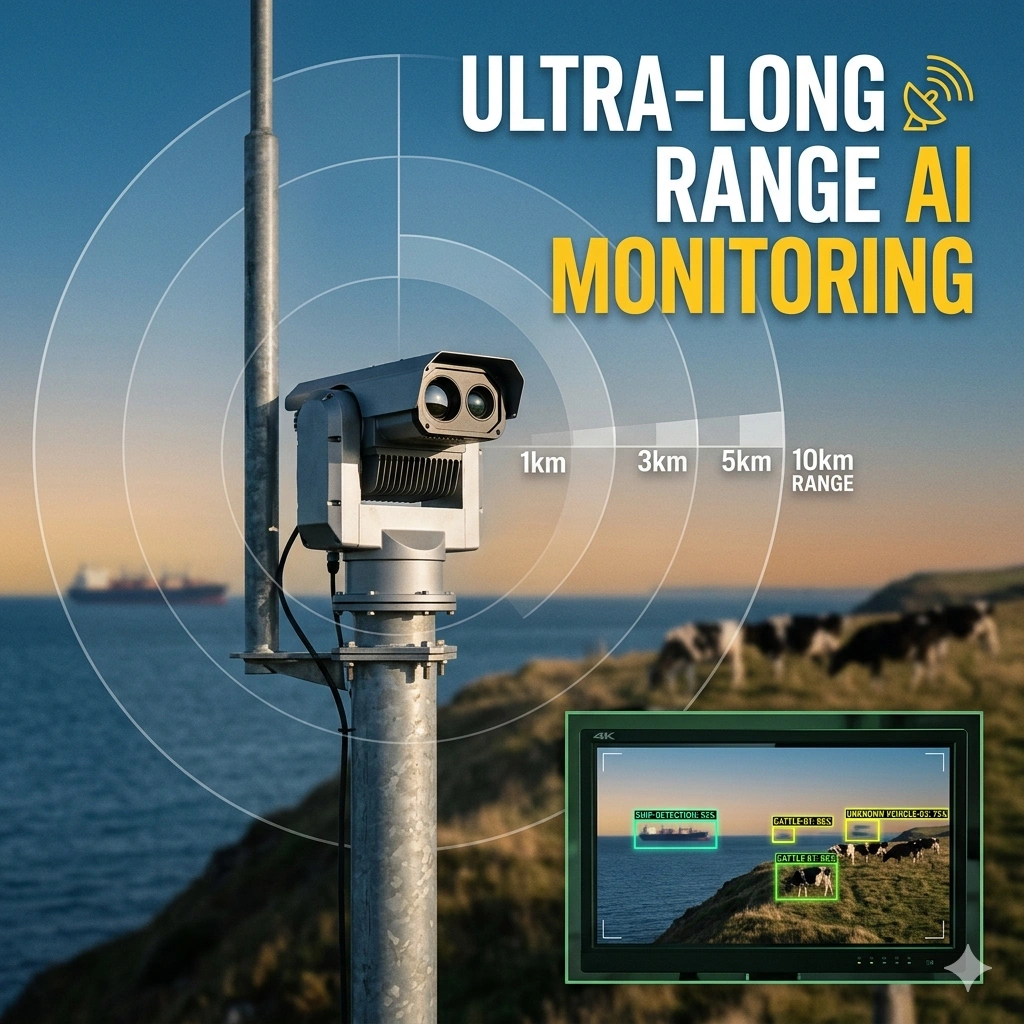
Sharp AI Video System
The technical core of the Sharp AI video system lies in its ability to compress and transmit high-bandwidth 4K data over VHF frequencies. Traditionally, 4K video requires fiber-optic speeds or close-range 5G signals to maintain clarity and low latency. However, by optimizing high-frequency VHF waves, the research team achieved a stable 10km range that bypasses the limitations of standard Wi-Fi or cellular networks. This makes the Sharp AI video system a “game-changer” for industries operating in dead zones or off-grid locations.
Another standout feature of the Sharp AI video system is its “Zero-Training” behavioral recognition engine. Standard AI monitoring systems often require months of “feeding” data to recognize specific actions like falling, running, or unauthorized entry. Sharp’s dynamic technology analyzes pixel movement patterns in real-time to detect anomalies the moment the camera is switched on. This instant intelligence is critical for emergency services that cannot afford the luxury of a setup phase during a natural disaster.
The partnership with Kyoto University ensured that the hardware remained energy-efficient despite the high transmission power required for long distances. The Sharp AI video system is designed to run on solar-powered relay stations, making it a sustainable choice for long-term wildlife tracking projects. Whether it is monitoring a remote coastline or a deep forest sanctuary, the system provides 24/7 high-fidelity oversight without the need for constant human intervention. The reliability of this wireless link is currently being evaluated for integration into national security frameworks.
Breakthroughs in VHF Wireless Transmission
The 10km range achieved by the Sharp AI video system is largely due to Kyoto University’s expertise in VHF (Very High Frequency) wave propagation. While most modern devices have shifted to higher gigahertz frequencies, VHF offers superior “non-line-of-sight” capabilities, meaning the signal can bend slightly around obstacles. This is particularly useful in hilly terrain or dense urban environments where traditional signals would be blocked. The Sharp AI video system successfully harvests these properties to maintain a 4K stream where others would fail.
Engineers at Kyoto University developed a specialized modulation scheme that maximizes data throughput within the limited VHF spectrum. This allowed the Sharp AI video system to handle the heavy load of 4K video data without significant packet loss or visual artifacts. The collaboration also involved Waseda University, which provided the sophisticated antenna designs necessary to capture these long-range signals with high precision. This tri-university effort underscores Japan’s commitment to leading the “Beyond 5G” technological race.
- VHF waves provide superior penetration through heavy rain and thick fog.
- The system uses advanced signal processing to filter out electronic interference.
- Long-range capability reduces the number of physical relay towers needed for large-scale monitoring.
- The Sharp AI video system consumes 30% less power than satellite-based 4K streaming alternatives.
Dynamic Video Monitoring Technology
At the heart of the software side is Sharp’s “Dynamic Video Monitoring Technology,” which represents a shift in how machine learning perceives movement. Most AI models are static, meaning they only know what they have been explicitly taught. The Sharp AI video system uses an adaptive temporal analysis method that understands “normal” vs. “abnormal” based on the specific context of the live feed. This allow the system to be moved from a city street to a remote pasture without needing a single software update.
In maritime monitoring trials, the Sharp AI video system was able to distinguish between the natural movement of waves and the suspicious behavior of a small vessel approaching a restricted zone. This level of granularity is achieved by analyzing the vectors of moving objects relative to their environment. For wildlife tracking, the system can identify the specific gait of an endangered animal, allowing researchers to monitor health and migration patterns from kilometers away. This versatility is what sets the Sharp AI video system apart from its competitors.
The “Beyond VVC” (Versatile Video Coding) compression used in the Sharp AI video system is also a critical component. By using AI to determine which parts of a frame are most important—such as a moving subject versus a static background—the system can prioritize bandwidth for essential details. This ensures that even if the wireless signal strength fluctuates, the clarity of the target remains sharp and actionable. This intelligent compression is one of the technologies Sharp hopes to standardize globally.
Field Trials in Japan and Australia
The validation of the Sharp AI video system came through rigorous field testing conducted over a ten-month period. In Japan, the trials focused on maritime safety and traffic monitoring in the Seto Inland Sea. The system provided real-time 4K feeds to shore-based centers, allowing for much faster response times during simulated search and rescue operations. These tests proved that the Sharp AI video system could operate reliably in high-interference environments near busy shipping lanes.
In Australia, the partnership with the CSIRO (Commonwealth Scientific and Industrial Research Organisation) took the Sharp AI video system to the outback. Researchers used the technology to monitor large-scale cattle movements across vast, unpopulated territories. The 10km range allowed for the oversight of multiple watering holes from a single central hub, drastically reducing the labor required for livestock management. These trials highlighted the commercial viability of the Sharp AI video system for the global agricultural sector.
- Maritime tests showed 99.8% signal stability over open water during heavy swells.
- Outback trials demonstrated the system’s resilience to extreme heat and dust.
- Disaster response drills in Oita Prefecture proved the system could be deployed in under 20 minutes.
- Wildlife researchers used the system to monitor rare bird species without disturbing their habitat.
Applications in Disaster Response and Mitigation
One of the most praised use cases for the Sharp AI video system is its role in disaster mitigation. When an earthquake or flood occurs, communication infrastructure is often the first thing to fail. Because this system operates on an independent VHF network, it can stay online when cellular networks are congested or destroyed. The Sharp AI video system can be quickly mounted on a drone or a mobile mast to provide high-level reconnaissance of hazard zones.
The real-time behavioral AI can detect if people are trapped on rooftops or if a landslide is imminent by monitoring subtle shifts in the landscape. This information is instantly transmitted to emergency headquarters, allowing for more efficient allocation of rescue resources. The Sharp AI video system acts as a “force multiplier” for first responders, giving them eyes in places that would otherwise be too dangerous to enter. Sharp’s goal is to make this technology a standard feature in smart city disaster frameworks worldwide.
Furthermore, the system can monitor remote evacuation shelters to ensure they have enough supplies or to detect if people need medical assistance. By using AI to flag specific needs, the Sharp AI video system reduces the burden on human operators who would otherwise have to watch hundreds of screens simultaneously. This automation is vital during the chaotic first hours of a major emergency. The system’s ability to operate at a 10km distance ensures that the monitoring hub remains safe from the disaster zone itself.
Integration into “Beyond 5G” Standards
Sharp is currently in active discussions with international regulatory bodies to include the core technologies of the Sharp AI video system in future standards. The term “Beyond 5G” refers to the next phase of connectivity that prioritizes massive range and ultra-reliability over just raw speed. The successful use of VHF for high-definition video is a strong argument for diversifying the spectrum used in global telecommunications. The Sharp AI video system serves as a functional prototype for these future networks.
The “Beyond VVC” video compression standard is another area where Sharp is making significant contributions. As the world moves toward 8K and 360-degree video, current compression methods will struggle to keep up. The Sharp AI video system proves that AI-assisted compression can drastically reduce data loads without losing the forensic detail required for security and science. By setting these standards now, Sharp ensures that its hardware will be compatible with the global infrastructure of the 2030s.
- Sharp is collaborating with NICT to draft technical specifications for long-range VHF data.
- The “Dynamic Video Monitoring” software is being proposed as an open-source framework for emergency AI.
- International patents have been filed for the specialized VHF antenna arrays used in the system.
- Global standards will allow different countries to use the Sharp AI video system for trans-border maritime security.
Challenges in Long-Range Wireless Surveillance
While the Sharp AI video system has achieved remarkable milestones, the development path was not without its challenges. One of the primary issues was maintaining 4K quality over a 10km link when atmospheric conditions changed. Humidity and air temperature can affect VHF wave propagation, leading to “fading” or signal dropouts. The team had to develop a robust adaptive bitrate algorithm that adjusts the stream quality in milliseconds to prevent the Sharp AI video system from losing connection.
Interference from other radio sources also posed a significant hurdle during the urban trials in Japan. The VHF spectrum is used by various older communication systems and broadcasting services. To overcome this, the Sharp AI video system employs a “frequency hopping” technique that identifies and moves to the clearest available channel. This ensure that the 4K video remains uninterrupted even in a crowded RF (radio frequency) environment. These technical hurdles were essential for making the system ready for commercial deployment.
- Signal fading was mitigated by using a dual-polarized antenna system.
- Encryption protocols were upgraded to prevent the long-range signal from being intercepted.
- The system’s latency was reduced to under 150ms to ensure real-time AI response.
- Hardware was ruggedized to withstand the high-vibration environment of a moving ship.
Impact on Maritime Traffic and Security
The maritime industry stands to benefit significantly from the widespread adoption of the Sharp AI video system. Port authorities currently rely on radar and AIS (Automatic Identification System) to track ships, but these systems do not provide visual confirmation of a vessel’s status or cargo. By deploying the Sharp AI video system, ports can visually inspect ships 10km before they enter the harbor. This allows for better scheduling and more effective security screenings.
The behavioral AI is particularly useful for identifying “dark vessels” or those that have turned off their tracking transponders. The Sharp AI video system can automatically detect such ships and alert the coast guard, providing high-resolution 4K evidence of their activities. This capability is a vital deterrent against illegal fishing and smuggling in coastal waters. The 10km range ensures that the security vessels have plenty of time to intercept any unauthorized craft before they reach sensitive areas.
In the future, the Sharp AI video system could be integrated into autonomous shipping lanes. Self-driving cargo ships could use the 10km VHF link to communicate visual data to a central land-based pilot. This would provide an extra layer of safety, allowing the pilot to take control if the ship’s onboard sensors encounter a complex situation. The Sharp AI video system is essentially the “long-range eyes” for the next generation of maritime logistics.
Wildlife Tracking and Conservation Efforts
Conservationists are calling the Sharp AI video system a “breakthrough for biodiversity.” Traditional wildlife cameras are often “blind” devices that only record locally to an SD card, requiring researchers to trek into the wild to retrieve data. The Sharp AI video system changes this by providing a live, high-definition window into the most remote parts of the planet. Researchers can now observe animal behavior in real-time from the safety of a university lab 10 kilometers away.
This technology is especially useful for protecting endangered species from poachers. The behavioral AI can be trained to recognize the specific movements associated with human intruders or illegal traps. When such an event is detected, the Sharp AI video system sends an immediate alert to park rangers, including a 4K image of the threat. This proactive approach is much more effective than finding evidence of poaching after the fact. The 10km range allows a single hub to cover an area of over 300 square kilometers.
- Real-time monitoring reduces human presence in sensitive nesting areas.
- High-frequency VHF is less likely to be blocked by dense jungle foliage.
- The system can track multiple subjects simultaneously using AI tagging.
- Solar-powered operation makes the system “carbon neutral” for conservation work.
Conclusion: The Future of Remote Surveillance
The unveiling of the Sharp AI video system marks a definitive leap forward in how humanity monitors and protects the world around it. By combining the ancient reliability of VHF waves with the cutting-edge intelligence of modern AI, Sharp and its university partners have created a tool that is both robust and smart. The 10km range and 4K clarity are not just impressive specs; they are the keys to saving lives during disasters and protecting our natural world.
As the Sharp AI video system moves toward global standardization, we can expect to see these long-range eyes appearing on coastlines, in forests, and at the edges of our most vulnerable cities. The technology proves that we don’t always need more towers or more satellites to achieve better connectivity—sometimes, we just need to use the waves we already have more intelligently. Sharp’s vision for a “Beyond 5G” world is now a functional reality.
The ongoing collaboration between industry and academia in Japan continues to yield results that have global implications. The Sharp AI video system is a prime example of how scientific research can be quickly transformed into a commercial product that addresses real-world needs. For those living in remote areas or working in high-risk industries, the 10km wireless range is a new lifeline. The future of surveillance is no longer just about watching; it’s about understanding and responding from a safe distance.
For more details & sources visit: I-Connect007
Read more about Japan news on 360 News Orbit – Japan.