
The Saudi female AI success has reached a historic milestone as the Kingdom emerges as the world leader in gender-inclusive technology training. Saudi Arabia has achieved the highest female-to-male ratio in Artificial Intelligence training globally. This achievement is a direct result of the strategic goals outlined in Vision 2030, which prioritizes digital transformation and human capital. Experts note that this surge in expertise is now transitioning from foundational learning into high-level innovation.
Driven by a decade of deliberate investment, Saudi women are now at the forefront of the nation’s burgeoning tech industry. The Saudi female AI success is rooted in long-term international scholarships and a massive expansion of domestic STEM education. Industry experts at Humain highlight that this success stems from a robust talent pool that has been growing since 2016. Domestically, institutions have been instrumental in producing a steady stream of graduates ready for the global stage.
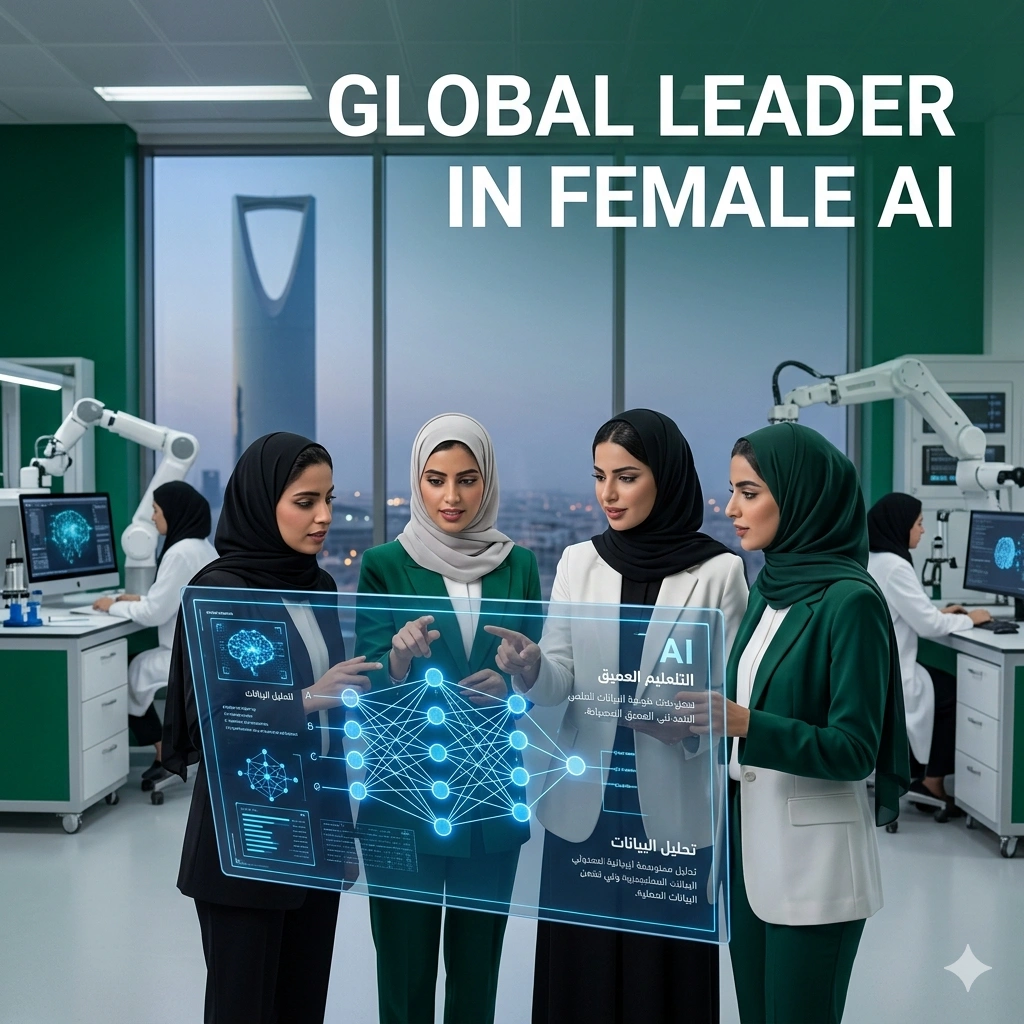
Saudi Female AI Success
The formal recognition of the Saudi female AI success comes at a time when the global tech industry is struggling with gender parity. By outpacing international averages, the Kingdom has demonstrated that targeted state intervention can close the gender gap in months, not decades. This success is not just about numbers; it is about the quality of innovation coming from Saudi female researchers. They are currently leading initiatives in machine learning, data science, and robotics across the country’s major cities.
One of the most significant pillars of the Saudi female AI success is the integration of technology into the early stages of the national curriculum. Girls across the Kingdom are introduced to coding and algorithmic thinking before they even reach high school. This early exposure ensures that by the time they enter university, they are already proficient in the languages of the future. The government’s “Human Capability Development Program” has been the engine behind this educational revolution.
Furthermore, the Saudi female AI success is being supported by a network of technology incubators specifically designed for women. These spaces provide the necessary resources, mentorship, and funding to turn AI-driven ideas into viable startups. Many of these female-led companies are now attracting international venture capital, further validating the Kingdom’s strategy. The shift from a consumer of technology to a creator of technology is the ultimate goal of this movement.
Impact of Vision 2030 on Tech Inclusion
The Saudi female AI success is inextricably linked to the broader socio-economic reforms of Vision 2030. When the vision was launched in 2016, it set ambitious targets for increasing female participation in the workforce. At that time, many skeptics doubted the feasibility of such a rapid cultural and economic shift. However, the tech sector has become the shining example of how these goals can be surpassed through dedicated policy making.
The roadmap provided by Vision 2030 created a safe and encouraging environment for women to pursue careers in previously male-dominated fields. Laws regarding workplace equality and physical mobility were updated to ensure that women could participate fully in the digital economy. The Saudi female AI success is a testament to the power of a clear national mission that aligns education with economic needs. Today, the tech sector is one of the most popular career choices for young Saudi women.
- The removal of barriers to entry has led to a 120% increase in female tech startups since 2020.
- Government tenders now often prioritize companies that show strong gender diversity in their technical teams.
- Vision 2030 has fostered a culture where Saudi female AI success is celebrated as a matter of national pride.
- The digital economy is expected to contribute significantly to the non-oil GDP by the end of the decade.
Role of International Scholarship Programs
A major catalyst for the Saudi female AI success has been the Custodian of the Two Holy Mosques Scholarship Program. This initiative has funded over 250,000 citizens for overseas study at some of the world’s most prestigious universities. A significant portion of these scholarships has been directed toward STEM subjects, with a particular focus on Artificial Intelligence. Saudi women have returned from Silicon Valley, London, and Tokyo with world-class expertise to share.
Upon their return, these scholars have taken up leadership positions in both government and the private sector. They bring with them a global perspective that is essential for the Saudi female AI success to be sustainable. These women are not just employees; they are the architects of the Kingdom’s future digital infrastructure. The knowledge transfer facilitated by these scholarships has saved the nation years of independent research and development.
The networking opportunities provided by international study have also led to numerous bilateral research projects. Saudi female AI success is now being recognized in international journals and at global tech conferences. This cross-pollination of ideas ensures that the Kingdom remains at the cutting edge of global AI trends. The scholarship program remains a vital part of the strategy to maintain this global leadership position in female AI training.
Princess Nourah University: A Global Leader
Princess Nourah Bint Abdulrahman University (PNU) plays a central role in the Saudi female AI success story. As the world’s largest women’s university, it provides a massive and concentrated environment for female academic excellence. The university’s College of Computer and Information Sciences has become a premier destination for aspiring AI specialists. PNU has forged partnerships with global tech giants like Apple, Google, and Huawei to provide certified training.
The university’s specialized labs allow students to work on real-world problems, from urban traffic management to healthcare diagnostics. This practical approach is a key reason for the Saudi female AI success in the professional world. Graduates from PNU are highly sought after by local and international firms due to their hands-on experience with advanced technologies. The campus serves as a microcosm of the larger digital transformation happening across Saudi Arabia.
- PNU’s AI research center is currently focusing on Natural Language Processing for regional dialects.
- The university hosts annual “Women in Data Science” conferences that attract global speakers.
- Career placement rates for PNU computer science graduates have reached nearly 95% in 2026.
- The Saudi female AI success is bolstered by the university’s strong emphasis on ethics in technology.
Developing Arabic-First AI Models
A critical technical achievement within the Saudi female AI success is the development of Arabic-first AI models. Most global AI systems are built on English-centric datasets, which often struggle with the nuances of the Arabic language and culture. Saudi female engineers are leading the charge to correct this bias by building Large Language Models (LLMs) from the ground up using local data. This ensures that the digital future of the region is culturally relevant and linguistically accurate.
These Arabic-first models are being used to improve government services, enhance educational tools, and drive local e-commerce. The Saudi female AI success in this field has significant implications for the entire Arab world. By creating tools that understand the local context, these engineers are making technology more accessible to millions of people. This work is being supported by the Saudi Authority for Data and Artificial Intelligence (SDAIA).
The focus on local AI also addresses concerns regarding data sovereignty and national security. By building their own models, Saudi Arabia reduces its dependence on external technology providers for critical functions. The Saudi female AI success in developing these models is a point of immense strategic importance for the Kingdom. It positions Saudi Arabia as a regional tech hub that can export its innovations to neighboring countries.
Transitioning from Training to Innovation
The year 2026 marks a “turning point” where the focus has shifted from foundational training to high-level innovation. The Saudi female AI success is no longer just about learning how to use tools, but about creating new ones. Female-led research teams are now filing patents in areas like computer vision and predictive analytics. This transition is supported by increased R&D spending from both the public and private sectors.
Major Saudi companies like Aramco and STC have established dedicated AI labs where female engineers are solving complex industrial problems. For example, AI is being used to optimize energy consumption in oil refineries and to predict network maintenance in telecommunications. The Saudi female AI success in these high-stakes environments proves that the training programs have been effective. The Kingdom is now seeing a return on its decades of investment in female education.
This shift to innovation is also attracting international tech talent to the Kingdom. Foreign experts are increasingly looking to collaborate with Saudi teams because of the unique datasets and high levels of funding available. The Saudi female AI success has created a vibrant ecosystem where ideas can flourish and reach the market quickly. The Kingdom is rapidly becoming a laboratory for the future of AI-driven societies.
Global Rankings and International Benchmarks
The Saudi female AI success is now reflected in various international rankings and benchmarks. The Kingdom has consistently climbed the Global Innovation Index and the World Economic Forum’s Gender Gap Report in the tech sub-category. According to industry experts at Humain, the ratio of women in AI training in Saudi Arabia is now double that of many G20 nations. This data-driven success is forcing the world to rethink its perceptions of the Saudi workforce.
International organizations are now looking to the Saudi model as a case study for how to rapidly increase female participation in STEM. The Saudi female AI success demonstrates that cultural change can be accelerated when it is paired with economic opportunity and state support. Several delegations from other developing nations have visited Riyadh to learn about the Kingdom’s educational and vocational programs. This soft power is a significant byproduct of the tech revolution.
- Saudi Arabia now ranks #1 globally for female-to-male ratio in AI training programs.
- The Kingdom has seen a 40% year-on-year increase in female participation in specialized tech bootcamps.
- International tech summits in 2026 have featured Saudi women as keynote speakers in record numbers.
- The Saudi female AI success is a key metric in the nation’s “Global AI Index” standing.
Economic Impact of Gender Diversity in AI
The economic benefits of the Saudi female AI success are becoming increasingly apparent in the national GDP. By integrating women into the high-value AI sector, the Kingdom is effectively doubling its available high-skilled talent pool. This has led to increased productivity and a faster pace of digital transformation across all industries. Economists suggest that the tech sector will be a primary driver of non-oil revenue growth through 2030 and beyond.
Gender diversity in AI also leads to better product design and more ethical technology. Because women are involved in the development process, AI systems are less likely to have gender-based biases. This makes the technology more effective and trustworthy for the entire population. The Saudi female AI success is therefore not just a social win, but a fundamental business advantage for the Kingdom’s companies.
Moreover, the rise of female-led tech startups is creating thousands of new jobs for the next generation. These companies are often more agile and innovative than traditional firms, helping to diversify the economy further. The Saudi female AI success is creating a ripple effect that benefits the entire society, from improved healthcare to more efficient public transportation. The investment in women is paying off in every sector of the Saudi economy.
Challenges and Future Outlook
Despite the overwhelming Saudi female AI success, challenges remain as the Kingdom looks toward the future. Maintaining the momentum requires a constant update of the educational curriculum to keep pace with rapid AI advancements. There is also a need to ensure that the success seen in major cities like Riyadh and Jeddah is replicated in more rural provinces. The government is addressing this through digital learning platforms and regional tech centers.
Another challenge is the global competition for AI talent, which remains fierce. Saudi Arabia must continue to provide a competitive and attractive environment for its female experts to stay and innovate within the country. The Saudi female AI success depends on long-term retention of this high-skilled workforce. However, the current levels of investment and the strong national mission suggest that the Kingdom is well-positioned for continued growth.
Looking ahead to 2030, the goal is for Saudi Arabia to be a top-five global player in AI innovation. The foundation laid by the Saudi female AI success will be the most important factor in reaching that target. As the Kingdom moves into the next phase of its digital journey, women will continue to be the primary drivers of progress. The world is watching as a new generation of Saudi female leaders reshapes the global technology landscape.
Success Stories of Saudi Female AI Leaders
The Saudi female AI success is best illustrated by the stories of the women leading the charge today. Many of these leaders started as scholarship students and are now heading national AI departments. For example, Dr. Fatmah Baothman, a pioneer in the field, has been instrumental in shaping the national AI strategy. Her work has paved the way for thousands of younger women to enter the sector with confidence and ambition.
Other young innovators are making waves in the private sector by developing AI solutions for the “Neom” smart city project. These women are designing the autonomous transport systems and smart energy grids that will define the city of the future. The Saudi female AI success is a living reality for these professionals who are building the world’s most advanced urban environment. Their achievements serve as a powerful inspiration for girls across the Kingdom and the wider region.
- Female data scientists are using AI to preserve and digitize ancient Saudi heritage sites.
- Saudi women in tech are leading regional efforts to establish ethical AI guidelines.
- Many Saudi female AI experts are now serving as advisors to international tech organizations.
- The visibility of these role models is a key factor in the continued Saudi female AI success.
Strengthening the Innovation Ecosystem
A robust innovation ecosystem is essential for the long-term sustainability of the Saudi female AI success. This ecosystem includes universities, government agencies, private corporations, and venture capital firms working in harmony. The government has created “Special Economic Zones” for technology where female entrepreneurs can benefit from tax breaks and simplified regulations. These zones are becoming hubs for AI research and development in the region.
The Saudi female AI success is also being supported by “Co-working” spaces that foster collaboration and networking. These spaces allow female engineers to meet with potential investors and business partners in a professional setting. The sense of community among Saudi women in tech is a powerful force that drives collective growth. This ecosystem is designed to be resilient and adaptable to the changing needs of the global tech market.
By providing a comprehensive support system, the Kingdom ensures that the Saudi female AI success is not a temporary trend but a permanent shift. The integration of AI into all aspects of the Saudi society requires a workforce that is both technically skilled and socially diverse. The Kingdom’s ecosystem is uniquely positioned to provide both. As more women enter the field, the ecosystem will only become stronger and more innovative.
Conclusion: A Vision Realized
The Saudi female AI success is one of the most remarkable stories of national transformation in the modern era. Through the lens of Vision 2030, the Kingdom has turned a potential challenge into a global leadership opportunity. By investing in its women, Saudi Arabia has secured its place at the forefront of the fourth industrial revolution. The journey from 2016 to 2026 has been defined by rapid progress, bold policy making, and the undeniable talent of Saudi women.
As the Kingdom moves toward the next decade, the impact of the Saudi female AI success will only grow. The Arabic-first models, the female-led startups, and the world-class research centers are just the beginning. Saudi Arabia has proven that with a clear vision and dedicated resources, anything is possible. The Saudi female AI success is a message of hope and a blueprint for the future of global technology.
The focus will now remain on scaling these successes and ensuring that the Kingdom remains a top destination for AI talent. The Iron Brotherhood between the people and their leadership has created a foundation that is built to last. The Saudi female AI success is a victory for the Kingdom, for the region, and for the global tech community. The future of AI is bright, and in Saudi Arabia, that future is being built by women.
For more details & sources visit: Arab News
Read more about Saudi Arabia news on 360 News Orbit – Saudi Arabia.